

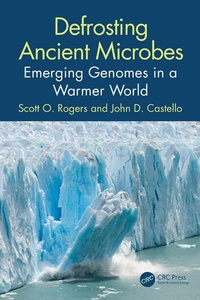
Defrosting Ancient Microbes
Emerging Genomes in a Warmer World
1st Edition
Published on 10. September 2019
254 pages
978-1-000-70244-6 (ISBN)
Description

Ice is melting around the world and glaciers are disappearing. Water, which has been solid for thousands and even millions of years, is being released into streams, rivers, lakes and oceans. Embedded in this new fluid water, and now being released, are ancient microbes whose effects on today's organisms and ecosystems is unknown and unpredictable. These long sleeping microbes are becoming physiologically active and may accelerate global climate change. This book explores the emergence of these microbes. The implications for terrestrial life and the life that might exist elsewhere in the universe are explored.
Key Selling Points:
Explores the role of long frozen ancient microbes will have when released due to global warming
Describes how ice preserves microbes and microbial genomes for thousands or millions of years
Reviews work done on permafrost microbiology
Identifies potential health hazards and environmental risks
Examines implications for the search for extraterrestrial life.
Key Selling Points:
Explores the role of long frozen ancient microbes will have when released due to global warming
Describes how ice preserves microbes and microbial genomes for thousands or millions of years
Reviews work done on permafrost microbiology
Identifies potential health hazards and environmental risks
Examines implications for the search for extraterrestrial life.
Reviews / Votes
"As just one example, the book teaches us that Earth's glaciers and subglacial sediments contain more microbial cells than all of the lakes and rivers on the surface of the planet combined. The resulting impact on global climate change is and will be huge, as this dead organic matter and newly revived microbes are thawed and summarily dumped into the sea. We lack the comparative context in our brief span of human history to gauge the contours ofthis impact. Paraphrasing Rogers and Castello, our surveillance for the unknown is nonexistent.The volume covers a wide-ranging and at times alarming topic. The human population is growing, global ice melting is increasing, and right about now is when these trends begin to collide. Although the book primarily focuses on records of the past, reconciling these two phenomena arguably has more importance to the future than anything else."
- Betuel Kacar (University of Arizona,Tucson, Arizona)
More details
Edition
1. Auflage
Language
English
Place of publication
London
United Kingdom
Publishing group
Taylor & Francis Ltd
Target group
Professional and scholarly
Illustrations
2 Tables, black and white; 2 Line drawings, color; 25 Line drawings, black and white
ISBN-13
978-1-000-70244-6 (9781000702446)
Copyright in bibliographic data and cover images is held by Nielsen Book Services Limited or by the publishers or by their respective licensors: all rights reserved.
Schweitzer Classification
Other editions
Additional editions
Book
09/2019
1st Edition
CRC Press
€70.61
Shipment within 15-20 days
Book
09/2019
1st Edition
CRC Press
€142.48
Shipment within 15-20 days
Persons
Scott O. Rogers is a professor of molecular biology and evolution in the Department of Biological Sciences at Bowling Green State University, Bowling Green, Ohio. He received his BS (1976) and MS (1980) degrees in Biology from the University of Oregon, Eugene, Oregon; and a PhD (1987) in Plant Molecular Biology from the University of Washington, Seattle, Washington; and was then a postdoc for two years at the same university. He was an Assistant Professor and Associate Professor at the State University of New York, College of Environmental Science and Forestry, Syracuse, New York from 1989 through 2001, before moving to BGSU, as Professor (and Departmental Chair 2001-2011). He has taught courses in general biology, botany, cell biology, molecular biology, molecular genetics, molecular techniques, molecular evolution, and bioinformatics. Research in his lab includes studies of microbes and nucleic acids preserved in ice, life in extreme environments, group I introns, ribosomal RNA genes, ribosomes, evolution of the genetic code, molecular microbial phylogenetics, microbial metagenomics/metatranscriptomics, ancient DNA, and plant development.
John D. Castello is professor emeritus of microbiology and forest pathology in the Department of Environmental and Forest Biology, State University of New York, College of Environmental Science and Forestry, Syracuse, New York. He received his BA (1973) in Biology from Montclair State College, Upper Montclair, New Jersey; his MS (1976) in Plant Pathology from Washington State University, Pullman, Washington; and his PhD (1978) in Plant Pathology from the University of Wisconsin, Madison, Wisconsin. He has been Assistant, Associate, Full Professor, and Associate Chair at SUNY-ESF, Department of Environmental and Forest Biology, Syracuse, New York. He has taught courses in microbiology, forest pathology, plant virology, forest health, and peoples, plagues, and pests.
John D. Castello is professor emeritus of microbiology and forest pathology in the Department of Environmental and Forest Biology, State University of New York, College of Environmental Science and Forestry, Syracuse, New York. He received his BA (1973) in Biology from Montclair State College, Upper Montclair, New Jersey; his MS (1976) in Plant Pathology from Washington State University, Pullman, Washington; and his PhD (1978) in Plant Pathology from the University of Wisconsin, Madison, Wisconsin. He has been Assistant, Associate, Full Professor, and Associate Chair at SUNY-ESF, Department of Environmental and Forest Biology, Syracuse, New York. He has taught courses in microbiology, forest pathology, plant virology, forest health, and peoples, plagues, and pests.
Content
1. Reaching Backwards 2. Questions and Answers 3. The Importance of Water and Ice 4. The Diversity of Ice 5. Permafrost 6. What Is Life? 7. Fossils: Marking Time 8. Walking into the Past 9. Isolating and Characterizing Microbes from Ice 10. A Brief History of Research on Life in Ice 11. Ice Core Discoveries 12. Subglacial Lake Vostok 13. Discoveries from Other Ice-Covered Lakes 14. Life Is Everywhere 15. Pathogens in the Environment: Viruses 16. Pathogens, Hazards, and Dangers 17. Everything Old Is New Again, the Ultimate in Recycling 18. Astrobiology-Out of This World 19. Disappearing Ice-Global Climate Change 20. Epilogue
