

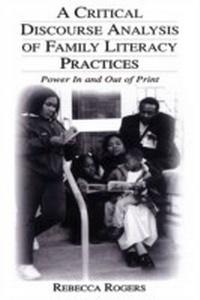
A Critical Discourse Analysis of Family Literacy Practices
Power in and Out of Print
1st Edition
Published on 20. June 2003
242 pages
978-1-135-63477-3 (ISBN)
Description

In this groundbreaking, cross-disciplinary book, Rebecca Rogers explores the complexity of family literacy practices through an in-depth case study of one family, the attendant issues of power and identity, and contemporary social debates about the connections between literacy and society. The study focuses on June Treader and her daughter Vicky, urban African Americans labeled as "low income" and "low literate." Using participant-observation, ethnographic interviewing, photography, document collection, and discourse analysis, Rogers describes and explains the complexities of identity, power, and discursive practices that June and Vicky engage with in their daily life as they proficiently, critically, and strategically negotiate language and literacy in their home and community. She explores why, despite their proficiencies, neither June or Vicky sees themselves as literate, and how this and other contradictions prevent them from transforming their literate capital into social profit. This study contributes in multiple ways to extending both theoretically and empirically existing research on literacy, identity, and power:
* Critical discourse analysis. The analytic technique of critical discourse analysis is brought into the area of family literacy. The detailed explanation, interpretation, and demonstration of critical discourse analysis will be extremely helpful for novices learning to use this technique. This is a timely book, for there are few ethnographic studies exploring the usefulness and limits of critical discourse analysis.
* Combines critical discourse analysis and ethnography. This new synthesis, which is thoroughly illustrated, offers an explanatory framework for the stronghold of institutional discursive power. Using critical discourse analysis as a methodological tool in order to build critical language awareness in classrooms and schools, educators working toward a critical social democracy may be better armed to recognize sources of inequity.
* Researcher reflexivity. Unlike most critical discourse analyses, throughout the book the researcher and analyst is clearly visible and complicated into the role of power and language. This practice allows clearer analysis of the ethical, moral, and theoretical implications in conducting ethnographic research concerned with issues of power.
* A critical perspective on family literacy. Many discussions of family literacy do not acknowledge the raced, classed, and gendered nature of interacting with texts that constitutes a family's literacy practices. This book makes clear how the power relationships that are acquired as children and adults interact with literacy in the many domains of a family's literacy lives.
A Critical Discourse Analysis of Family Literacy Practices: Power In and Out of Print will interest researchers and practitioners in the fields of qualitative methodology, discourse analysis, critical discourse studies, literacy education, and adult literacy, and is highly relevant as a text for courses in these areas.
* Critical discourse analysis. The analytic technique of critical discourse analysis is brought into the area of family literacy. The detailed explanation, interpretation, and demonstration of critical discourse analysis will be extremely helpful for novices learning to use this technique. This is a timely book, for there are few ethnographic studies exploring the usefulness and limits of critical discourse analysis.
* Combines critical discourse analysis and ethnography. This new synthesis, which is thoroughly illustrated, offers an explanatory framework for the stronghold of institutional discursive power. Using critical discourse analysis as a methodological tool in order to build critical language awareness in classrooms and schools, educators working toward a critical social democracy may be better armed to recognize sources of inequity.
* Researcher reflexivity. Unlike most critical discourse analyses, throughout the book the researcher and analyst is clearly visible and complicated into the role of power and language. This practice allows clearer analysis of the ethical, moral, and theoretical implications in conducting ethnographic research concerned with issues of power.
* A critical perspective on family literacy. Many discussions of family literacy do not acknowledge the raced, classed, and gendered nature of interacting with texts that constitutes a family's literacy practices. This book makes clear how the power relationships that are acquired as children and adults interact with literacy in the many domains of a family's literacy lives.
A Critical Discourse Analysis of Family Literacy Practices: Power In and Out of Print will interest researchers and practitioners in the fields of qualitative methodology, discourse analysis, critical discourse studies, literacy education, and adult literacy, and is highly relevant as a text for courses in these areas.
Reviews / Votes
"It is a book that provokes all educators to think more deeply about what literacy education is for-to pass tests and 'move up,' or to help individuals value themselves as literate individuals".-Language Arts
"Through her work, Rogers challenges researchers and educators to not only recognize the power of language, but to take a course of action that eliminates the lack of agency and autonomy felt by people who are not afforded the privileges of those who have access to the language of dominance".
-Journal of Literacy Research
"...this is a unique book, which deftly combines Critical Discourse Analysis (CDA) with ethnography. It reveals the value of CDA, and how it can throw up analysis of power in relation to the concept of orders of discourse. Rogers also offers a methodological argument for offering one case study as a 'telling case' and gives the qualitative research argument a stronger case by describing such detailed, high quality research."
-belles lettres: A Literary Journal
"Rogers powerfully demonstrated the injustice of holding up the so-called right kind of literacy as the measure of competence and success in life, thereby severely hindering people's ability to increase control of their own social circumstances."
-Studies in Second Languages
"[To] paraphrase Rogers' own words just a bit: how does the 'sticky web of institutional discourse' hold certain sorts of people, often people with the least power and opportunities in our society, 'in place despite ample commitment, persistence, and cultural capital' on their part? Her book makes a signal contribution to addressing this problem."
-James Paul Gee
From the Foreword
"This compelling and powerful book makes a significant contribution both as a model of ethnographically grounded critical discourse analysis and as an analysis of the role of historically and discursively constructed subjectivities in perpetuating oppression and injustice."
-Judith W. Solsken
University of Massachusetts
More details
Language
English
Place of publication
London
United Kingdom
Publishing group
Taylor & Francis Ltd
Target group
Professional and scholarly
Product notice
Reflowable
File size
1,13 MB
ISBN-13
978-1-135-63477-3 (9781135634773)
Copyright in bibliographic data and cover images is held by Nielsen Book Services Limited or by the publishers or by their respective licensors: all rights reserved.
Schweitzer Classification
Other editions
Additional editions
Book
04/2003
1st Edition
Routledge
€206.40
Article not available at the moment
Book
04/2003
1st Edition
Routledge
€69.40
Shipment within 10-20 days
Content
Contents: J.P. Gee, Foreword. Preface. Introduction: Participants in the Study and Theoretical Orientations. Methodology. Personal and Institutional Histories. Family Literacy as Apprenticeship. "I'm Her Mother, Not Them." Into the Meeting Room. Through the Eyes of the Institution. The Paradox of Literacy. Appendices: A Brief History of Education in Albany. Data Collection Timetable. Fieldnote Chart. Document Summary Form. Chart of Critical Discourse Analysis Definitions and Codes. Snapshots of Vicky's Remedial Reading Lesson. Committee on Special Education Meeting Transcript. Role of the Researcher.
