

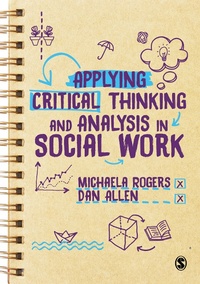
Applying Critical Thinking and Analysis in Social Work
1st Edition
Published on 8. April 2019
208 pages
978-1-5264-8269-3 (ISBN)
Description

This highly practical guidebook will help you develop the critical and analytical skills essential to your successful social work education and evidence-informed, reflective practice.
Key features include:
Theoretical break down and simplification of key theories
How to avoid common pitfalls
Activities to help you cement your learning
Case studies applicable in practice.
This will support you right from the very beginning of your programme through to the end of your final placement and into practice.
Key features include:
Theoretical break down and simplification of key theories
How to avoid common pitfalls
Activities to help you cement your learning
Case studies applicable in practice.
This will support you right from the very beginning of your programme through to the end of your final placement and into practice.
Reviews / Votes
This book is a very valuable and rich resource to enable social work students in training to develop effective critical thinking skills and habits. It has excellent content and practice relevant exercises with which to encourage students to develop their critical thinking further both in their academic studies and professional practice. -- Jasper Shotts As the authors of this book suggest, critical thinking is a 'sought after' skill in social work practice, yet is something that can be difficult for students to conceptualise. This practical text is written in such a way, that it aims to speak directly to student social workers to help them understand the concept, and application of, critical thinking. A range of models are clearly set out by the authors for students to follow, including helpful themes such as 'danger points' which alert students to some of the pitfalls in certain models of thinking.I therefore recommend this book be used by student social workers throughout their social work degrees to help them develop and master their skills. -- Lesley Deacon What I like about the book is that it covers the core skills of critical thinking, critical writing and critical reflection. Although it is written at a basic level and does not go into much detail in this complex subject area, it does however provide sufficient material to grasp the fundamental concept of 'criticality' when applied to a range of social work activities. -- Graham Ixer. Professor of Social Work and Social Policy This book provides highly practical suggestions for record keeping and report writing, the good practice of which frequently slips from attention and is fraught with pitfalls. Overall, this is an excellent book which is memorable for its fusion of concepts with sheer practicality, no jargon, no acronyms, just clear language and sharp analysis. -- Isabel Martin, Independent Practice Teacher, Argyll and Bute, Scotland
More details
Edition
1. Auflage
Language
English
Place of publication
London
United Kingdom
Target group
College/higher education
Product notice
Reflowable
ISBN-13
978-1-5264-8269-3 (9781526482693)
Copyright in bibliographic data and cover images is held by Nielsen Book Services Limited or by the publishers or by their respective licensors: all rights reserved.
Schweitzer Classification
Other editions
Additional editions
Michaela Rogers | Dan Allen
Applying Critical Thinking and Analysis in Social Work
Book
05/2019
1st Edition
SAGE Publications Ltd
€69.20
Shipment within 15-20 days
Michaela Rogers | Dan Allen
Applying Critical Thinking and Analysis in Social Work
Book
05/2019
1st Edition
SAGE Publications Ltd
€132.50
Shipment within 15-20 days
Persons
Dr Michaela Rogers is a lecturer of social work who is involved in both research and teaching across the areas of social care, social justice, equality and diversity, safeguarding, interpersonal violence and gender. Dr Rogers has delivered and worked alongside colleagues on a range of projects in the voluntary and public sector. These projects typically aim to explore social problems in terms of everyday experiences or assess the impact of service delivery or specific policy initiatives. Dr Rogers is a qualified social worker registered with the profession's regulatory body in England, the Health and Care Professions Council.
Dr Dan Allen is a social work academic with over 18 years' experience working to democratise child protection practice with Romani and Traveller families. He has published widely on this topic and has represented child protection practitioners working to support Romani and Traveller families at the European Union Agency for Fundamental Rights, the House of Lords, and the Welsh Assembly. Dr Allen is particularly interested in examining the intersection of power relations, prejudice, and the impact of governmentality, subjectivities, and ethics on the translocation of professional conduct. Developing a perspective that combines 'neoliberal governmentality' with 'socio-political' influence and 'critical' and 'radical' theory, Dr Allen seeks to critically examine the questions of why, how and so what in the context of dominant discourses affecting regimes of practice at individual, cultural and societal levels. Dr Allen is a qualified social worker registered with the professional regulatory body, Social Work England, and he is an active member of the Gypsy, Roma, and Traveller Social Work Association.
Dr Dan Allen is a social work academic with over 18 years' experience working to democratise child protection practice with Romani and Traveller families. He has published widely on this topic and has represented child protection practitioners working to support Romani and Traveller families at the European Union Agency for Fundamental Rights, the House of Lords, and the Welsh Assembly. Dr Allen is particularly interested in examining the intersection of power relations, prejudice, and the impact of governmentality, subjectivities, and ethics on the translocation of professional conduct. Developing a perspective that combines 'neoliberal governmentality' with 'socio-political' influence and 'critical' and 'radical' theory, Dr Allen seeks to critically examine the questions of why, how and so what in the context of dominant discourses affecting regimes of practice at individual, cultural and societal levels. Dr Allen is a qualified social worker registered with the professional regulatory body, Social Work England, and he is an active member of the Gypsy, Roma, and Traveller Social Work Association.
Content
Introduction
Part I: An Introduction to Critical Thinking and Analysis
Chapter 1: Introduction to Critical thinking
Chapter 2: Introduction to Critical Knowledge
Part II: An Introduction to Critical Reading and Writing
Chapter 3: Critical Reading
Chapter 4: Critical Writing
Part III: Critical Thinking and Analysis in Practice
Chapter 5: Critical Reflection
Chapter 6: Professional Judgement and Decision Making
Chapter 7: Critical Analysis and Working with Risks and Strengths
Chapter 8: Reflexivity and Use of Self
Chapter 9: Analytical Assessments and Report Writing
Conclusion
Part I: An Introduction to Critical Thinking and Analysis
Chapter 1: Introduction to Critical thinking
Chapter 2: Introduction to Critical Knowledge
Part II: An Introduction to Critical Reading and Writing
Chapter 3: Critical Reading
Chapter 4: Critical Writing
Part III: Critical Thinking and Analysis in Practice
Chapter 5: Critical Reflection
Chapter 6: Professional Judgement and Decision Making
Chapter 7: Critical Analysis and Working with Risks and Strengths
Chapter 8: Reflexivity and Use of Self
Chapter 9: Analytical Assessments and Report Writing
Conclusion
