

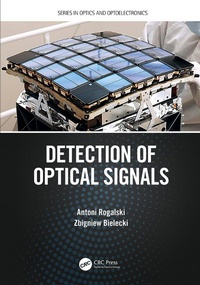
Detection of Optical Signals
1st Edition
Published on 9. June 2022
594 pages
978-1-000-54348-3 (ISBN)
Description

Detection of Optical Signals provides a comprehensive overview of important technologies for photon detection, from the X-ray through ultraviolet, visible, infrared to far-infrared spectral regions. It uniquely combines perspectives from many disciplines, particularly within physics and electronics, which are necessary to have a complete understanding of optical receivers.
This interdisciplinary textbook aims to:
Guide readers into more detailed and technical treatments of readout optical signals
Give a broad overview of optical signal detection including terahertz region and two-dimensional material
Help readers further their studies by offering chapter-end problems and recommended reading.
This is an invaluable resource for graduate students in physics and engineering, as well as a helpful refresher for those already working with aerospace sensors and systems, remote sensing, thermal imaging, military imaging, optical telecommunications, infrared spectroscopy, and light detection.
This interdisciplinary textbook aims to:
Guide readers into more detailed and technical treatments of readout optical signals
Give a broad overview of optical signal detection including terahertz region and two-dimensional material
Help readers further their studies by offering chapter-end problems and recommended reading.
This is an invaluable resource for graduate students in physics and engineering, as well as a helpful refresher for those already working with aerospace sensors and systems, remote sensing, thermal imaging, military imaging, optical telecommunications, infrared spectroscopy, and light detection.
More details
Series
Edition
1. Auflage
Language
English
Place of publication
London
United Kingdom
Publishing group
Taylor & Francis Ltd
Target group
College/higher education
Professional and scholarly
Illustrations
1 Tables, color; 57 Tables, black and white; 11 Line drawings, color; 404 Line drawings, black and white; 3 Halftones, color; 64 Halftones, black and white; 14 Illustrations, color; 468 Illustrations, black and white
ISBN-13
978-1-000-54348-3 (9781000543483)
Copyright in bibliographic data and cover images is held by Nielsen Book Services Limited or by the publishers or by their respective licensors: all rights reserved.
Schweitzer Classification
Other editions
Additional editions
Antoni Rogalski | Zbigniew Bielecki
Detection of Optical Signals
Book
10/2024
1st Edition
CRC Press
€110.60
Shipment within 10-20 days
Antoni Rogalski | Zbigniew Bielecki
Detection of Optical Signals
Book
06/2022
1st Edition
CRC Press
€246.20
Shipment within 10-20 days
Persons
Antoni Rogalski is a professor at the Institute of Applied Physics, Military University of Technology in Warsaw. He is one of the world's leading researchers in the field of infrared (IR) optoelectronics. He has made pioneering contributions in the areas of theory, design, and technology of different types of IR detectors. In 1997, Professor Rogalski received an award from the Foundation for Polish Science, the most prestigious scientific award in Poland, for his achievements in the study of ternary alloy systems for infrared detectors. His monumental monograph, Infrared and Terahertz Detectors (published in three editions by Taylor and Francis), has been translated into Russian and Chinese.
In 2013, Professor Rogalski was elected as an Ordinary Member of the Polish Academy of Sciences and as a member of the Central Commission for Academic Degrees and Titles. Since early 2015, he has been the Dean of the Faculty of Technical Sciences of the Polish Academy of Sciences, and, from 2016, he has been a member of the group for affairs of scientific awards of the Prime Minister of Poland.
Professor Rogalski is a fellow of the International Society for Optical Engineering (SPIE), vicepresident of the Polish Optoelectronic Committee, editor-in-chief of the journal Opto-Electronics Review (1997-2015), deputy editor-in-chief of the Bulletin of the Polish Academy of Sciences: Technical Sciences (2003-present), and a member of the editorial boards of several international journals. He is an active member of the international technical community - as chair and co-chair, organizer, and member of scientific committees of many national and international conferences on optoelectronic devices and materials sciences.
Zbigniew Bielecki, PhD, D.Sc., Eng. is a graduate of the Faculty of Electronics of the Military University of Technology in Warsaw. Since 1983 he has been working at the Institute of Optoelectronics of the Military University of Technology. He received a PhD degree in 1992, obtained his post-doctoral degree in 2002 and received the title of professor in 2008. Professor Bielecki has held many managerial positions at his alma mater. Currently, he is a full professor at the Military University of Technology. His scientific achievements include over 450 publications in the field of optical detection signals (including 4 monographs, 2 academic scripts, 11 chapters in foreign monographs, 7 chapters in domestic monographs, and over 70 publications in indexed journals). Since he received the title of professor, the subjects of his scientific activity have been highly sensitive sensors of hazardous gases, optoelectronic sensors of disease markers contained in exhaled air, and optical communication in open space.
In 2017, Professor Bielecki received the Award of the Minister of National Defense for his lifetime achievements.
In 2013, Professor Rogalski was elected as an Ordinary Member of the Polish Academy of Sciences and as a member of the Central Commission for Academic Degrees and Titles. Since early 2015, he has been the Dean of the Faculty of Technical Sciences of the Polish Academy of Sciences, and, from 2016, he has been a member of the group for affairs of scientific awards of the Prime Minister of Poland.
Professor Rogalski is a fellow of the International Society for Optical Engineering (SPIE), vicepresident of the Polish Optoelectronic Committee, editor-in-chief of the journal Opto-Electronics Review (1997-2015), deputy editor-in-chief of the Bulletin of the Polish Academy of Sciences: Technical Sciences (2003-present), and a member of the editorial boards of several international journals. He is an active member of the international technical community - as chair and co-chair, organizer, and member of scientific committees of many national and international conferences on optoelectronic devices and materials sciences.
Zbigniew Bielecki, PhD, D.Sc., Eng. is a graduate of the Faculty of Electronics of the Military University of Technology in Warsaw. Since 1983 he has been working at the Institute of Optoelectronics of the Military University of Technology. He received a PhD degree in 1992, obtained his post-doctoral degree in 2002 and received the title of professor in 2008. Professor Bielecki has held many managerial positions at his alma mater. Currently, he is a full professor at the Military University of Technology. His scientific achievements include over 450 publications in the field of optical detection signals (including 4 monographs, 2 academic scripts, 11 chapters in foreign monographs, 7 chapters in domestic monographs, and over 70 publications in indexed journals). Since he received the title of professor, the subjects of his scientific activity have been highly sensitive sensors of hazardous gases, optoelectronic sensors of disease markers contained in exhaled air, and optical communication in open space.
In 2017, Professor Bielecki received the Award of the Minister of National Defense for his lifetime achievements.
Content
1. Radiometry and Photometry 2. Characterization of Optical Detectors 3. Noise Sources 4. Fundamentals of Optical detection Systems. 5. Thermal Detectors 6. Photoemissive Detectors 7. Photon Detectors 8. Quantum Well, Superlattice and Quantum Dot Photodetectors 9. 2D Material Photodetectors 10. Terahertz Detectors 11. Direct and Advanced Detection Systems 12. Focal Plane Arrays
