

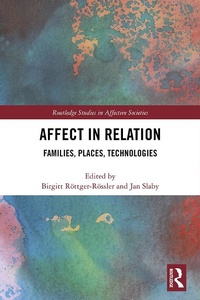
Affect in Relation
Families, Places, Technologies
1st Edition
Published on 11. May 2018
306 pages
978-1-351-67243-6 (ISBN)
Description

Decades of research on affect and emotion have brought out the paramount importance of affective processes for human lives.
Affect in Relation brings together perspectives from social science and cultural studies to analyze the formative, subject constituting potentials of affect and emotion. Relational affect is understood not as individual mental states, but as social-relational processes that are both formative and transformative of human subjects.
This volume explores relational affect through a combination of interdisciplinary case studies within four key contexts:
Part I: "Affective Families" deals with the affective dynamics in transnational families who are scattered across several regions and nations.
Part II: "Affect and Place" brings together work on affective place-making in the contexts of migration and in political movements.
Part III: "Affect at Work" analyzes the affective dimension of contemporary white-collar workplaces.
Part IV: "Affect and Media" focuses on the role of media in the formation and mobilization of relational affect.
In its transdisciplinary spirit, analytical rigor and focus on timely and salient global matters, Affect in Relation consolidates the field of affect studies and opens up new avenues for scholarly and practical co-operation. It will appeal to both students and postdoctoral researchers interested in fields such as anthropology, sociology, cultural studies, media studies and human development.
Affect in Relation brings together perspectives from social science and cultural studies to analyze the formative, subject constituting potentials of affect and emotion. Relational affect is understood not as individual mental states, but as social-relational processes that are both formative and transformative of human subjects.
This volume explores relational affect through a combination of interdisciplinary case studies within four key contexts:
Part I: "Affective Families" deals with the affective dynamics in transnational families who are scattered across several regions and nations.
Part II: "Affect and Place" brings together work on affective place-making in the contexts of migration and in political movements.
Part III: "Affect at Work" analyzes the affective dimension of contemporary white-collar workplaces.
Part IV: "Affect and Media" focuses on the role of media in the formation and mobilization of relational affect.
In its transdisciplinary spirit, analytical rigor and focus on timely and salient global matters, Affect in Relation consolidates the field of affect studies and opens up new avenues for scholarly and practical co-operation. It will appeal to both students and postdoctoral researchers interested in fields such as anthropology, sociology, cultural studies, media studies and human development.
More details
Series
Edition
1. Auflage
Language
English
Place of publication
London
United Kingdom
Publishing group
Taylor & Francis Ltd
Target group
College/higher education
Illustrations
1 Tables, black and white; 12 Halftones, black and white; 12 Illustrations, black and white
ISBN-13
978-1-351-67243-6 (9781351672436)
Copyright in bibliographic data and cover images is held by Nielsen Book Services Limited or by the publishers or by their respective licensors: all rights reserved.
Schweitzer Classification
Other editions
Additional editions
Book
01/2020
1st Edition
Routledge
€65.80
Shipment within 15-20 days
Book
05/2018
1st Edition
Routledge
€208.10
Shipment within 10-20 days
Persons
Birgitt Roettger-Roessler is Professor of Social and Cultural Anthropology and Director of the Collaborative Research Center Affective Societies at Freie Universitaet Berlin, Germany.
Jan Slaby is Professor of Philosophy at Freie Universitaet Berlin, Germany.
Jan Slaby is Professor of Philosophy at Freie Universitaet Berlin, Germany.
Content
Introduction: Affect in Relation - Jan Slaby & Birgitt Roettger-Roessler
PART I - Affective Families
Ageing Kin, Proximity and Distance: Translocal Relatedness as Affective Practice and Movement - Maruska Svasek
Education Sentimentale in Migrant Students' University Trajectories: Family, and other Significant Relations - Joanna Pfaff-Czarnecka
"Germans With Parents From Vietnam": The Affective Dimensions of Parent-Child relations in Vietnamese Berlin - Birgitt Roettger-Roessler & Anh Thu Anne Lam
PART II - Affect and Place
Spatialities of Belonging: Affective Place-Making among Diasporic Neo-Pentecostal and Sufi Groups in Berlin's Cityscape - Hansjoerg Dilger, Omar Kasmani, & Dominik Mattes
"Midan Moments": Conceptualizing Space, Affect and Political Participation on Occupied Squares - Bilgin Ayata & Cilja Harders
Muslim Domesticities: Home Invasions and Affective Identification - Gilbert Caluya
PART III - Affect at Work
Immersion at Work: Affect and Power in Post-Fordist Work Cultures - Rainer Muehlhoff & Jan Slaby
Managing Community: Coworking, Hospitality and the Future of Work - Melissa Gregg & Thomas Lodato
Automation and Affect: A Study of Algorithmic Trading - Robert Seyfert
PART IV - Affect and Media
Affect and Mediation - Lisa Blackman
Intensive Bondage - Marie-Luise Angerer
Beyond Turkish-German Cinema: Affective Experience and Generic Relationality - Nazli Kilerci & Hauke Lehmann
PART I - Affective Families
Ageing Kin, Proximity and Distance: Translocal Relatedness as Affective Practice and Movement - Maruska Svasek
Education Sentimentale in Migrant Students' University Trajectories: Family, and other Significant Relations - Joanna Pfaff-Czarnecka
"Germans With Parents From Vietnam": The Affective Dimensions of Parent-Child relations in Vietnamese Berlin - Birgitt Roettger-Roessler & Anh Thu Anne Lam
PART II - Affect and Place
Spatialities of Belonging: Affective Place-Making among Diasporic Neo-Pentecostal and Sufi Groups in Berlin's Cityscape - Hansjoerg Dilger, Omar Kasmani, & Dominik Mattes
"Midan Moments": Conceptualizing Space, Affect and Political Participation on Occupied Squares - Bilgin Ayata & Cilja Harders
Muslim Domesticities: Home Invasions and Affective Identification - Gilbert Caluya
PART III - Affect at Work
Immersion at Work: Affect and Power in Post-Fordist Work Cultures - Rainer Muehlhoff & Jan Slaby
Managing Community: Coworking, Hospitality and the Future of Work - Melissa Gregg & Thomas Lodato
Automation and Affect: A Study of Algorithmic Trading - Robert Seyfert
PART IV - Affect and Media
Affect and Mediation - Lisa Blackman
Intensive Bondage - Marie-Luise Angerer
Beyond Turkish-German Cinema: Affective Experience and Generic Relationality - Nazli Kilerci & Hauke Lehmann
