

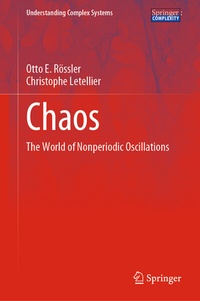
Chaos
Description

The manuscript has now been edited by Christophe Letellier - involved in chaos theory for almost three decades himself, as well as being active in the history of sciences - with a minimum of changes to the original text.
Finally released for the benefit of specialists and non-specialists alike, this book is equally interesting from the historical and the scientific points of view: an unconventionally modern approach to chaos theory, it can be read as a classic introduction and short monograph as well as a collection of original insights into advanced topics from this field.
More details
Other editions
Additional editions
Persons
He started his career in performing numerical simulations of chemical reaction models with the help of an analog computer. He spent nearly a decade focusing on chaotic attractors. He proposed the so-called Rössler system and introduced the concept of hyperchaos.
The Rössler system is today the second-most quoted system in chaos theory (after the Lorenz one). This program more or less ended with his proposition for a hierarchy of chaos, for which he proposed many different examples of various types of chaos.
With his numerous contributions, he largely contributed to construct the paradigm of chaos , insisting on the qualitative approach inherited from Henri Poincaré.
This book, written in the early 1980s, is a kind of review of his views on this topic. He then switched to researches in biogenesis, endophysics, cryodynamics, etc. He wrote many hundreds of scientific papers.
Christophe Letellier has a background in physics. He concluded his Ph.D. in chaos theory on data-driven modelling and topological characterization of chaotic attractors.
With Robert Gilmore (Drexel University, U.S.A.) he investigated the role of symmetries in dynamical systems.
Together with Luis Aguirre (Universidade Federal de Minas Gerais, Brazil), he developed the observability coefficients for assessing the quality of information contained in a measured variable.
For 20 years, he also collaborated with physicians to transfer techniques from chaos theory towards clinical applications in mechanical ventilation, heart variability and oncology.
With Fabrice Denis, he developed a clinical follow-up method for patients who were treated for lung cancer.
Since 15 years he teaches a course in history of science and wrote a book, entitled Chaos in Nature , exploring how chaos emerged in the 20th century.
