

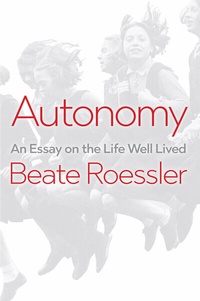
Autonomy
An Essay on the Life Well-Lived
1st Edition
Published on 18. May 2021
380 pages
978-1-5095-4493-6 (ISBN)
Description

In everyday life, we generally assume that we can make our own decisions on matters which concern our own lives. We assume that a life followed only according to decisions taken by other people, against our will, cannot be a well-lived life - we assume, in other words, that we are and should be autonomous. However, it is equally true that many aspects of our lives are not chosen freely: this is true of social relations and commitments but also of all those situations we simply seem to stumble into, situations which just seem to happen to us. The possibility of both the success of an autonomous life and its failure are part of our everyday experiences.
In this brilliant and illuminating book, Beate Roessler examines the tension between failing and succeeding to live an autonomous life and the obstacles we have to face when we try to live our life autonomously, obstacles within ourselves as well as those that stem from social and political conditions. She highlights the ambiguities we encounter, examines the roles of self-awareness and self-deception, explores the role of autonomy for the meaning of life, and maps out the social and political conditions necessary for autonomy. Informed by philosophical perspectives but also drawing on literary texts, such as those of Siri Hustvedt and Jane Austen, and diaries, including those of Franz Kafka and Sylvia Plath, Roessler develops a formidable defense of autonomy against excessive expectations and, above all, against overpowering skepticism.
In this brilliant and illuminating book, Beate Roessler examines the tension between failing and succeeding to live an autonomous life and the obstacles we have to face when we try to live our life autonomously, obstacles within ourselves as well as those that stem from social and political conditions. She highlights the ambiguities we encounter, examines the roles of self-awareness and self-deception, explores the role of autonomy for the meaning of life, and maps out the social and political conditions necessary for autonomy. Informed by philosophical perspectives but also drawing on literary texts, such as those of Siri Hustvedt and Jane Austen, and diaries, including those of Franz Kafka and Sylvia Plath, Roessler develops a formidable defense of autonomy against excessive expectations and, above all, against overpowering skepticism.
More details
Other editions
Persons
Content
- Cover
- Title page
- Copyright page
- Contents
- Preface to the English Edition
- Preface
- Introduction: Autonomy in Everyday Life
- 1 What is Autonomy? A Conceptual Approach
- Remarks on the history of the concept
- Negative freedom, positive freedom, autonomy
- Conditions of individual autonomy
- Autonomy and rational plans
- 2 Ambivalences
- Various forms of ambivalence
- Ambivalence as a disease of the will
- Is an ambivalent will a healthy will?
- The ambivalent self
- Conflicts of ambivalence as conflicts of identity
- Autonomy and the acceptance of conflicts
- 3 Autonomy and the Meaning of Life
- Sisyphus contented
- Does the meaning of life consist in the satisfaction of desire?
- The objective meaning of life
- Mill's crisis and subjective meaning in life
- When does the question of meaning arise?
- 4 Autonomy, Self-Knowledge, and Self-Deception
- Self-knowledge and self-determination
- Self-deception: how can I be mistaken about myself?
- How can self-knowledge fail? On fundamental epistemic uncertainties
- The quantified self
- 5 Autonomy, Self-Thematization, Self-Examination: From Diaries to Blogs
- Self-examination, self-control, reflection
- Why diaries? And which diaries?
- Autonomy in the diary: examples
- Blogs and the new technologies of self-examination
- What is the framework of autonomy?
- 6 Autonomous Choice and the Good Life
- The question of the good life and perfectionism
- Happiness, autonomy, and meaning
- The significance of choosing: conditions of an autonomous decision
- Who actually chooses and in what context?
- Alienation (and authenticity)
- Virtue and character
- 7 Private Life
- Why privacy?
- Dimensions of privacy
- Informational privacy, social relationships, and autonomy
- Autonomous persons in relationships (I)
- Autonomy and domestic privacy: autonomous persons in relationships (II)
- Privacy and democratic society
- 8 Social Preconditions of Autonomy
- What are social conditions?
- The social constitution of autonomy
- Autonomy, ideology, and adaptive preferences
- Social opportunities and justice
- Between autonomy and oppression: limiting cases
- 9 The Reality of Autonomy
- Autonomy is not an illusion
- The significance of social practices
- Social unfreedom and implicit bias
- Aspects of moral responsibility
- Autonomy and the life well lived
- Notes
- Introduction: Autonomy in Everyday Life
- Chapter 1 What is Autonomy? A Conceptual Approach
- Chapter 2 Ambivalences
- Chapter 3 Autonomy and the Meaning of Life
- Chapter 4 Autonomy, Self-Knowledge, and Self-Deception
- Chapter 5 Autonomy, Self-Thematization, Self-Examination: From Diaries to Blogs
- Chapter 6 Autonomous Choice and the Good Life
- Chapter 7 Private Life
- Chapter 8 Social Preconditions of Autonomy
- Chapter 9 The Reality of Autonomy
- Bibliography
- Index
- EULA
