

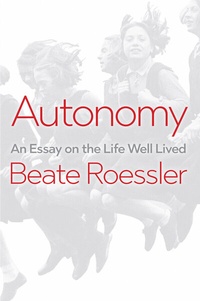
Autonomy
Description

In this brilliant and illuminating book, Beate Roessler examines the tension between failing and succeeding to live an autonomous life and the obstacles we have to face when we try to live our life autonomously, obstacles within ourselves as well as those that stem from social and political conditions. She highlights the ambiguities we encounter, examines the roles of self-awareness and self-deception, explores the role of autonomy for the meaning of life, and maps out the social and political conditions necessary for autonomy. Informed by philosophical perspectives but also drawing on literary texts, such as those of Siri Hustvedt and Jane Austen, and diaries, including those of Franz Kafka and Sylvia Plath, Roessler develops a formidable defense of autonomy against excessive expectations and, above all, against overpowering skepticism.
More details
Other editions
Persons
Content
Introduction: Autonomy in Everyday Life
In liberal societies in the West, we generally assume that we are autonomous. We take it to be self-evident that we have the right to make autonomous choices and live a self-determined life. We believe that we are capable of living such a life, of reflecting on what we want to do and how we want to live, and then converting these thoughts into action. And we value this, for a heteronomous life - a life in which I would have to live and do existentially important things against my own will and my own choices - could never be a good, well-lived life.
Autonomy has long been a fundamental theme of philosophy, especially since Kant. The contemporary theory landscape thus features, on one side, normative theories that describe in detail the conditions - frequently idealized - under which an autonomous life is possible, including, of course, theories that declare leading an autonomous life to be utterly unproblematic. On the other side, however, we find fundamental doubts about the possibility and meaning of autonomy, for instance in positions that seek to establish that leading an autonomous life is impossible by demonstrating just how much each and every one of us is dependent on circumstances and relations that we do not choose ourselves. So, while autonomy is morally and legally fundamental to our societies, what exactly this means for our lives remains largely unclear. It is therefore a pressing question how to develop and substantiate a plausible concept of autonomy between the detailed normative theories and their defenders, on the one hand, and the fundamental skeptics, on the other. Interestingly, both normative concept and fundamental skepticism can be described from the perspective of the autonomous person herself - at which point we are dealing no longer with two opposing theories but with the tension between our normative understanding of ourselves and our everyday experience.
Although we most often proceed from the assumption that it is possible to lead a self-determined life, there are countless situations and aspects of our lives that we precisely did not choose for ourselves, in which we ask ourselves how it could come to this, in which we decide that fate or, more simply, our own carelessness is to blame. The possibility that we succeed or fail in shaping our own lives is part of our everyday experience. Nevertheless, there are very different reasons why this tension is connected with the idea of autonomy. On the one hand, we can describe this tension as that between the individual pursuit of self-determination and events that have always already happened, that simply occur and seem to present us with accomplished facts. On the other hand, it is more specifically a tension that concerns our embeddedness in social relationships and the resulting obligations and demands of others from which we cannot and do not want to free ourselves, but which nonetheless can often be subjectively understood as a failure of autonomy.1
In this book, I shall take up a range of different perspectives to consider these various forms of conflict between the possibility and the impossibility of self-determination, between the idea of self-determination and everyday experience. As a normative ideal, individual self-determination or autonomy is constitutive of our self-understanding and of our understanding of the law and politics - individual self-determination at least in the sense that we can think about what we really want in life, that we can relate reflectively to our own desires and beliefs. The fact that we often cannot achieve this kind of autonomy in our everyday lives, why and in what contexts this is the case, and why this difficulty nevertheless changes nothing about the necessity and persuasive power of autonomy: these are the major themes of this book.
The tension between our pursuit of autonomy and our everyday experiences can be illustrated and clarified through literature. For precisely when it comes to understanding the phenomenology of our everyday entanglements, literary texts can often be of greater help to us than philosophy. The writer I would first like to consult is Iris Murdoch, who was both an author and a philosopher:2
It's not like that. One doesn't just look and choose and see where one might go, one's sunk in one's life up to the neck, or I am. You can't swim about in a swamp or a quicksand. It's when things happen to me that I know what I evidently wanted, not before! I can see when there's no way back. It's a muddle, I don't even understand it myself.3
This call for help out of the chaos of life, this wrestling with the idea of whether one can determine one's own life, is a central theme of Murdoch's novels. The reality that we are always already up to our necks in it is, she writes, "basically incomprehensible." Elsewhere, Murdoch opines: "The message is - everything is contingent. There are no deep foundations. Our life rests on chaos and rubble, and all we can try to do is be good."4
Chaos and rubble are the opposite of self-determination and justifiability. This is, first and foremost, a reference to the fateful coincidences that frequently plunge Murdoch's protagonists, ominously and hopelessly, into the tangled disorder of life. These contingencies give expression to the impossibility of planning out one's own life. We experience them as an overwhelming power, as circumstances that confront us over the course of our lives that we simply have to accept. This is the first tension that I described above, that between the idea of self-determination and the feeling that we are always presented with accomplished facts. Murdoch has in mind here not so much the contingencies of birth and ancestry but those of the social entanglements that we are confronted with in the course of our adult life in the form of unforeseen, unfortunate events or undesired consequences of our own actions that we were unable to predict and therefore often experience as acts of fate.
Let us consider, for example, Hilary Burde, the protagonist of Murdoch's novel A Word Child. Hilary comes from poor, even miserable circumstances but is able to work his way up thanks to his exceptional talent for languages, becoming a student at Oxford, winning every possible prize, writing a brilliant final exam, and being made a fellow at one of the university's colleges. Then he falls in love with Anne Jopling, the wife of his benefactor and doctoral supervisor. The two have a passionate affair that ends with a car accident caused by Hilary, in which Anne dies. Of course, Hilary has to give up his position at the college. Twenty years later - dull years spent leading a sad life as a minor civil servant at a nondescript government office in London - he runs into his former doctoral adviser Jopling, who has since remarried. Once again, entirely against his own intentions, Hilary falls in love with Jopling's wife Kitty. Once again there are intimate encounters that, once again, end with an accident and the woman's death.
Murdoch, writing in Hilary's voice, describes why this is interesting in the context of being skeptical about the possibility of planning out one's own life: "Yet such things happen to men, lives are thus ruined, thus tainted and darkened and irrevocably spoilt, wrong turnings are taken and persisted in, and those who make one mistake wreck all the rest out of frenzy, even out of pique."5
The events with which Hilary is confronted are almost exaggeratedly fateful. They seem to be entirely out of his hands, contingencies that make a determinable life, a self-determined life, impossible because it is utterly unclear what autonomous, authentic decisions would actually look like under such catastrophic conditions, what acting with plans and goals would even mean. "Yet such things happen to men" - and things that happen to us are the exact opposite of those aspects of life that we determine ourselves.
Fate, however - and Murdoch suggests this, too - is not such a simple matter. "The strange thing about fate," the philosopher and psychoanalyst Jonathan Lear writes, "is that it does not fit neatly on either side of the me/not-me divide."6 That is, the extent to which such events are not also due to our own actions, our own complex, difficult identities, remains unsettlingly open. Hilary's repetition compulsion, for example, may be attributable to his own obsessions to a far greater degree than he recognizes or would like to recognize. And in any case, these extraordinary coincidences - the love affairs, the tragic accidents, the catastrophic repetitions - are only one side of the coin. The other, more important form of contingency - or bad planning - is the utterly common and familiar one that entangles and binds the protagonists in different and instructive ways in their own personal, ordinary chaos, their totally normal daily lives. Above all, it is the everyday problem of dealing thoughtfully and sensibly with our own decisions, intentions, possible choices, social relationships, and social obligations that throws a skeptical light on the scope of self-determination.
This "fatalistic feeling of helplessness," as Murdoch calls it, is especially clear in the case of one of her other unfortunate protagonists, John Rainborough, another midlevel civil servant in a dubious public...
