

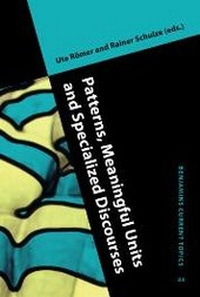
Patterns, Meaningful Units and Specialized Discourses
1st Edition
Published on 30. June 2010
V, 124 pages
978-90-272-8809-7 (ISBN)
Description

This collection of papers explores some facets in the areas of Corpus Linguistics and Phraseology which have gone unnoticed so far. With the aid of a range of different corpora and new-generation software tools, the authors tackle specialized domains and discourse in specialized settings, utilizing some innovative approaches to the study of recurrent features and patterns in the languages of economics, history, linguistics, politics, and other fields. The papers critically examine contemporary discourses in which experts and laypersons are equally involved, showing that the spoken and written texts, selected from various specialized corpora, can be seen as collective memory banks. The series of reflections and specialized meanings uncovered in these texts are closely tied to particular sequences of patterned chunks in language and offer exciting insights into the inseparability of lexis and grammar.
The contributions to this volume were previously published in International Journal of Corpus Linguistics 13:3 (2008).
The contributions to this volume were previously published in International Journal of Corpus Linguistics 13:3 (2008).
More details
Other editions
Additional editions
Ute Roemer-Barron | Rainer Schulze
Patterns, Meaningful Units and Specialized Discourses
Book
06/2010
John Benjamins Publishing Co
€84.80
Shipment within 10-15 days
Persons
Content
- Patterns, Meaningful Units and Specialized Discourses
- Editorial page
- Title page
- LCC data
- Table of contents
- Introduction
- The contributions
- Acknowledgment
- References
- Starting with the small words
- 1. Introduction
- 2. Looking for semantic sequences: some examples
- 2.1 Starting with a lexical word or phrase
- 2.2 Starting with a pattern: 'N that'
- 2.3 Specialised discourses and small words
- 3. Grammar patterns: at the interface of lexis and grammar
- 4. Theoretical grounding
- 5. Conclusion
- Notes
- References
- Emphasizers in spoken and written academic discourse
- 1. Introduction
- 2. Materials and methods
- 2.1 Corpora
- 2.2 Tools for the analysis of the adverb really
- 3. Results and discussion
- 3.1 Comparing frequencies of really in spoken and written academic discourse
- 3.2 Focus on syntactic role/scope of really across the two registers
- 3.3 Lexico-grammatical patterns of really across the two registers
- 4. Concluding remarks
- Notes
- References
- The 'terroridiom' principle between spoken and written discourse
- 1. Introduction
- 2. Mapping the theoretical framework
- 3. Data and methodology
- 4. Distribution of the word forms of the lemma TERROR across corpora
- 5. A search of concgrams in the environment of the lemma TERROR in the spoken corpus (BBB)
- 6. The phraseological environment of terror in the written corpus (NDC)
- 7. Conclusion
- Notes
- References
- N-grams in comparable specialized corpora
- 1. Introduction: investigating the idiom principle in the form of 4-grams
- 2. The most frequent 4-grams in the British National Corpus and a purpose-built specialized corpus of English
- 3. The lexico-grammar and functions of at the end of
- 4. Seeking equivalent n-grams of at the end of: monolingual, contrastive and translational perspectives
- 5. Pedagogical explorations: investigating phraseological units in comparable corpora
- 6. Conclusion
- Acknowledgements
- Notes
- References
- From phraseology to culture
- 1. Introduction
- 2. British farmhouse holidays and Italian 'agriturismi'
- 3. Context of culture, context of situation and meaning
- 4. The case of qualifying adjectives
- 4.1 Analysis and results
- 5. Conclusion
- Notes
- References
- Websites
- Index
- The series Benjamins Current Topics
