

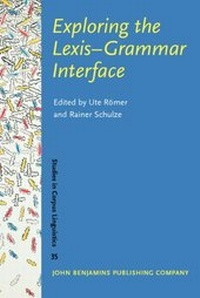
Exploring the Lexis-Grammar Interface
1st Edition
Published on 11. March 2009
VI, 321 pages
978-90-272-8980-3 (ISBN)
Description

This volume showcases studies that recognize and provide evidence for the inseparability of lexis and grammar. The contributors explore in what ways these two areas, often treated separately in linguistic theory and description, form an organic whole. The papers in Section I (Setting the Scene) introduce some of the key methodological approaches and theoretical positions at the lexis-grammar interface, while Section II (Considering the Particulars) contains papers that report on case studies and show concrete applications of the central methods and theories. Exploring the Lexis-Grammar Interface is a stimulating collection of papers for anyone who wishes to learn more about and get fresh state-of-the-art perspectives on language patterning.
More details
Other editions
Additional editions
Ute Roemer-Barron | Rainer Schulze
Exploring the Lexis-Grammar Interface
Book
03/2009
John Benjamins Publishing Co
€104.94
Shipment within 10-15 days
Persons
Content
- Exploring the Lexis-Grammar Interface
- Editorial page
- Title page
- LCC data
- Table of contents
- Introduction
- Part I. Setting the scene
- Technology and phraseology
- 1. On forgotten ideas (and forgotten scholars)
- 2. On two early corpus-driven studies
- 3. On corpus tools for phraseology extraction: PIE
- 4. On Sinclair's model of extended lexical units
- 5. Illustrative research programme
- 6. Locating corpus studies in a wider frame
- 7. Conclusions
- Acknowledgements
- References
- Corpus-driven approaches to grammar
- 1. Introduction
- 2. Lexical priming
- 3. The idiom principle
- 4. Hunston and Francis's Pattern Grammar
- 5. Some conclusions
- References
- Valency - item-specificity and idiom principle
- 1. Open choice and idiom principle
- 2. Valency as an abstraction
- 3. Unpredictability of valency patterns
- 4. Lexical aspects of valency
- 5. Valency and the idiom principle
- References
- Fowler's Modern English Usage at the interface of lexis and grammar
- 1. Introduction
- 2. The concept of usage
- 3. Fowler's Modern English Usage as a type of reference book
- 4. MEU - more of a grammar or more of a dictionary?
- 5. Three test cases for the lexis-grammar interface
- 6. Summary and conclusion
- References
- Appendix
- The psycholinguistic reality of collocation and semantic prosody (1)
- 1. Introduction
- 2. Experiment 1: The effects of collocation upon lexical access
- 3. Experiment 2: The effects of semantic prosody upon lexical access
- 4. Conclusions
- References
- Part II. Considering the particulars
- The lexicogrammar of present-day Indian English
- 1. Introduction: Indian English as an endonormatively stabilised variety
- 2. Structural nativisation at the lexis-grammar interface of Indian English
- 3. Concluding remarks: Large and small corpora as complementary databases
- References
- The semantic and grammatical overlap of as and that
- 1. Introduction
- 2. Terminology
- 3. Methods
- 4. Analysis
- 4.1 Hypotheses
- 4.2 Etymology
- 4.3 Development of that
- 4.4 Development of as
- 4.5 The development of as as a complementizer
- 5. Conclusion
- References
- The historical development of the verb doubt
- 1. Introduction
- 2. Doubt in Present Day English
- 3. Doubt in affirmative sentences
- 4. Doubt in negative sentences
- 5. Conclusion
- References
- The grammatical properties of recurrent phrases with body-part nouns
- 1. Introduction
- 2. Material and method
- 3. The fixedness of phrases
- 4. The N + X + N pattern
- 5. The N1 to N1 pattern
- 6. The N1 to N1 pattern with body-part nouns
- 7. Conclusion
- References
- A corpus-based investigation of cognate object constructions
- 1. Introduction
- 2. A short portrait of COCs
- 3. A usage-based network of COCs
- 4. Summary and conclusion
- References
- Appendix
- Revisiting the evidence for objects in English
- 1. Evidence for objects
- 2. Reconsidering active-passive relationships
- 3. A false analogy between buy and give
- 4. Prepositional complements of transitive verbs
- 5. Further notes on passivisation
- 6. Lexical findings: Passives of traditional ditransitives
- 7. Summary: Basic structures
- References
- Lexico-functional categories and complex collocations
- 1. Introduction
- 2. The category 'intensifiers'
- 3. Corpus data and methodology
- 4. Results and discussion
- 5. Summary and final remarks
- References
- Polysemy and lexical priming
- 1. Introduction
- 2. The corpus
- 3. Results and discussion
- 4. Conclusion
- References
- Local textual functions of move in newspaper story patterns
- 1. Introduction
- 2. Lexis, grammar, text and the study of corpora
- 3. Newspaper articles: Textual structure and lexical patterns
- 4. Methodology
- 5. Distribution of move follow* across sections of The Guardian
- 6. Meanings following move follow
- 7. Textual structure and the position of move follow
- 8. Textual structure and news values
- 9. Conclusions
- References
- Appendix
- Loud signatures
- 1. The background
- 2. Humorous opinion pieces
- 3. Evaluation
- 4. Methodology
- 5. Comparisons
- 6. Rudeness
- 7. Figurative language as part of the signature
- 8. Conclusion
- References
- Index
- The series Studies in Corpus Linguistics
