

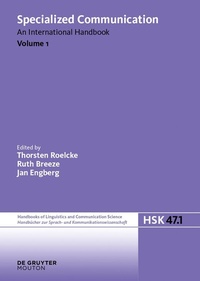
Specialized Communication
An International Handbook
1st Edition
Published on 2. June 2025
XV, 743 pages
978-3-11-067263-3 (ISBN)
Description

Specialized communication in science, technology or institutions is one of the most important and exciting fields of applied linguistics. The handbook captures the current and relevant knowledge of specialized languages and professional communication. It promotes international communication on central issues, where dialogue is urgently needed concerning both their intellectual underpinning and the day-to-day practices associated with them.
More details
Series
Language
English
Place of publication
Berlin/Boston
Germany
Publishing group
de Gruyter Mouton
Target group
Professional and scholarly
US School Grade: College Graduate Student
Illustrations
74 b/w ill., 20 b/w tbl.
File size
31,64 MB
ISBN-13
978-3-11-067263-3 (9783110672633)
Schweitzer Classification
Other editions
Additional editions
E-Book
06/2025
1st Edition
De Gruyter Mouton
€410.00
Available for download
Book
06/2025
1st Edition
De Gruyter Mouton
€410.00
Shipment within 5-7 days
Persons
Thorsten Roelcke
, TU Berlin, Germany;
Ruth Breeze
, Pamplon, Spain;
Jan Engberg
, Aarhus, Denmark.
Content
- Intro
- Contents
- Preface
- I General aspects
- 1 Models and concepts of Specialized Communication
- 2 Typology of Languages for Special Purposes and Specialized Communication
- 3 Communication about specialized knowledge
- 4 Specialized Communication and cognition
- 5 Inter- and transdisciplinarity
- 6 Multilingual Specialized Communication
- 7 Intercultural Specialized Communication
- 8 Linguae francae in Specialized Communication
- II Functional aspects
- 9 Efficiency of Specialized Communication
- 10 Figurative language in domain-specific communication
- 11 The cognition of credibility in Specialized Communication
- 12 The multimodal complexity of Specialized Communication: Examples and approaches
- 13 Cohesion and coherence in specialized written communication
- 14 Gender aspects in Specialized Communication
- 15 Authorship and anonymity in Specialized Communication
- 16 Power in Specialized Communication
- 17 Epistemicide and Open Science Communication
- III Methodological aspects
- 18 Critical Genre Analysis of specialized texts: Demystifying professional practices
- 19 Terminology and terminography in Specialized Communication
- 20 Corpus linguistics in Languages for Specific Purposes (LSP)
- 21 Academic language and content development for multilingual learners: the SIOP model
- 22 Research and didactics of Specialized Communication: Content and Language Integrated Learning
- 23 Ethnography and ethnographic methods in Specialized Communication
- 24 Conversation Analysis and Specialized Communication
- 25 Needs analysis
- 26 Communication in multilingual workplaces: A mixed methods approach
- 27 Qualitative and quantitative text analysis
- IV Media aspects
- 28 Specialized Communication in literary texts
- 29 Orality (and/as media) in Specialized Communication
- 30 Towards collaborative journalism in Specialized Communication
- 31 Specialized Communication in the press
- 32 Specialized Communication in the World Wide Web
- 33 Specialized Communication in social media
- 34 Language construction and Specialized Communication
- 35 Languages of logical calculation
- 36 Open Access publishing
