

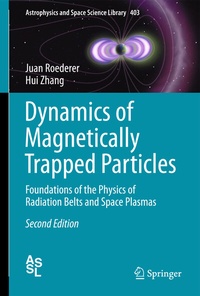
Dynamics of Magnetically Trapped Particles
Description

This book is a new edition of Roederer's classic Dynamics of Geomagnetically Trapped Radiation , updated and considerably expanded. The main objective is to describe the dynamic properties of magnetically trapped particles in planetary radiation belts and plasmas and explain the physical processes involved from the theoretical point of view. The approach is to examine in detail the orbital and adiabatic motion of individual particles in typical configurations of magnetic and electric fields in the magnetosphere and, from there, derive basic features of the particles' collective "macroscopic" behavior in general planetary environments. Emphasis is not on the "what " but on the "why " of particle phenomena in near-earth space, providing a solid and clear understanding of the principal basic physical mechanisms and dynamic processes involved. The book will also serve as an introduction to general space plasma physics, with abundant basic examples to illustrate and explain the physical origin of different types of plasma current systems and their self-organizing character via the magnetic field. The ultimate aim is to help both graduate students and interested scientists to successfully face the theoretical and experimental challenges lying ahead in space physics in view of recent and upcoming satellite missions and an expected wealth of data on radiation belts and plasmas.
Reviews / Votes
From the book reviews:
"This book provides a substantial discussion of the above fundamental topics in space-plasma physics, and will undoubtedly form a useful future resource for students (of all ages) when delving into those subjects." (Stan Cowley, The Observatory, Vol. 135, February, 2015)
More details
Other editions
Additional editions
Persons
Professor of Physics Emeritus, Geophysical Institute and Department of Physics,
University of Alaska Fairbanks (since 1993).
Senior Adviser, The Abdus Salam International Centre for Theoretical Physics (1997-2003).
Professor of Physics, Geophysical Institute and Department of Physics, University of Alaska Fairbanks (1977-1993).
Chairman, United States Arctic Research Commission (presidential commission, 1987- 1991).
Director, Geophysical Institute, University of Alaska Fairbanks, 1977-1986.
Dean, College of Environmental Sciences, University of Alaska Fairbanks, 1979-1982.
Chairman, Advisory Committee, Los Alamos National Laboratory, Division of Earth and Space Sciences, 1985-1988.
Vice Chairman, U.S. Arctic Research Commission, 1985-1987.
Visiting Staff Member, Johns Hopkins University, Applied Physics Laboratory, 1987.
Visiting Staff Member, Los Alamos National Laboratory, University of California, 1968-1981.
Expert (consultant), Headquarters, National Aeronautics and Space Administration, 1974-1978.
Visiting Professor, Stanford University, 1974.
Professor and Senior Research Physicist, University of Denver, 1967-1977.
Professor of Physics, University of Buenos Aires, 1959-1966.
Director, National Cosmic Ray Center, National Council for Scientific and Technological Research, Buenos Aires, 1962-1966.
