

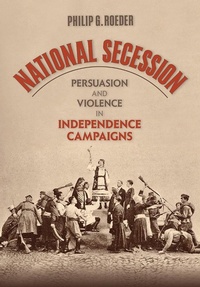
National Secession
Description

How do some national-secessionist campaigns get on the global agenda whereas others do not? Which projects for new nation-states, Philip Roeder asks, give rise to mayhem in the politics of existing states? National secession has been explained by reference to identities, grievances, greed, and opportunities. With the strategic constraints most national-secession campaigns face, the author argues, the essential element is the campaign's ability to coordinate expectations within a population on a common goal-so that independence looks like the only viable option.
Roeder shows how in most well-known national-secession campaigns, this strategy of programmatic coordination has led breakaway leaders to assume the critical task of propagating an authentic and realistic nation-state project. Such campaigns are most likely to draw attention in the capitals of the great powers that control admission to the international community, to bring the campaigns' disputes with their central governments to deadlock, and to engage in protracted, intense struggles to convince the international community that independence is the only viable option.
In National Secession, Roeder focuses on the goals of national-secession campaigns as a key determinant of strategy, operational objectives, and tactics. He shifts the focus in the study of secessionist civil wars from tactics (such as violence) to the larger substantive disputes within which these tactics are chosen, and he analyzes the consequences of programmatic coordination for getting on the global agenda. All of which, he argues, can give rise to intractable disputes and violent conflicts.
More details
Other editions
Additional editions
Person
Philip Roeder is Professor of Political Science at the University of California, San Diego. Roeder has published books on Kremlin politics and the failure of the Soviet state, the incomplete post-Soviet transitions to democracy, and national-secession disputes and conflicts around the world. His articles have appeared in such journals as the American Political Science Review, World Politics, and International Studies Quarterly.
Content
Figures and Tables
Acknowledgments
1. Three Questions about National Secession
2. Strategic Constraints: Goals and Means
3. Organization and Mobilization in Campaign Development
4. Programmatic Coordination in Campaigns
5. Significant Campaigns: Getting on the Global Agenda
6. Intractable Disputes: Consequences of SuccessfulCampaigning
7. Protracted Intense Struggles: Reinforcing Intractability
8. Complementary Explanations: Motivations and Opportunities
9. Looking Forward: Implications of Programmatic Analysis
Appendix to Chapter 2
Appendix to Chapter 5
Appendix to Chapter 7
Appendix to Chapter 9
Notes
Glossary
References
Index
