

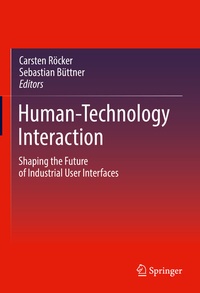
Human-Technology Interaction
Description

Digitalization and automation are leading to fundamental changes in the industrial landscape. In the German-speaking countries, this development is often summarized under the term Industry 4.0. Simultaneously, interaction technologies have made huge developments in the last decades. The use of mobile devices and touch screens is ubiquitous, augmented and virtual reality technologies have made their way into the market and new interaction concepts have become established. While new interaction technologies offer new possibilities for organizing or executing work in the context of Industry 4.0, the transformation of industrial processes also creates a need for new work practices.
This book sheds light on the interplay of Industry 4.0 and new interaction technologies. It presents selected research articles on the topic of Human-Technology Interaction in the context of Industry 4.0. Researchers from various disciplines present the current state of research with regard to futureinteractions with production environments to develop a common vision of how to design future interactions in the industrial domain.
In this context, various topics are covered: a detailed overview on assistive systems for supporting manual work is given, including technological and design aspects as well as implementation strategies. Industrial use-cases for extended reality (XR) technologies such as augmented and virtual reality (AR and VR) are presented, also covering aspects of how to author content in XR environments. The role of new work practices is examined, for example, by presenting concepts of gamification and human-machine teamwork for supporting well-being. Finally, topics of trust and technology acceptance are discussed in the context of Industry 4.0. Given this broad perspective, a vision is sketched of how to design future human-technology interactions in a way that realizes their full technical and human potential.
More details
Other editions
Additional editions
Persons
Sebastian Büttner
is working as a researcher in the Human-Centered Information Systems group at Clausthal University of Technology. Prior to this, he was a doctoral student at TH OWL University of Applied Sciences and Arts and conducted research on the topic of projection-based augmented reality in industrial settings.
Content
Human-Technology Interaction in the context of Industry 4.0 - current trends and challenges.- Digital Assembly Assistance Systems: Methods, Technologies and Implementation Strategies.- Cognitive Operator Support in the manufacturing industry - three tools to help SMEs select, test and evaluate operator support technology.- Human-Centered Adaptive Assistance Systems for the Shop Floor.- Deep Learning-based Action Detection for Continuous Quality Control in Interactive Assistance Systems.- Advancements in Vocational Training through Mobile Assistance Systems.- Designing User-Guidance for eXtendend Reality Interfaces in Industrial Environments.- Lenssembly: Authoring Assembly Instructions in Augmented Reality Using Programming-By-Demonstration.- Escaping the Holodeck: Designing Virtual Environments for Real Organizations.- Gamification in Industrial Production: An Overview, Best Practices, and Design Recommendations.- New industrial work - personalised job roles, smooth human-machine teamwork and support for well-being at work.- Which factors influence laboratory employees' acceptance of laboratory 4.0 systems?.- Determinants of trust in smart technologies.- Interfaces, Interactions, and Industry 4.0. - Why and how to design human-centered Industrial User Interfaces in the Internet of Production.
