

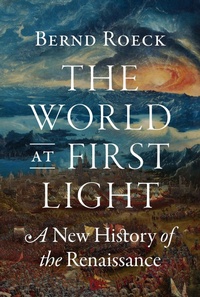
The World at First Light
A New History of the Renaissance
1st Edition
Published on 5. June 2025
1184 pages
978-0-691-27215-3 (ISBN)
Description

A magisterial history of the Renaissance and the birth of the modern world
The cultural epoch we know as the Renaissance emerged at a certain time and in a certain place. Why then and not earlier? Why there and not elsewhere? In The World at First Light, historian Bernd Roeck explores the cultural and historical preconditions that enabled the European Renaissance. Roeck shows that the rediscovery of ancient knowledge, including the science of the medieval Arab world, played a critical role in shaping the beginnings of Western modernity. He explains that the Renaissance emerged in a part of Europe where competing states and cities formed relatively open societies. Most of the era's creative minds-from Leonardo da Vinci and Michelangelo to Copernicus and Galileo-came from the middle classes. The art of arguing flowered, the basso continuo to intellectual and cultural breakthroughs.
Roeck argues that two revolutions shaped the Renaissance: a media revolution, triggered by Gutenberg's invention of movable type-which itself was a driving force behind the scientific revolution-and the advent of modern science. He also reports on the dark side of the era-hatred of Jews, witch panic, religious wars, and the atrocities of colonialism. In a series of meditative counterfactuals, Roeck considers other cultural rebirths throughout the first millennium, from the Islamic empire to the Carolingians, examining why the epic developments of the Renaissance took place in the West and not elsewhere. The complicated legacy of the Renaissance, he shows, encompasses the art of critical thinking as learned from the ancients, the emergence of the modern state, and the genesis of democracy.
The cultural epoch we know as the Renaissance emerged at a certain time and in a certain place. Why then and not earlier? Why there and not elsewhere? In The World at First Light, historian Bernd Roeck explores the cultural and historical preconditions that enabled the European Renaissance. Roeck shows that the rediscovery of ancient knowledge, including the science of the medieval Arab world, played a critical role in shaping the beginnings of Western modernity. He explains that the Renaissance emerged in a part of Europe where competing states and cities formed relatively open societies. Most of the era's creative minds-from Leonardo da Vinci and Michelangelo to Copernicus and Galileo-came from the middle classes. The art of arguing flowered, the basso continuo to intellectual and cultural breakthroughs.
Roeck argues that two revolutions shaped the Renaissance: a media revolution, triggered by Gutenberg's invention of movable type-which itself was a driving force behind the scientific revolution-and the advent of modern science. He also reports on the dark side of the era-hatred of Jews, witch panic, religious wars, and the atrocities of colonialism. In a series of meditative counterfactuals, Roeck considers other cultural rebirths throughout the first millennium, from the Islamic empire to the Carolingians, examining why the epic developments of the Renaissance took place in the West and not elsewhere. The complicated legacy of the Renaissance, he shows, encompasses the art of critical thinking as learned from the ancients, the emergence of the modern state, and the genesis of democracy.
More details
Language
English
Place of publication
Princeton, NJ
United States
Publishing group
De Gruyter
Target group
Professional and scholarly
Edition type
Digital original
Product notice
Reflowable
Illustrations
32 color + 83 b/w illus.
File size
91,85 MB
ISBN-13
978-0-691-27215-3 (9780691272153)
Schweitzer Classification
Other editions
Additional editions
Book
06/2025
Princeton University Press
€47.50
Shipment within 10-20 days
Persons
Bernd Roeck has been professor of modern history at the University of Zurich and director of the German Centre for Venetian Studies in Venice. He is the author of Florence 1900: The Quest for Arcadia, Civic Culture and Everyday Life in Early Modern Germany, and other books.
Content
- Cover
- Contents
- Preface to the English Edition
- 1. Europe's Grand Dialogue
- The Portrait of the World
- History of a Possibility
- The Deep History of an Epochal Emergence: The Seven Pillars of Modernity
- Part I. Foundations: From the First Beginnings to the Turn of the Millennium
- Eurasia and the Greco-Roman Legacy
- 2. The Luck of Geography
- The Phoenix Takes Flight
- Europe Learns to Spell
- 3. Greek Thought: Creativity and Critique
- In the Beginning Was the Polis
- Presocratic Fragments: The Cosmos, the Gods, and Human Beings
- Dialogue and Critique
- Sages for the Ages: Plato and Aristotle
- The Garden of Epicurus and the Stoa
- Alexandria
- 4. Rome: Empire and Myth
- The Phoenix Flies Westward
- Rome's Hellenic Yearning
- An Empire without Borders
- The Greek Christ
- Collapse
- 5. The Roman Legacy
- Empire and Republic
- Cities, Statues, and Statutes
- Honey and Poison: The Christian Inheritance
- Transmission and Translation
- 6. New Powers, Scribal Monks
- The Origins of a Kaleidoscopic Continent
- The Last Romans
- Broken Traditions
- Writing So That Posterity May Learn
- The Islamic Empire
- Byzantium on the Brink and the Rise of the Franks
- 7. First Rebirths and the Striving for a New Order
- The Phoenix in Francia: The Carolingian Renaissance
- Blueprint for a Europe of States
- Yearning for Rome: The Renaissance of an Idea
- Christ in the Forests: State Formation and Christianization in the East and the North
- Resuscitation of a Superlanguage
- 8. Arab Spring, Byzantine Autumn
- The Cities of the Prophet
- In the House of Wisdom
- Students of the World, Teachers of Europe
- First Contacts
- Macedonian Renaissance?
- Part II. The Development of Possibilities: 1000-1400
- Turning Points
- 9. The Centers of the World: India, Japan, China
- Asia's Mediterranean and Its Inhabitants
- The Center of the Center: China
- Chinese Renaissance
- 10. Takeoff under the Sun
- Europe Begins to Fly
- Deep History: Bridled Passion
- Urbanization
- 11. Latin Europe Falls Apart
- The Struggle for Purity
- Monastic Reform
- Earthquake: The Investiture Controversy
- Age of Crusades: The Origins of Occidentalism
- Fledgling Europe
- Magna Carta
- 12. Vertical Power, Horizontal Power
- Feudalism
- Guilds, Communes, Confederations
- Political Representation
- Universities and the Law of Rome
- Triumph of the Ink State
- 13. Origins of the "Great Divergence
- Mongol Invasions
- China: Walled-In Freedom
- A Muslim in the Vatican
- The Byzantine Empire: Learning in the Haze of Incense
- 14. First "Renaissances"
- A Revolution of Speaking, Reading, and Writing
- The Secular World in Ancient Dress: The Renaissance of the Twelfth Century
- Reason, Faith, and Novelty
- A Millefleur Tapestry of Piety
- Sicily's Renaissance
- The Power of Philosophy and Divine Omnipotence
- 15. New Horizons, New Things
- Individuality and Freedom
- Italy after the Demise of the Hohenstaufen
- The Holy Roman Empire and Its Neighbors
- Kings under the Midnight Sun and a Prince on the Moskva
- The World Gets Bigger: Off to Asia!
- Paper, Eyeglasses, and Earthly Existence: Taking Stock
- First Lights, Cold Weather, and Death: The Fourteenth Century
- 16. Italian Overture
- Rise of the Notaries
- The First Humanists
- Epochal Interlude: The Divine Comedy
- Dante's Emperor, Popes in Avignon, and an Exile in Munich
- The Most Modern City in the World
- Europe Enters the Age of Art
- Intellectual Ascent: Petrarca
- 17. A World(view) Falls Apart
- The Triumph of Death
- Division Everywhere
- An Emperor in Prague
- The English Serpent, Feverish Florence, and a Two-Headed Papacy
- West, East, and North in the Late Fourteenth Century
- Moscow, Mongols, Ottomans
- 18. Before the Great Renaissance
- Decameron, Canterbury Tales
- On the Eve of the New Science
- Gunpowder and Capital
- Dawn of the Mechanical Age
- In the Millennium of Odysseus
- Europe's Diversity and the Boundaries of Belief
- Strong Women
- 19. The Sun Sets in the East
- The Birth of Ming China
- The Decline of Arabic Science
- Part III. The Realization of Possibilities: 1400-1600
- Artists and Humanists, Wars and Councils: 1400-1450
- 20. Florence at First Light
- Origins of the Monumental Renaissance
- Republican Values, Romantic Classicism
- The Rotten Republic
- Color plates
- 21. From Constance to Constantinople
- Constance
- Postponed Reforms
- The Hundred Years' War: Reversals and Resolution
- Midsummer in Burgundy: The Play of Realism
- Resetting the Italian Chessboard
- 22. Children of the Discursive Revolution
- Humanist Education, the Rhetorical Revolution, and Textual Criticism
- Greco-Italian Networks
- Archaeology of Wisdom
- The Truth Cries Out in the Streets: Cusanus's Concordances
- Understanding the Causes of Things: The Return of Epicurus
- Alberti: Window on the World
- A Knight Tilting at Modernity
- Beyond Italy: The Origins of European Humanism
- The First Academies, Poets in the Cities
- Competition and Creativity: 1450-1500
- 23. Le tens revient
- Constantinople's Last Stand
- After 1453
- The Italian Mobile
- The European Framework
- Italy, Land of Patronage
- In Plato's Heaven
- At the Close of Fair Days
- 24. Media Revolution
- Innovation in Mainz
- The Gutenberg Continent
- 25. New Worlds
- Nanjing, Ceuta: World History Shifts Course
- Birth of a Catholic Empire
- Columbus: Westward to the East
- 1492
- Spain: A Pure Country
- 26. Witches, High Finance, and the Authority of the State
- Hellfire
- Hammer of Witches
- Turnaround: Population, Economy
- Silver, Iron, Paper: The Consolidation of the Ink State
- Father of an Empire: Maximilian I
- Big Business: The Fugger Family
- High Renaissance
- 27. Raison d'État Is Born
- The Triumph of Hierarchy: Renaissance Popes
- Machiavelli
- 28. Travels to Utopia, Art Worlds
- Beautiful Cities
- Arcadian Dreams
- Nowhere Lands
- The Utopia of Urbino: Castiglione and the Civilizing Process
- The Art Market
- The Ungodly: Leonardo
- The Divine: Michelangelo and Raphael
- Italy, Capital of Culture
- 29. South Wind: The Renaissance Conquers Europe
- Paths of Art and Ideas: Western Europe,Eastern Europe
- O tempora, o mores! Humanism in the Holy Roman Empire
- The Apogee of Humanism: Erasmus of Rotterdam
- New Empires, New Knowledge, Religious Schism
- 30. Empires and Emperors
- The Ottoman Empire at Its Zenith
- Moscow: On the Path to Empire
- Conquistadors
- Beyond the Cape of Good Hope
- The Habsburg World Empire
- 31. Religious Revolution
- Luther
- A German Realm of Possibility
- Shadows of the Apocalypse: Peasant Revolution
- Roman Graffiti and the Nightingale's Song
- Splintering of the Splinters: Wittenberg, Zurich, Münster
- Divorce English Style: Henry VIII's Reformation
- Stunted Reformations
- God's Sheepdog: Calvin
- War and Council
- Luther's Legacy, Humanism, and Renaissance
- 32. Revolution of the Heavenly Spheres
- Prometheus
- Paradigm Shift
- The Music of the Spheres: The Premodern Sky
- Copernicus
- The Books of God
- 33. The Great Chain of Being
- RenaissanceMagic: The Power of Words and Things
- The Power of Stones and Stars: Alchemists and Astrologers
- Scholars, Charlatans, Science
- 34. The Dissection of Man
- The Rise of the Medicus
- Vital Spirits, Holistic Medicine: Fernel, Paracelsus
- Anatomical Revolution: Vesalius
- Icy Times
- 35. European Tableau I: Western Europe-Confessions, Wars, Countries of the Future
- Climate Change, Starvation, Witchcraft Craze
- From Augsburg to Trent
- Catholic Renaissance
- Darkness Descends: The French Wars of Religion
- Night Falls on Spain
- Dutch Daybreak
- A Woman on the Throne: Elizabeth I
- 36. European Tableau II: The North, the East, the Center, and Italy
- Patriots
- The Baltic Region and Siberia
- The Holy Roman Empire
- History of a Mythology: Italy
- 37. Beyond the Pillars of Hercules
- The Wrath of God
- Latin American Renaissance, Tristes Tropiques
- Spain Grasps for East Asia
- The Magic of the Capes
- History and Truth
- 38. Autumn of the Renaissance
- Gardens of Melancholy
- The Painting of the Self: Montaigne
- Mannerism: The Arts in the World
- The Abundance and Order of Knowledge
- Fall of the Titans
- Winter Journey to Infinity: Giordano Bruno
- Winter's Tale: Shakespeare
- Scientific Revolution
- 39. Observation, Experimentation, Calculation
- 1600: In the Shadow of the Volcano
- Experimental Science, Systematic Research
- Turning against Galen
- 40. The Sun Rises in the West
- Tycho Brahe: The Luck of Patronage
- Kepler Conquers Mars
- God as a Mathematician
- The Invention of the Telescope
- Galileo's New Physics
- The Trial
- The Phoenix in Europe
- On the Cusp of Modernity
- 41. In the Age of Leviathan
- Between Renaissance and Baroque
- The Demystification of Politics
- Power Play for the World
- Leviathan's Triumph
- The Dawn of Civil Society
- 42. The Mechanical Universe
- Inventive Passion
- Lost Center
- Color plates
- 43. The Archaeology of Modernity
- The Great Divergence
- Screws and Inventors: The Completion of an Alexandrian Project
- The Butterfly Effect
- Part IV. Conclusions: The "West" and the Rest
- 44. Vertical Power, Sky High
- Russia: Tsars and Patriarchs
- The Sick Man on the Bosporus
- 45. Pastoral Power: State, Society, Religion
- Painful Separations, Crippling Connections
- Words of Wax
- Kant Stopped before Bagdad
- No Middle Class in Sight
- Apollo Stopped at Gandhara: Religion, Art, Anatomy
- 46. Lost Civilizations, Stubborn States
- Beyond the Realm of Leviathan
- Parallels, Divergences: Central Asia, Southeast Asia
- India
- Japan: Tokugawa Renaissance?
- 47. Why Not China?
- Dreams of Tranquility, Bustling Trade
- An Arrogant Giant
- Stoic, Not Dramatic
- 48. Deep History: Soundings
- The Benefits of Religious Conflict
- Demographic Regimes: Life, Survival, Death
- Middle Class Power
- The Long Grasp of History
- 49. Epilogue
- On the Shoulders of Giants
- The Uniqueness of the European Renaissance
- Twilight of a Faun
- The World a Dream
- Postscript to the First German Edition
- Postscript to the New German Edition
- Notes
- Abbreviations
- Bibliography
- List of Images
- Color Plate Credits
- Index of Names
