

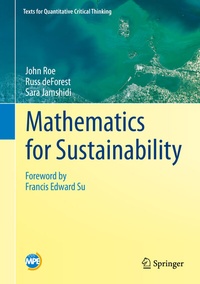
Mathematics for Sustainability
Description

Designed for the 21
st
century classroom, this textbook poses, refines, and analyzes questions of sustainability in a quantitative environment. Building mathematical knowledge in the context of issues relevant to every global citizen today, this text takes an approach that empowers students of all disciplines to understand and reason with quantitative information. Whatever conclusions may be reached on a given topic, this book will prepare the reader to think critically about their own and other people's arguments and to support them with careful, mathematical reasoning.
Topics are grouped in themes of measurement, flow, connectivity, change, risk, and decision-making. Mathematical thinking is at the fore throughout, as students learn to model sustainability on local, regional, and global scales. Exercises emphasize concepts, while projects build and challenge communication skills. With no prerequisites beyond high school algebra, instructors will find this book arich resource for engaging all majors in the mathematics classroom.
From the Foreword
No longer will you be just a spectator when people give you quantitative information-you will become an active participant who can engage and contribute new insights to any discussion.[.] There are many math books that will feed you knowledge, but it is rare to see a book like this one that will help you cultivate wisdom.[.] As the authors illustrate, mathematics that pays attention to human considerations can help you look at the world with a new lens, help you frame important questions, and help you make wise decisions. Francis Edward Su, Harvey Mudd College
Reviews / Votes
"This is a most revolutionary book, and I would love to teach a course using it! There is much interest in what is variously termed quantitative literacy (QL), quantitative reasoning (QR), and critical thinking (CT). This book is the first in a series of Texts for Quantitative Critical Thinking . . I do not want to fail to mention that the book's layout is simply beautiful." (Paul J. Campbell, Mathematics Magazine, Vol. 92 (1), November, 2018)More details
Other editions
Additional editions
Persons
John Roe is a Professor of Mathematics at Pennsylvania State University, where his research has centered around the Atiyah-Singer index theorem and its generalizations. His contributions to mathematics span research, exposition, and education, with previous books including Winding Around (AMS, 2015) and Lectures on Coarse Geometry (AMS, 2003).
Russ deForest is a mathematician interested in PDE models in mathematical biology. He co-authored this book while completing his Ph.D. at Pennsylvania State University.
Sara Jamshidi researches topics related to learning, cognition, and noisy systems from a mathematical standpoint. She co-authored this book while completing her Ph.D. at Pennsylvania State University.
All three authors are deeply committed to issues of sustainability and empowering students of all disciplines to engage in quantitative conversations surrounding these issues.