
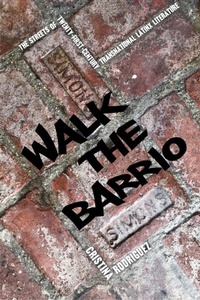
Walk the Barrio
Description
Alles über E-Books | Antworten auf Fragen rund um E-Books, Kopierschutz und Dateiformate finden Sie in unserem Info- & Hilfebereich.
Immigrant communities evince particular and deep relationship to place. Building on this self-evident premise, Walk the Barrio adds the less obvious claim that to write about place you must experience place. Thus, in this book about immigrants, writing, and place, Cristina Rodriguez walks neighborhood streets, talks to immigrants, interviews authors, and puts herself physically in the spaces that she seeks to understand.
The word barrio first entered the English lexicon in 1833 and has since become a commonplace not only of American speech but of our literary imagination. Indeed, what draws Rodriguez to the barrios of Los Angeles, New York, Miami, and others is the work of literature that was fueled and inspired by those neighborhoods. Walk the Barrio explores the ways in which authors William Archila, Richard Blanco, Angie Cruz, Junot Di¿az, Salvador Plascencia, He¿ctor Tobar, and Helena Mari¿a Viramontes use their U.S. hometowns as both setting and stylistic inspiration.
Asking how these writers innovate upon or break the rules of genre to render in words an embodied experience of the barrio, Rodriguez considers, for example, how the spatial map of New Brunswick impacts the mobility of Di¿az's female characters, or how graffiti influences the aesthetics of Viramontes's novels. By mapping each text's fictional setting upon the actual spaces it references in what she calls "barriographies," Rodriguez reveals connections between place, narrative form, and migrancy.
This first-person, interdisciplinary approach presents an innovative model for literary studies as it sheds important light on the ways in which transnationalism transforms the culture of each Latinx barrio, effecting shifts in gender roles, the construction of the family, definitions of social normativity, and racial, ethnic, national, and linguistic identifications.
All prices
More details
Other editions
Additional editions
Person
Cristina Rodriguez is Associate Professor of English at Providence College.
Content
Part I: Mexican-American East Los Angeles
1. The El Monte Aesthetic in Salvador Plascencia's The People of Paper
2. "Earthquakes or earthmovers": The East L.A. Barrio and Helena María Viramontes' Their Dogs Came With Them
Part II: Central American Downtown Los Angeles
3. The War for Space in Héctor Tobar's The Tattooed Soldier
4. "The Blackouts of a Tiny Country": The Art of William Archila's Salvadoran Exile
Part III: Dominican New York City
5. "No Promises Can Survive that Sea": This is How You Lose Her's Diasporic Identity
6. "Washington Heights Is Like a Prison Sentence": Soledad's Female Surveillance
Part IV: Cuban Miami
7. "Why Don't I Got a Street?": Little Havana in Richard Blanco's Queer Cuban-American Bildungsroman
Conclusion: Your Hometown and Other Barriographies

System requirements
File format: ePUB
Copy protection: Adobe-DRM (Digital Rights Management)
System requirements:
- Computer (Windows; MacOS X; Linux): Install the free reader Adobe Digital Editions prior to download (see eBook Help).
- Tablet/smartphone (Android; iOS): Install the free app Adobe Digital Editions or the app PocketBook before downloading (see eBook Help).
- E-reader: Bookeen, Kobo, Pocketbook, Sony, Tolino and many more (not Kindle).
The file format ePub works well for novels and non-fiction books – i.e., „flowing” text without complex layout. On an e-reader or smartphone, line and page breaks automatically adjust to fit the small displays.
This eBook uses Adobe-DRM, a „hard” copy protection. If the necessary requirements are not met, unfortunately you will not be able to open the eBook. You will therefore need to prepare your reading hardware before downloading.
Please note: We strongly recommend that you authorise using your personal Adobe ID after installation of any reading software.
For more information, see our ebook Help page.
File format: PDF
Copy-Protection: Adobe-DRM (Digital Rights Management)
System requirements:
- Computer (Windows; MacOS X; Linux): Install the free reader Adobe Digital Editions prior to download (see eBook Help).
- Tablet/smartphone (Android; iOS): Install the free app Adobe Digital Editions or the app PocketBook before downloading (see eBook Help).
- E-reader: Bookeen, Kobo, Pocketbook, Sony, Tolino and many more (only limited: Kindle).
The file format PDF always displays a book page identically on any hardware. This makes PDF suitable for complex layouts such as those used in textbooks and reference books (images, tables, columns, footnotes). Unfortunately, on the small screens of e-readers or smartphones, PDFs are rather annoying, requiring too much scrolling.
This eBook uses Adobe-DRM, a „hard” copy protection. If the necessary requirements are not met, unfortunately you will not be able to open the eBook. You will therefore need to prepare your reading hardware before downloading.
Please note: We strongly recommend that you authorise using your personal Adobe ID after installation of any reading software.
For more information, see our eBook Help page.
File format: ePUB
Copy protection: without DRM (Digital Rights Management)
System requirements:
- Computer (Windows; MacOS X; Linux): Use a reader that can handle the file format ePUB, such as Adobe Digital Editions or FBReader – both free (see eBook Help).
- Tablet/Smartphone (Android; iOS): Install the free app Adobe Digital Editions or the app PocketBook (see eBook Help).
- E-reader: Bookeen, Kobo, Pocketbook, Sony, Tolino and many more (not Kindle).
The file format ePUB works well for novels and non-fiction books – i.e., 'flowing' text without complex layout. On an e-reader or smartphone, line and page breaks automatically adjust to fit the small displays.
This eBook does not use copy protection or Digital Rights Management
For more information, see our eBook Help page.
