

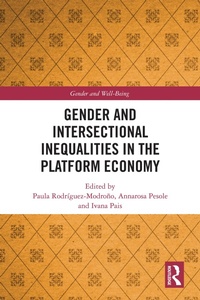
Gender and Intersectional Inequalities in the Platform Economy
Will be published approx. on 22. June 2026
334 pages
978-1-040-60681-0 (ISBN)
Description

This book examines different key aspects around new forms of work and gender and intersectional inequalities in platforms, how the platform economy intervenes, changes and reconfigures the organization of work, and the challenges faced by policymakers and workers' organizations regarding formalization, professionalization, remuneration, quality of work or social protection of platform work.
Including case studies from different countries from the Global North and the Global South, it contributes to a better understanding of how digital platforms are inserting themselves into neoliberal transformations in labour markets, taking advantage of digitization, the commodification of reproductive labour and migrant labour regimes to quickly access a precaritized female migrant workforce with low bargaining power.
It will be of interest to all scholars and students of gender studies, health and social care and sociology more broadly.
Including case studies from different countries from the Global North and the Global South, it contributes to a better understanding of how digital platforms are inserting themselves into neoliberal transformations in labour markets, taking advantage of digitization, the commodification of reproductive labour and migrant labour regimes to quickly access a precaritized female migrant workforce with low bargaining power.
It will be of interest to all scholars and students of gender studies, health and social care and sociology more broadly.
More details
Series
Language
English
Place of publication
London
United Kingdom
Publishing group
Taylor & Francis Ltd
Target group
College/higher education
Professional and scholarly
Product notice
Reflowable
Illustrations
18 Tables, black and white; 19 Line drawings, black and white; 3 Halftones, black and white; 22 Illustrations, black and white
File size
5,05 MB
ISBN-13
978-1-040-60681-0 (9781040606810)
Copyright in bibliographic data and cover images is held by Nielsen Book Services Limited or by the publishers or by their respective licensors: all rights reserved.
Schweitzer Classification
Other editions
Additional editions
Paula Rodriguez Modrono | Annarosa Pesole | Ivana Pais
Gender and Intersectional Inequalities in the Platform Economy
Book
approx. 06/2026
1st Edition
Routledge
€191.50
Not yet published
Persons
Paula Rodriguez-Modrono, PhD in economics from Universidad de Sevilla (Spain) and MPhil in development studies from University of Cambridge, is Professor of Economics and Director of the Interdisciplinary Centre of Women's, Gender and Feminist Studies (CINEF) and the Master Programme for Gender and Equality at Universidad Pablo de Olavide, Sevilla.
Annarosa Pesole, PhD in economics from Universita degli Studi di Milano Statale (Italy), is a labour economist specialised in new forms of digital labour and technological change. She is an expert consultant on digital and labour policies for the European Commission and the United Nations.
Ivana Pais is Full Professor of Economic Sociology at Universita Cattolica del Sacro Cuore in Milan (Italy), where she directs the Transformative Actions Interdisciplinary Laboratory (TRAILab).
Annarosa Pesole, PhD in economics from Universita degli Studi di Milano Statale (Italy), is a labour economist specialised in new forms of digital labour and technological change. She is an expert consultant on digital and labour policies for the European Commission and the United Nations.
Ivana Pais is Full Professor of Economic Sociology at Universita Cattolica del Sacro Cuore in Milan (Italy), where she directs the Transformative Actions Interdisciplinary Laboratory (TRAILab).
Content
Introduction, 1. Access to work in the Kenyan digital economy: Resilience, Resistance and Digital Intersectionality in the UPDATE Project , 2. The Digital Double Shift: How the Flexibility Myth and Therapeutic Maternalism Engender Platform Therapy, 3. Digital Platform Work and Gender Discrimination: an Analysis of the European Platforms Directive, 4. The Impact of the Platform Economy on Gender and Social Inequalities in Eastern Europe: A Case Study of Moldova and Lithuania , 5. The Social Status of Platform Economy Work: Prestige and Social Value Dynamics and their Social Structuration, 6. Domestic Work Platforms in the Global South: A State-of-the-Art Review and Lessons from Mexico, 7. Negotiating working conditions: the case of domestic work mediated by digital platforms in Argentina , 8. Women Workers in India's Digital/ Platform economy , 9. Gendered Insecurity and the Informalisation of Work on Domestic and Care Platforms in Belgium , 10. The platformisation of care in Spain. Examining the sustainability and potential gendered impacts of platform models , 11. Redefining digital labour platforms through a technico-organizational approach: a study of care and cleaning in French-Speaking Switzerland through the lens of interfaces, 12. Transformation and Platformisation of Domestic Work in Italy. A Qualitative Case Study in Milan on Digital Labour Platforms and Other Digital Spaces, 13. Conclusions
