

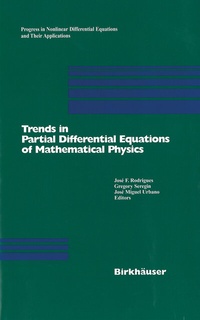
Trends in Partial Differential Equations of Mathematical Physics
Description

Vsevolod Alekseevich Solonnikov is known as one of the outstanding mathematicians from the St. Petersburg Mathematical School. His remarkable results on exact estimates of solutions to boundary and initial-boundary value problems for linear elliptic, parabolic, Stokes and Navier-Stokes systems, his methods and contributions to the inverstigation of free boundary problems, in particular in fluid mechanics, are well known to specialists all over the world.
The International Conference on "Trends in Partial Differential Equations of Mathematical Physics" was held on the occasion of his 70th birthday in Óbidos (Portugal) from June 7 to 10, 2003. The conference consisted of thirty-eight invited and contributed lectures and gathered, in the charming and unique medieval town of Óbidos, about sixty participants from fifteen countries.
This book contains twenty original contributions on many topics related to V.A. Solonnikov's work, selected from the invited talks of the conference.
Written for: Postgraduates and researchers in analysis, pde and mathematical physics, physicists
More details
Other editions
Additional editions
Content
Stopping a Viscous Fluid by a Feedback Dissipative Field: Thermal E.ects without Phase Changing (p. 1)
S.N. Antontsev, J.I. D´ýaz and H.B. de Oliveira
Dedicated to Professor V.A. Solonnikov on the occasion of his 70th birthday. Abstract. We show how the action on two simultaneous e.ects (a suitable coupling about velocity and temperature and a low range of temperature but upper that the phase changing one) may be responsible of stopping a viscous .uid without any changing phase. Our model involves a system, on an unbounded pipe, given by the planar stationary Navier-Stokes equation perturbed with a sublinear term f (x, ?, u) coupled with a stationary (and possibly nonlinear) advection di.usion equation for the temperature. After proving some results on the existence and uniqueness of weak solutions we apply an energy method to show that the velocity u vanishes for x large enough.
1. Introduction
It is well known (see, for instance, [6, 8, 14]) that in phase changing .ows (as the Stefan problem) usually the solid region is assumed to remain static and so we can understand the final situation in the following way: the thermal e.ect are able to stop a viscous fluid.
The main contribution of this paper is to show how the action on two simultaneous effects (a suitable coupling about velocity and temperature and a low range of temperature but upper the phase changing one) may be responsible of stopping a viscous fld without any changing phase. This philosophy could be useful in the monitoring of many .ows problems, specially in metallurgy.
