

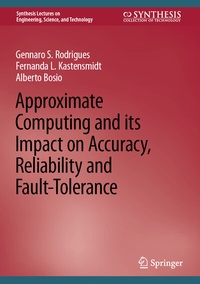
Approximate Computing and its Impact on Accuracy, Reliability and Fault-Tolerance
Description

This book introduces the concept of approximate computing for software and hardware designs and its impact on the reliability of embedded systems. It presents approximate computing methods and proposes approximate fault tolerance techniques applied to programmable hardware and embedded software to provide reliability at low computational costs. The book also presents fault tolerance techniques based on approximate computing, thus presenting how approximate computing can be applied to safety-critical systems.
More details
Other editions
Additional editions
Persons
Gennaro Severino Rodrigues got his Ph.D. in Microelectronics from the Universidade Federal do Rio Grande do Sul (UFRGS, Porto Alegre, Brazil), in cooperation with LIRMM (Montpellier, France) and the Ecole Centrale de Lyon (France). His research is focused on Approximate Computing and Fault Tolerance, and he has been working on the development of embedded software for safety-critical applications and fault tolerance techniques. His interests are also in Machine Learning and its relation to approximate computing and fault tolerance.
Fernanda Lima Kastensmidt is a Full Professor at Instituto de Informatica, Universidade Federal do Rio Grande do Sul, Porto Alegre, Brasil. She has bachelor's at Engenharia Elétrica from Universidade Federal do Rio Grande do Sul (1997), master's at Computer Science from Universidade Federal do Rio Grande do Sul (1999) and doctorate at Computer Science from Universidade Federaldo Rio Grande do Sul (2003). Has experience in Computer Science, focusing on Hardware, acting on the following subjects: fault tolerance, radhard systems, FPGAs, fault modeling. She is author of the book: Fault Tolerance Techniques for SRAM-based FPGAs published in 2006 by Springer and co-author of other 3 books. She has developed part of the payload of NanoSat-BR1 satellite that was launched on June 2104. And she is currently working in the payload of NanoSAT-BR2, launched at 2021.
Alberto Bosio received the PhD in Computer Engineering from the Politecnico di Torino, Italy in 2006. He is a Full Professor at the Institute of Nanotechnology - Ecole Centrale de Lyon (France). His research interests include Approximate Computing, In-Memory Computing, Reliability, Test and Diagnosis of Digital circuits and systems. He co-authored 4 books, 4 patents 54 journals, and over 164 conference papers. He served as committee member in prestigious international conferences as DAC and DATE, as well as guest editors for ACM, IEEE and ELSEVIER journals. He is the vice-chair of the Europeen Test Technical Technology Council (eTTTC) and a member of the IEEE.
Content
Introduction.- The Approximate Computing Paradigm.- Radiation Effects on Digital Devices.- Methodologies for Testing and Assessing Approximate Computing Systems.- Embedded Systems Fault Tolerance.- Conclusion.
