

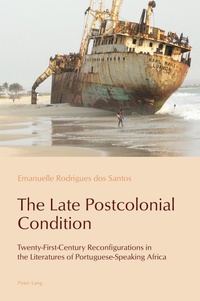
The Late Postcolonial Condition
Description

«How can we read twenty-first-century African literatures in Portuguese so that we can properly understand the voices telling us of their particular situation today? In The Late Postcolonial Condition Emanuelle Rodrigues dos Santos deftly shows us how to adjust our perspectives and assumptions from those of the past into the dynamics of the very different conditions of the present. This book will be essential reading for all students and scholars of contemporary African fiction in Portuguese.»
(Robert J. C. Young, Julius Silver Professor of English and Comparative Literature, New York University)
«In The Late Postcolonial Condition, Emanuelle Rodrigues dos Santos counters the perception of the backlash against postcolonial studies by proposing a reconfiguration of its paradigms for studying the African literatures of Portuguese-speaking countries. In doing so, she explores the interpretative perspectives of the longue durée of the past to understand the different levels of coloniality in the studies of the literatures of the Global South, with an emphasis on a main theme in African literatures in the twenty-first century: the role of the nation-state in the contemporary juncture of each postcolonial context. This book is an important contribution to contemporary literary studies, especially to the literatures of Portuguese-speaking Africa that are still peripheral to hegemonic anglophone scholarship. It brings valuable insights into postcolonial studies and debates around identity and narration of the nation in African literatures through the conceptualisation of late postcoloniality.»
(Inocência Mata, Professor in the Department of Romance Literatures, School of Arts and Humanities, University of Lisbon)
This book provides a unique portrait of the late postcolonial condition in the twenty-first century, shedding new light on complex national and transnational dynamics in the development of postcolonial states in the aftermath of independence. This analysis of fictional narratives from Angola, Mozambique, Cape Verde, Guinea Bissau, and São Tomé and Príncipe establishes a much-needed critical reassessment of the theoretical framework of postcolonial studies used to trace the development of key tropes within these national literary systems, including nation building, the role of violence and economic exploitation in the postcolonial age. Engaging with a selection of works published at the turn of the millennium by authors such as José Eduardo Agualusa, João Paulo Borges Coelho, Evel Rocha, Filomena Embaló and Albertino Bragança, this study considers the impact of relevant aesthetic, cultural, political and economic circumstances to propose the concept of late postcolonial condition to define their contemporary postcolonial experience.
More details
Other editions
Additional editions
Person
Emanuelle Rodrigues dos Santos is Associate Professor in Modern Languages at the University of Birmingham, where she is also the Director of the Instituto Camões' Cátedra Gil Vicente. Her research focuses on the intersections between the cultures of the Portuguese-speaking world, postcolonial studies and theories of world literature. Her work also addresses representations of race, gender and sexuality, memory studies, world-systems theory, and decolonial critique with special attention to structures of inequality, oppression and hegemony.
