

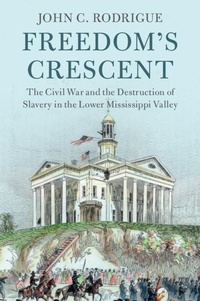
Freedom's Crescent
The Civil War and the Destruction of Slavery in the Lower Mississippi Valley
Published on 18. January 2023
978-1-108-33736-6 (ISBN)
Description

The Lower Mississippi Valley is more than just a distinct geographical region of the United States; it was central to the outcome of the Civil War and the destruction of slavery in the American South. Beginning with Lincoln's 1860 presidential election and concluding with the final ratification of the Thirteenth Amendment in 1865, Freedom's Crescent explores the four states of this region that seceded and joined the Confederacy: Tennessee, Mississippi, Arkansas, and Louisiana. By weaving into a coherent narrative the major military campaigns that enveloped the region, the daily disintegration of slavery in the countryside, and political developments across the four states and in Washington DC, John C. Rodrigue identifies the Lower Mississippi Valley as the epicenter of emancipation in the South. A sweeping examination of one of the war's most important theaters, this book highlights the integral role this region played in transforming United States history.
Reviews / Votes
'Based on a fresh and masterful reading of sources, both old and new, John Rodrigue demonstrates that the process of emancipation and the abolition of slavery in four confederate states played a critical role in the downfall of the Confederacy. Filled with stories, unforgettable characters and a careful presentation of political events, Freedom's Crescent is an impressive and original contribution to the history of the civil war and slavery.' Louis A. Ferleger, author of Cultivating Success in the South: Farm Households in Postbellum Georgia 'The Lower Mississippi Valley may seem like a limited part of the Confederate South, but John Rodrigue tells a big story. Beginning with the secession crisis in 1860 and ending with the ratification of the Thirteenth Amendment, Rodrigue shows how complex and contingent the wartime destruction of slavery was, and how painfully slow it unfolded and, until the end, threatened to backslide. A first-rate contribution to Civil War era scholarship and a sobering reminder of the boundaries to social justice.' Steven Hahn, author of A Nation Under Our Feet: Black Political Struggles in the Rural South from Slavery to the Great Migration 'John Rodrigue critically reflects on scholarly and popular tendencies to conflate the ending of slavery and the Emancipation Proclamation. Insisting on a distinction between emancipation and abolition, he examines the unevenness of slavery's destruction in federal and state law and in the social hierarchies of daily life. Readers interested in Atlantic slave emancipations and the American Civil War will find much value in this stimulating and capacious account.' Julie Saville, author of The Work of Reconstruction: From Slave to Wage Laborer in South Carolina 'A sweeping examination of one of the war's most important theaters, this book highlights the integral role this region played in transforming United States history ... a possible career magnum opus.' Andrew Wagenhoffer, Civil War Books and Authors (https://cwba.blogspot.com/2023/02/booknotes-freedoms-crescent.html) 'This is a long book and a dense one, but it deserves and will reward a close reading. Rodrigue urges us all to reflect on how the struggle to abolish slavery, much like the Civil War itself, was long and hard fought.' David A. Zonderman, North Carolina Historical Review '[An] excellent study that will be of great interest to scholars of emancipation and Reconstruction.' David T. Ballantyne, Journal of Southern HistoryMore details
Series
Language
English
Place of publication
Cambridge
United Kingdom
Illustrations
Worked examples or Exercises
File size
8,27 MB
ISBN-13
978-1-108-33736-6 (9781108337366)
Copyright in bibliographic data and cover images is held by Nielsen Book Services Limited or by the publishers or by their respective licensors: all rights reserved.
Schweitzer Classification
Other editions
Additional editions
John C. Rodrigue
Freedom's Crescent
The Civil War and the Destruction of Slavery in the Lower Mississippi Valley
Book
01/2023
Cambridge University Press
€36.50
Shipment within 15-20 days
John C. Rodrigue
Freedom's Crescent
The Civil War and the Destruction of Slavery in the Lower Mississippi Valley
Book
01/2023
Cambridge University Press
€122.50
Shipment within 15-20 days
Content
Introduction; Prologue; Life - and labor - on the Mississippi; Part I. From War for Union to Military Emancipation, 1860-1862: 1. 'An independent power'; 2. Of stampedes and free papers; 3. 'Broken eggs cannot be mended'; 4. 'The unsatisfactory prospect before them'; Part II. From Military Emancipation to State Abolition, 1863: 5. 'The return of the seceded states to this Union as slave states'; 6. 'Repugnant to the spirit of the age'; 7. 'The greatest question ever presented to practical statesmanship'; 8. 'The name of 'slavery''; 9. 'Repudiating the emancipation proclamation and reestablishing slavery'; Part III. Abolition: State and Federal, 1864: 10. 'Slavery is incompatible with a republican form of government'; 11. Of foul combinations and the common object; 12. 'The jewel of liberty'; 13. 'The virus of slavery is as virulent as it ever was'; 14. 'No longer slaves but freedmen'; 15. 'So long as a spark of vitality remains in the institution of slavery'; 16. 'Freedom, full, broad and unconditional'; 17. 'To resolve never again to be reduced to slavery'; Part IV. The Destruction of Slavery, 1865: 18. 'The tyrants rod has been broken'; 19. 'This cup of liberty'; 20. 'Establish things as they were before the war'; 21. 'The institution of slavery having been destroyed'; 22. 'Americans in America, one and indivisible'; Epilogue: Memphis and New Orleans: May 1-3, and July 30, 1866.
