

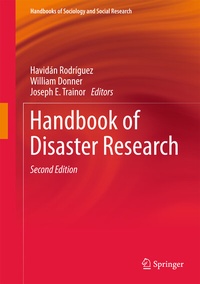
Handbook of Disaster Research
Description

This second edition of the Handbook reflects some of the foundational topics for disaster studies; current substantive, methodological or theoretical topics of interest; as well as new and emerging topics in the field. While highlighting some of the iconic themes of the 1st Edition, including what is a disaster; morbidity and mortality associated with disasters; gender and disasters; and race, class, ethnicity, and disasters, the 2nd Edition also brings to the forefront new and emerging research themes in the field of disaster studies, including climate change; children and disasters; technological and natech disasters; as well as the news media and disasters, among others. The 2nd Edition of the Handbook will continue to inform the field of disaster studies for years to come; it will expand our knowledge in this important field of inquiry, but will also generate new questions and research ideas; will continue to positively impact the growth, development, and expansion of thisfield and our growing community; and will continue to raise awareness regarding the onset and impact of these events in societies throughout the world, and, in turn, will have significant and positive impacts on disaster mitigation, preparedness, response, and recovery.
Reviews / Votes
"This book constitutes an important contribution to the field of disaster studies and is especially valuable for scholars, researchers, and those designing curricula in the field of emergency and disaster management . . It represents a critical addition for academic libraries and disaster collections with articles that will be heavily sought by students of disaster studies and would also make an excellent classroom textbook for students across a range of disciples and in the field of emergency management." (Laura Olson, recoverydiva.com, June, 2018)More details
Other editions
Additional editions
Persons
Joseph E. Trainor is an Associate Professor of Public Policy and Administration at the University of Delaware (UD). He is the current director of the UD Disaster Science and Management Degree Programs and is a Core Faculty memberat the Disaster Research Center (DRC).
William Donner is Associate Professor of Sociology and Disaster Studies M.A. Director at the University of Texas-Rio Grande Valley. Research interests include hazard warnings, epidemiology, demography, and statistical applications in disaster research.
Content
Part I. Perspectives on Disasters.- Chapter 1. Defining Disaster; Ronald W. Perry.- Chapter 2. The Crisis Approach; Arjen Boin, Paul 't Hart and Sanneke Kuipers.- Chapter 3. Contributions of Technological and Natech Disaster Research to the Social Science Disaster Paradigm; Duane A. Gill and Liesel A. Ritchie.- Chapter 4. Studying Future Disasters and Crises: A Heuristic Approach; E.L. Quarantelli, Arjen Boin, and Patrick Lagadec.- Part II. Contemporary Issues in Disaster.- Chapter 5. Resilience and Disasters; James M. Kendra, Lauren Clay and Kimberly Gill.- Chapter 6. The Cultural Turn in Disaster Research: Understanding Resilience and Vulnerability through the Lens of Culture; Gary R. Webb.- Chapter 7. Terrorism as Hazard and Disaster; William L. Waugh Jr.- Chapter 8. Climate Change and Disasters; Katherine Hore, Ilan Kelman, Jessica Mercer and JC Gaillard.- Chapter 9. On Bridging Research and Practice in Disaster Science and Management: Unified System or Impossible Mission?; Joseph E. Trainor. Eric Stern and Tony Subbio.- Part III. Inequality, Social Stratification, and Disasters.- Chapter 10. Race, Class, Ethnicity, and Disaster Vulnerability; Bob Bolin and Liza C. Kurtz.- Chapter 11. Gender and Disaster: Foundations and New Directions for Research and Practice; Elaine Enarson, Alice Fothergill and Lori Peek.- Chapter 12. People with Disabilities and Disasters; Laura M. Stough and Ilan Kelman.- Chapter 13. Children and Disasters; Lori Peek, David Abramson, Robin S. Cox, Alice Fothergill and Jennifer Tobin.- Chapter 14. Social Capital in Disaster Research; Michelle A. Meyer.- Part IV. Methods and Methodological Issues in Disaster Research.- Chapter 15. Methodological Issues in Disaster Research; William Donner and Walter Diaz.- Chapter 16. The Role of Geographic Information Science and Technology in Disaster Management; Deborah S. K. Thomas.- Chapter 17. Computer Simulation and Optimization; Rachel A. Davidson and Linda Nozick.- Chapter 18. Morbidity and Mortality Associated with Disasters; Michele M. Wood and Linda B. Bourque.- Part V. Communities in Disaster.- Chapter 19. Community Innovation and Disasters; Tricia Wachtendorf, James M. Kendra and Sarah DeYoung.- Chapter 20. Community-based Disaster Risk Management; Dewald Van Niekerk, Livhuwani David Nemakonde, Leandri Kruger and Kylah Forbes-Genade.- Chapter 21. Population/Community Displacement; Ann-Margaret Esnard and Alka Sapat.- Part VI. Communication and the Mass Media.- Chapter 22. Communication Imminent Risk; Michael K. Lindell.- Chapter 23. News Media and Disasters: Navigating Old Challenges and New Opportunities in the Digital Age; Brian Monahan and Matthew Ettinger.- Chapter 24. Social Media in Disaster Communication; Leysia Palen and Amanda L. Hughes.- Part VII. From Coordination to Recovery: Managing Disasters.- Chapter 25.Community Processes: Coordination; Thomas E. Drabek.- Chapter 26. Governmental Response to Disasters: Key Attributes, Expectations, and Implications; Sandra K. Schneider.- Chapter 27. Post-Disaster Sheltering, Temporary Housing and Permanent Housing Recovery; Walter Gills Peacock, Nicole Dash, Yang Zhang and Shannon Van Zandt.- Chapter 28. Disaster Recovery in an Era of Climate Change: The Unrealized Promise of Institutional Resilience; Gavin Smith, Amanda W. Martin, and Dennis E. Wenger.
