

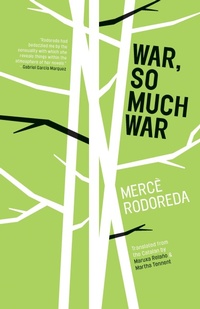
War, So Much War
Description

Featured on Jeff VanderMeer's "Epic List of Favorite Books Read in 2015"
"Rodoreda had bedazzled me by the sensuality with which she reveals things within the atmosphere of her novels."-Gabriel García Marquez
"Rodoreda plumbs a sadness that reaches beyond historic circumstances . . . an almost voluptuous vulnerability."-Natasha Wimmer, The Nation
"It is a total mystery to me why [Rodoreda] isn't widely worshipped; along with Willa Cather, she's on my list of authors whose works I intend to have read all of before I die. Tremendous, tremendous writer."-John Darnielle, The Mountain Goats
Despite its title, there is little of war and much of the fantastic in this coming-of-age story, which was the last novel Mercè Rodoreda published during her lifetime.
We first meet its young protagonist, Adrià Guinart, as he is leaving Barcelona out of boredom and a thirst for freedom, embarking on a long journey through the backwaters of a rural land that one can only suppose is Catalonia, accompanied by the interminable, distant rumblings of an indefinable war. In vignette-like chapters and with a narrative style imbued with the fantastic, Guinart meets with numerous adventures and peculiar characters who offer him a composite, if surrealistic, view of an impoverished, war-ravaged society and shape his perception of his place in the world.
As in Rodoreda's Death in Spring, nature and death play an fundamental role in a narrative that often takes on a phantasmagoric quality and seems to be a meditation on the consequences of moral degradation and the inescapable presence of evil.
Mercè Rodoreda (1908-1983) is widely regarded as the most important Catalan writer of the twentieth century. Exiled in France and Switzerland following the Spanish Civil War, Rodoreda began writing the novels and short stories-Twenty-Two Short Stories, The Time of the Doves, Camellia Street, Garden by the Sea-that would eventually make her internationally famous.
Maruxa Relaño is a journalist and translator based in Barcelona. She has worked as a translator for The Wall Street Journal, a writer for NY1, and wrote articles for the New York Daily News, Newsday, and New York magazine, among other publications.
Martha Tennent was born in the U.S, but has lived most of her life in Barcelona where she served as founding dean of the School of Translation and Interpreting at the University of Vic. She translates from Spanish and Catalan, and received an NEA Translation Fellowship for her work on Rodoreda.
More details
Other editions
Additional editions
Persons
Mercè Rodoreda is widely regarded as the most important Catalan writer of the twentieth century. Exiled to France during the Spanish Civil War, and only able to return to Catalonia in the mid-1960s, she wrote a number of highly praised works, including The Time of the Doves and Death in Spring.
Maruxa Relaño is a journalist and translator based in Barcelona. She has worked as a translator for The Wall Street Journal, a writer for NY1, and wrote articles for the New York Daily News, Newsday, and New York magazine, among other publications.
Martha Tennent was born in the U.S, but has lived most of her life in Barcelona where she served as founding dean of the School of Translation and Interpreting at the University of Vic. She translates from Spanish and Catalan, and received an NEA Translation Fellowship for her work on Rodoreda.
Content
- Intro
- Title Page
- Copyright
- Contents
- Epigraph
- PART ONE
- I: Midnight
- II: The Escape
- III: In the Woods
- IV: The Hanged Man
- V: The Wagon
- VI: The Girl by the River
- VII: The Miller Woman
- VIII: Like a Skeleton
- IX: Lice
- X: The Girl in the Two-Tone Dress
- XI: The Religious Medallions
- XII: Eva
- XIII: The Farmhouse
- XIV: A Night in the Castle
- XV: The Prisoner
- XVI: Three Girls and an Orange
- XVII: The Man with the Sandwich
- XVIII: The Girl on the Beach
- XIX: What I Should Have Said
- XX: The Woman with the Canary
- XXI: A House by the Sea
- XXII: A Red Light
- PART TWO
- XXIII: The Inheritance
- XXIV: The Mirror in the Foyer
- XXV: I Returned
- XXVI: The Three Acacia Town
- XXVII: The Cat Man
- XXVIII: Pride
- XXIX: The Hermit
- XXX: Another Farmhouse
- XXXI: Matilda's White Belly
- XXXII: The Man Who Walked with His Back to the Sun and the Moon
- XXXIII: The Bricklayer
- XXXIV: A Victim
- PART THREE
- XXXV: The Red Earth
- XXXVI: Fear
- XXXVII: The Lake
- XXXVIII: The Fisherman
- XXXIX: The Fall
- XL: Later
- XLI: The River
- XLII: Ire
- XLIII: Night's End
- About the Author
