

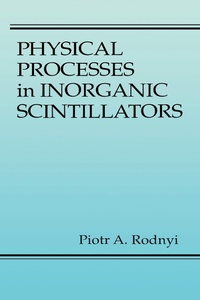
Physical Processes in Inorganic Scintillators
1st Edition
Published on 17. December 2020
240 pages
978-0-429-61181-0 (ISBN)
Description

During the last ten to fifteen years, researchers have made considerable progress in the study of inorganic scintillators. New scintillation materials have been investigated, novel scintillation mechanisms have been discovered, and additional scintillator applications have appeared. Demand continues for new and improved scintillation materials for a variety of applications including nuclear and high energy physics, astrophysics, medical imaging, geophysical exploration, radiation detection, and many other fields. However, until now there have been no books available that address in detail the complex scintillation processes associated with these new developments.
Now, a world leader in the theory and applications of scintillation processes integrates the latest scientific advances of scintillation into a new work, Physical Processes in Inorganic Scintillators. Written by distinguished researcher Piotr Rodnyi, this volume explores this challenging subject, explains the complexities of scintillation from a modern point of view, and illuminates the way to the development of better scintillation materials.
This unique work first defines the fundamental physical processes underlying scintillation and governing the primary scintillation characteristics of light output, decay time, emission spectrum, and radiation hardness. The book then discusses the complicated mechanisms of energy conversion and transformation in inorganic scintillators. The section on the role of defects in energy transfer and scintillation efficiency will be of special interest. Throughout, the author does not offer complicated derivations of equations but, instead, presents useful equations with practical results.
Now, a world leader in the theory and applications of scintillation processes integrates the latest scientific advances of scintillation into a new work, Physical Processes in Inorganic Scintillators. Written by distinguished researcher Piotr Rodnyi, this volume explores this challenging subject, explains the complexities of scintillation from a modern point of view, and illuminates the way to the development of better scintillation materials.
This unique work first defines the fundamental physical processes underlying scintillation and governing the primary scintillation characteristics of light output, decay time, emission spectrum, and radiation hardness. The book then discusses the complicated mechanisms of energy conversion and transformation in inorganic scintillators. The section on the role of defects in energy transfer and scintillation efficiency will be of special interest. Throughout, the author does not offer complicated derivations of equations but, instead, presents useful equations with practical results.
More details
Series
Edition
1. Auflage
Language
English
Place of publication
London
United Kingdom
Publishing group
Taylor & Francis Ltd
Target group
Professional and scholarly
ISBN-13
978-0-429-61181-0 (9780429611810)
Copyright in bibliographic data and cover images is held by Nielsen Book Services Limited or by the publishers or by their respective licensors: all rights reserved.
Schweitzer Classification
Other editions
Additional editions
Piotr A. Rodnyi
Physical Processes in Inorganic Scintillators
Book
05/1997
1st Edition
CRC Press
€429.20
Shipment within 15-20 days
Person
Piotr A. Rodnyi, Ph.D. St.Petersburg State Technical University, St. Petersburg, Russia
Content
BASIC PRINCIPLES AND PROCESSES
Physical Mechanism of Scintillation
Creation of Electron Hole Pairs
Excitation and Emission of Luminescence Centers
Scintillation Materials
Halides
Oxides and Oxide Systems
Chalcogenides
Glasses
Interaction of Ionizing Radiation with Scintillators
High Energy Photons
Charged Particles
Neutral Particles
General Characteristics of Inorganic Scintillators
Light Yield
Duration of Scintillation Pulse
Afterglow
Temperature Response
Optical Properties
Radiation Hardness
Density
Emission Spectra
Mechanical and Chemical Properties
Physical Parameters
Cost Consideration
Scintillator Requirements in Various Applications
High Energy Physics
Intermediate Energy Physics
Positron Emission Tomography
Gamma Spectroscopy
Energy Resolution
Intrinsic Scintillator Resolution; Nonproportional Response
Time Resolution
Low Energy Quanta and Electrons
CONVERSION OF ELECTRONIC EXCITATIONS IN SOLIDS
Charge Carrier Behaviors
Delta Rays
Secondaries
Excitation of Luminescence Centers
Effect of Ionization Density
Energy Losses
Simple Phenomenological Model
Plasmon Model
Polaron Model
Scintillation Yield Spectra
Vacuum Ultraviolet Region
Ultrasoft X-Rays
X-Rays
Gamma Rays
Heavy Ionizing Particles
INTRINSIC LUMINESCENCE OF INORGANIC SCINTILLATORS
Excitonic Luminescence
Alkali Halide Crystals
Alkaline-Earth Fluorides
Ternary Halide Compounds
Excitonic-Like Luminescence
Cesium Iodide
Tungstate and Molybdate Phosphors
Core-to-Valence Transitions
First Evidence for Radiative Core-to-Valence Transitions
Excitation Spectra
Emission Spectra
Experiment
Theory
Luminescence Kinetics
Experimental
Theoretical Investigations
Temperature Dependence of Luminescence Parameters
Conditions of Detection
Prospects for Research
EXTRINSIC LUMINESCENCE OF INORGANIC SCINTILLATORS
Physical Mechanism of Scintillation
Creation of Electron Hole Pairs
Excitation and Emission of Luminescence Centers
Scintillation Materials
Halides
Oxides and Oxide Systems
Chalcogenides
Glasses
Interaction of Ionizing Radiation with Scintillators
High Energy Photons
Charged Particles
Neutral Particles
General Characteristics of Inorganic Scintillators
Light Yield
Duration of Scintillation Pulse
Afterglow
Temperature Response
Optical Properties
Radiation Hardness
Density
Emission Spectra
Mechanical and Chemical Properties
Physical Parameters
Cost Consideration
Scintillator Requirements in Various Applications
High Energy Physics
Intermediate Energy Physics
Positron Emission Tomography
Gamma Spectroscopy
Energy Resolution
Intrinsic Scintillator Resolution; Nonproportional Response
Time Resolution
Low Energy Quanta and Electrons
CONVERSION OF ELECTRONIC EXCITATIONS IN SOLIDS
Charge Carrier Behaviors
Delta Rays
Secondaries
Excitation of Luminescence Centers
Effect of Ionization Density
Energy Losses
Simple Phenomenological Model
Plasmon Model
Polaron Model
Scintillation Yield Spectra
Vacuum Ultraviolet Region
Ultrasoft X-Rays
X-Rays
Gamma Rays
Heavy Ionizing Particles
INTRINSIC LUMINESCENCE OF INORGANIC SCINTILLATORS
Excitonic Luminescence
Alkali Halide Crystals
Alkaline-Earth Fluorides
Ternary Halide Compounds
Excitonic-Like Luminescence
Cesium Iodide
Tungstate and Molybdate Phosphors
Core-to-Valence Transitions
First Evidence for Radiative Core-to-Valence Transitions
Excitation Spectra
Emission Spectra
Experiment
Theory
Luminescence Kinetics
Experimental
Theoretical Investigations
Temperature Dependence of Luminescence Parameters
Conditions of Detection
Prospects for Research
EXTRINSIC LUMINESCENCE OF INORGANIC SCINTILLATORS
