

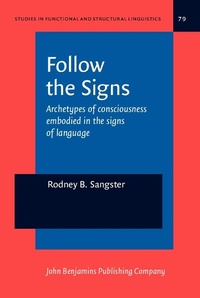
Follow the Signs
Archetypes of consciousness embodied in the signs of language
1st Edition
Published on 19. February 2020
189 pages
978-90-272-6157-1 (ISBN)
Description

In this his latest book, Sangster presents a comprehensive theory that takes the cognitive view of language in a promising new direction, based upon how linguistic signs relate to one another at different levels of consciousness. At the rational level, where signs are necessarily experienced in context, they are primarily polysemic. At the transpersonal or pre-contextual level, however, they are monosemic, constituting a dynamic and self-organizing relational structure capable of producing a potentially infinite variety of contextual applications. The two levels are united by a stochastic or somatic selection process called contextualization, where feedback from experience assures the evolution of the system. The relational structure itself is composed of archetypes of space and time consciousness that derive from the evolution of the linguistic sign from the signaling behavior of antecedent species. Detailed analyses are provided to explain how the archetypes structure meaning in both the grammatical and lexical spheres, as well as in syntax.
More details
Other editions
Additional editions
Book
02/2020
John Benjamins Publishing Co
€123.50
Shipment within 10-15 days
Content
- Intro
- Follow the Signs
- Editorial page
- Title page
- Copyright page
- Table of contents
- Preface
- Introduction: Theories of form and meaning
- Part 1. General concepts
- 1.1 The evolution of conciousness and its neurological foundation
- 1.2 From primate signals to human signs
- 1.3 The concept of reference in a self-organizing system
- 1.4 Higher-order consciousness reexamined
- 1.5 The locus and function of monosemy in human consciousness
- 1.6 The ultimate nature of meaning
- 1.7 The role of metaphor in higher-order consciousness
- 1.8 The place of sign theory in neurolinguistics
- Part 2. Archetypes of meaning
- 2.1 The archetypes of time-consciousness
- 2.2 Evidence of time-consciousness in prepositions
- Verbs with both 'up' and 'down'
- Verbs only with 'up'
- Verbs only with 'down'
- 2.3 Comparing time- and space-consciousness in prepositions
- 2.4 Further evidence of space-consciousness in prepositions
- 2.5 Plurality as the defining characteristic of one-dimensional phenomena
- 2.6 Further evidence of space-consciousness in grammatical relations: Aspect in Russian
- 2.7 The space-time continuum in human consciousness
- Part 3. Syntactic structure
- 3.1 The syntactic structure of sign relations
- 3.2 The modification relation in English
- Primarily descriptive, or in some cases generalized beyond the given situation:
- Anaphoric, referring back to a previously established situation or individual:
- Reported speech, word order commonly used after quotations:
- 3.3 The structure of the English predicate
- 3.4 The modification relation in French
- 3.5 The archetypal structure of the French verb
- Part 4. The structure of the lexicon
- 4.1 Transition to lexical meaning
- 4.2 Archetypes in the nominal lexicon
- 4.3 Archetypes in the verbal lexicon
- Epilogue: Towards a quantum theory of meaning in language
- Bibliography
- Index
