

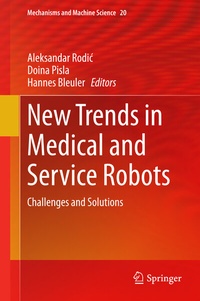
New Trends in Medical and Service Robots
Description

More details
Other editions
Additional editions
Content
Preface.- Robotic Assistance for Senior People for Safe Mobility and Work Support, by D. Eck, F. Leutert, K. Schilling.- The Robot that Learns from the Therapist how to Assist Stroke Patients, by M.D. Kostic, M.D. Popovic, D.B. Popovic.- Lower Limbs Robotic Rehabilitation: A case study with clinical trials, by M. Bouri, E. Abdi, H. Bleuler, F. Reynard and O. Deriaz.- Robot-Assisted 3D Medical Sonography, by P.B. Petrovic, N. Lukic and I. Danilov.- Innovative Approaches Regarding Robots for Brachytherapy, by D. Pisla, N. Plitea, B. Galdau, C. Vaida, B. Gherman.- Markerless Vision-Based Skeleton Tracking in Therapy of Gross Motor Skill Disorders in Children, by B. Karan, S. Golubovic, M. Gnjatovic.- Force Training for Position/Force Control of Massage Robots, by V. Golovin, M. Arkhipov, V. Zhuravlev.- Flexible Bi-Modal Control Modes for Hands-Free Operation of a Wheelchair by Head Movements and Facial Expressions, by. E.J. Rechy-Ramirez and H. Hu.- New Results On Classifying EMG Signals for Interfacing Patients and Mechanical Devices, by G. Gini, L. Cavazzana, F. Mutti, P. Belluco, A. Mauri.- Mathematical Modelling of Human Affective Behavior Aimed to Development Robot EI-Controller, by A. Rodic, K. Addi.- Robot Skill Acquisition by Demonstration and Explorative Learning, by B. Nemec, A. Ude.- Two Faces of Human-Robot Interaction: Field and Service Robots, by R. Ventura.- Advanced Gesture and Pose Recognition Algorithms using Computational Intelligence and Microsoft KINECT Sensor, by D. Katic, P. Radulovic, S. Spasojevic ,Z. Durovic, A. Rodic.- Recursive Design of Dependable Robot Systems for Safety-Critical Applications, by A. Wagner.- Some Applications of Biomimetics and Fractional Calculus in Control and Modeling of (Bio)robotic Systems M.Lazarevic.- Towards Sensor-Less Haptic Teleoperation, by A. Hace, M. Franc.- Incorporation of Artificial Limbs and Role of Haptic Feedback, by A. Sengul, S. Shokur, H. Bleuler.- Offline Imitation of aHuman Motion by a Humanoid Robot Under Balance Constraint, by K. Munirathinam, C. Chevallereau, S. Sakka.- Contributions on the Modeling and Simulation of the Human Knee Joint with Applications to the Robotic Structures, by D. Tarnita, M. Catana, D.N. Tarnita.- How to Control Anthropomimetic Robot - Engineering and Cognitive Approach, by V. Potkonjak, K. Jovanovic and P. Milosavljevic.- Kinematic and Dynamic Modeling of a Parallel Manipulator with Eight Actuation Modes, by S. Caro, D. Chablat, P. Wenger and X. Kong.- Experiences on Service Robots at LARM in Cassino, by M. Ceccarelli, G. Carbone.- Moving from 'How to Go There?' to 'Where to Go?': Towards Increased Autonomy of Mobile Robots, by F. Amigoni, N. Basilico, A. Quattrini Li.- Safety for an Autonomous Bucket Excavator During Typical Landscaping Tasks, by G. Zolynski, D. Schmidt, and K. Berns.- Testing Capacity for Space Technology Suppliers, by A. Pisla, C.Vaida.
