

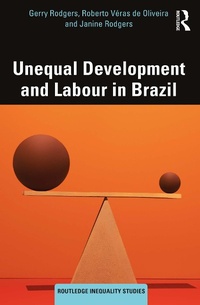
Unequal Development and Labour in Brazil
1st Edition
Published on 30. December 2022
218 pages
978-1-000-82876-4 (ISBN)
Description

This book is about unequal development and labour in Brazil, with particular reference to the economic and social development of the Northeast region, which has suffered persistent disadvantage.
It combines a historical approach, which shows how economic, social and political institutions have been restructured over time, with an analysis of changes in the pattern of production, employment, unemployment and inequality up to the present day. It draws on detailed case studies to examine the connections between local and national production systems and critical labour market outcomes such as informality in employment, precarious work and disparities between genders, races and regions. The case of the Brazilian Northeast illustrates processes, relationships and policy debates that are important not only in Brazil but also elsewhere.
The book will be of interest to teachers, researchers and students in economics, sociology, labour and development; public officials and policy-makers; the international development community; and the general public interested in Latin American affairs. They will find in the book an original and systematic analysis of the factors underlying unequal development and how they respond to different policy regimes and suggestions about the issues that need to be addressed in the future.
It combines a historical approach, which shows how economic, social and political institutions have been restructured over time, with an analysis of changes in the pattern of production, employment, unemployment and inequality up to the present day. It draws on detailed case studies to examine the connections between local and national production systems and critical labour market outcomes such as informality in employment, precarious work and disparities between genders, races and regions. The case of the Brazilian Northeast illustrates processes, relationships and policy debates that are important not only in Brazil but also elsewhere.
The book will be of interest to teachers, researchers and students in economics, sociology, labour and development; public officials and policy-makers; the international development community; and the general public interested in Latin American affairs. They will find in the book an original and systematic analysis of the factors underlying unequal development and how they respond to different policy regimes and suggestions about the issues that need to be addressed in the future.
Reviews / Votes
This book is the result of a long-term and thorough collaborative research project thatneeds to be praised. [...] I would recommend the reading of this book as a priority for all social scientists
interested by the economic, social, and political situation of Brazil and its Northeast region
but also, more widely, to all those working on development policies, regional inequality
issues and the determinant role of labour market and employment conditions to reduce
poverty.
Jean-Luc Maurer, Honorary Professor in Development Studies, The Graduate Institute of International and Development Studies, Geneva
This fine book provides an assessment and analysis of the pattern of unequal development in Brazil, with specific reference to Brazil's Northeast region, which has historically been significantly less developed and poorer than other regions. It is a fascinating, rich and insightful account of both the historical processes that contributed to the "persistent disadvantage" of this region compared with other parts of Brazil, as well as a careful and penetrating analysis of recent policies that either reduced this disadvantage (during the 2003-14 period) or once again led to increasing inequalities (in the period after 2016, in particular). Clearly, therefore, this book will be essential reading for anyone concerned with Brazil's economic development and the living conditions of its people, especially in the Northeast. In fact, the book is much more than that and deserves an even wider audience, providing an object lesson in how to study inequality, both horizontal and vertical. The thoughtful political economy approach and the recognition of the intermingling of different forces are both admirable.
Jayati Ghosh, Professor of Economics, University of Massachusetts, Amherst, USA
This book, authored by Gerry Rodgers, Roberto Veras de Oliveira and Janine Rodgers, is destined to become a reference in both Brazilian and international debates on the country's Northeast region. It covers a wide range of themes and issues related to the dilemmas of unequal social and economic development, seen through the lens of labour regimes and with focus on the Northeast, a persistently disadvantaged region in Brazil. [...] Readers will find particularly interesting the conclusions in Chapter 5, especially Section 3, which discusses issues and scenarios for a possible less unequal future. As can be seen, this book is a must-read.
Adalberto Cardoso, Universidade do Estado do Rio de Janeiro, Brazil, Journal of Latin American Studies (2025), 1-3
More details
Series
Edition
1. Auflage
Language
English
Place of publication
London
United Kingdom
Publishing group
Taylor & Francis Ltd
Target group
College/higher education
Professional and scholarly
Illustrations
23 Tables, black and white; 16 Halftones, black and white; 16 Illustrations, black and white
ISBN-13
978-1-000-82876-4 (9781000828764)
Copyright in bibliographic data and cover images is held by Nielsen Book Services Limited or by the publishers or by their respective licensors: all rights reserved.
Schweitzer Classification
Other editions
Additional editions
Gerry Rodgers | Roberto Veras de Oliveira | Janine Rodgers
Unequal Development and Labour in Brazil
Book
12/2022
1st Edition
Routledge
€58.10
Shipment within 10-20 days
Gerry Rodgers | Roberto Veras de Oliveira | Janine Rodgers
Unequal Development and Labour in Brazil
Book
12/2022
1st Edition
Routledge
€193.13
Shipment within 10-20 days
Persons
Gerry Rodgers has a DPhil in Economic Development from the University of Sussex (1972) and an MA (Cantab) in Economics and Mathematics. He worked at the International Labour Organization in a variety of research and management positions, including Director of the International Institute for Labour Studies. He has mainly worked on poverty, inequality and employment, especially in India and in Latin America, and has published widely on these issues. Presently he is a collaborator of the Laboratory for Studies and Research on Labour and Public Policy at the Federal University of Paraiba in Joao Pessoa, and is also Visiting Professor at the Institute for Human Development, New Delhi.
Roberto Veras de Oliveira has a doctorate in Sociology from the University of Sao Paulo (2002) and undertook post-doctoral work during 2015-2016 at the UCLA Institute for Research on Labor and Employment (Los Angeles). He is presently Full Professor at the Federal University of Paraiba, Joao Pessoa. His research is concerned with the Sociology of Labour, Political Sociology and Economic Sociology. He is a Scholar of the Brazilian National Council for Scientific and Technological Development and a member of its Social Sciences Advisory Committee, and a member of the Coordinating Group of the Network for Studies and Interdisciplinary Monitoring of the Labour Reform.
Janine Rodgers has a Degree in Economics from Paris (1966), an MA in Development Economics from the University of Sussex (1969) and a Certificate in Political Science from the Graduate Institute of International and Development Studies, Geneva (1982). She worked for the International Labour Organization on labour market inequalities, on gender issues and on crises. She has been Deputy Executive Secretary of the European Association of Development Research and Training Institutes (EADI). She is currently a collaborator of the Laboratory for Studies and Research on Labour and Public Policy at the Federal University of Paraiba, Joao Pessoa, and a Visiting Senior Research Fellow at the Institute for Human Development, New Delhi.
Roberto Veras de Oliveira has a doctorate in Sociology from the University of Sao Paulo (2002) and undertook post-doctoral work during 2015-2016 at the UCLA Institute for Research on Labor and Employment (Los Angeles). He is presently Full Professor at the Federal University of Paraiba, Joao Pessoa. His research is concerned with the Sociology of Labour, Political Sociology and Economic Sociology. He is a Scholar of the Brazilian National Council for Scientific and Technological Development and a member of its Social Sciences Advisory Committee, and a member of the Coordinating Group of the Network for Studies and Interdisciplinary Monitoring of the Labour Reform.
Janine Rodgers has a Degree in Economics from Paris (1966), an MA in Development Economics from the University of Sussex (1969) and a Certificate in Political Science from the Graduate Institute of International and Development Studies, Geneva (1982). She worked for the International Labour Organization on labour market inequalities, on gender issues and on crises. She has been Deputy Executive Secretary of the European Association of Development Research and Training Institutes (EADI). She is currently a collaborator of the Laboratory for Studies and Research on Labour and Public Policy at the Federal University of Paraiba, Joao Pessoa, and a Visiting Senior Research Fellow at the Institute for Human Development, New Delhi.
Content
List of map and graphs. List of tables. Preface. Acronyms. Chapter 1. A focus on the Northeast. Chapter 2. The historical trajectory. Chapter 3. The labour regime. Chapter 4. Diversity in production systems and labour relations. Chapter 5. Towards a more equal development. Index.
