

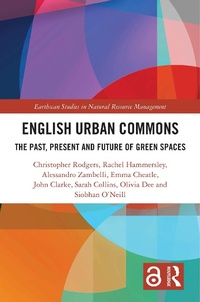
English Urban Commons
The Past, Present and Future of Green Spaces
1st Edition
Published on 28. November 2023
264 pages
978-1-000-99994-5 (ISBN)
Description

This book presents a novel examination of urban commons which provides a robust base for education initiatives and future public policy guidance on the protection and use of urban commons as invaluable urban green spaces that offer a diverse cultural and ecological resource for future communities.
This book's central argument is that only through a deep understanding of the past and a rigorous engagement with present users can we devise new futures or imaginaries of culture, well-being and diversity for the urban commons. It argues that understanding the genesis of, and interactions between, the different pressures on urban green space has important policy implications for the delivery of nature conservation, recreational access and other land use priorities. The stakeholders in today's urban commons, whether land users, policy makers or the public, are the inheritors of a complex cultural legacy and must negotiate diverse and sometimes conflicting objectives in their pursuit of a potentially unifying goal: a secure future for our urban commons. This book offers a unique and strongly interdisciplinary study of urban commons, one that brings together original historical investigation, contemporary legal scholarship, extensive oral history research with user groups and research examining the imagined futures for the urban common in modern society. It explores the complex social and political history of the urban common, as well as its legal and cultural status today, using four diverse case studies from within England as exemplars of the distinctively urban common. These are Town Moor in Newcastle, Mousehold Heath in Norwich, Clifton and Durdham Downs in Bristol and Valley Gardens in Brighton. This book concludes by looking forward and considering new tools and methods of negotiation, inclusivity and creativity to inform the future of these case studies, and of urban commons more widely.
This book will be of great interest to students and scholars of the commons, green spaces, urban planning, environmental and urban geography, environmental studies and natural resource management.
The Open Access version of this book, available at www.taylorfrancis.com, has been made available under a Creative Commons [Attribution-Non Commercial-No Derivatives (CC-BY-NC-ND)] 4.0 license.
This book's central argument is that only through a deep understanding of the past and a rigorous engagement with present users can we devise new futures or imaginaries of culture, well-being and diversity for the urban commons. It argues that understanding the genesis of, and interactions between, the different pressures on urban green space has important policy implications for the delivery of nature conservation, recreational access and other land use priorities. The stakeholders in today's urban commons, whether land users, policy makers or the public, are the inheritors of a complex cultural legacy and must negotiate diverse and sometimes conflicting objectives in their pursuit of a potentially unifying goal: a secure future for our urban commons. This book offers a unique and strongly interdisciplinary study of urban commons, one that brings together original historical investigation, contemporary legal scholarship, extensive oral history research with user groups and research examining the imagined futures for the urban common in modern society. It explores the complex social and political history of the urban common, as well as its legal and cultural status today, using four diverse case studies from within England as exemplars of the distinctively urban common. These are Town Moor in Newcastle, Mousehold Heath in Norwich, Clifton and Durdham Downs in Bristol and Valley Gardens in Brighton. This book concludes by looking forward and considering new tools and methods of negotiation, inclusivity and creativity to inform the future of these case studies, and of urban commons more widely.
This book will be of great interest to students and scholars of the commons, green spaces, urban planning, environmental and urban geography, environmental studies and natural resource management.
The Open Access version of this book, available at www.taylorfrancis.com, has been made available under a Creative Commons [Attribution-Non Commercial-No Derivatives (CC-BY-NC-ND)] 4.0 license.
More details
Series
Edition
1. Auflage
Language
English
Place of publication
London
United Kingdom
Publishing group
Taylor & Francis Ltd
Target group
College/higher education
Professional and scholarly
Illustrations
30 Halftones, black and white; 30 Illustrations, black and white
File size
20,42 MB
ISBN-13
978-1-000-99994-5 (9781000999945)
Copyright in bibliographic data and cover images is held by Nielsen Book Services Limited or by the publishers or by their respective licensors: all rights reserved.
Schweitzer Classification
Other editions
Additional editions
Christopher Rodgers | Rachel Hammersley | Alessandro Zambelli
English Urban Commons
The Past, Present and Future of Green Spaces
Book
04/2025
1st Edition
Routledge
€67.50
Shipment within 10-20 days
Christopher Rodgers | Rachel Hammersley | Alessandro Zambelli
English Urban Commons
The Past, Present and Future of Green Spaces
Book
11/2023
1st Edition
Routledge
€206.60
Shipment within 10-20 days
Persons
Christopher Rodgers is an Emeritus Professor of Law at Newcastle University, UK.
Rachel Hammersley is Professor of Intellectual History in the School of History, Classics and Archaeology at Newcastle University, UK.
Alessandro Zambelli is a Reader in Architecture at the University of Portsmouth, UK.
Emma Cheatle is Senior Lecturer in Architecture at the University of Sheffield, UK.
John Clarke is an Associate Professor of Creative Writing and Academic Director for Arts and Culture at the University of Exeter, UK.
Sarah Collins is a Research Associate in History in the School of History, Classics and Archaeology at Newcastle University, UK.
Olivia Dee was a Research Associate in Oral History at Newcastle University. She is now a Research Fellow at Queen's University Belfast, UK.
Siobhan O'Neill is an applied performance practitioner and a Research Fellow at Portsmouth School of Architecture, UK.
Rachel Hammersley is Professor of Intellectual History in the School of History, Classics and Archaeology at Newcastle University, UK.
Alessandro Zambelli is a Reader in Architecture at the University of Portsmouth, UK.
Emma Cheatle is Senior Lecturer in Architecture at the University of Sheffield, UK.
John Clarke is an Associate Professor of Creative Writing and Academic Director for Arts and Culture at the University of Exeter, UK.
Sarah Collins is a Research Associate in History in the School of History, Classics and Archaeology at Newcastle University, UK.
Olivia Dee was a Research Associate in Oral History at Newcastle University. She is now a Research Fellow at Queen's University Belfast, UK.
Siobhan O'Neill is an applied performance practitioner and a Research Fellow at Portsmouth School of Architecture, UK.
Content
1. Introduction: The Urban Common as "Common" Space
Part I: The English Urban Common: Four Case Studies
2. Town Moor, Newcastle upon Tyne
3. Mousehold Heath, Norwich
4. Clifton and Durdham Downs, Bristol
5. Valley Gardens, Brighton
Part II: The Urban Common as a Contested Common Space
6. Land Use and the Culture of the Urban Commons: Continuity and Change
7. Conflict and the Contested Common
Part III: The Future of the Urban Common
8. "Urban" or "Urbane"? Models for Governance and Property Rights in the "Urban" Commons
9. Present Voices, Future Directions
10. Whispers of Better Things - Re-Imagining the Future of the "Urban" Common
Part I: The English Urban Common: Four Case Studies
2. Town Moor, Newcastle upon Tyne
3. Mousehold Heath, Norwich
4. Clifton and Durdham Downs, Bristol
5. Valley Gardens, Brighton
Part II: The Urban Common as a Contested Common Space
6. Land Use and the Culture of the Urban Commons: Continuity and Change
7. Conflict and the Contested Common
Part III: The Future of the Urban Common
8. "Urban" or "Urbane"? Models for Governance and Property Rights in the "Urban" Commons
9. Present Voices, Future Directions
10. Whispers of Better Things - Re-Imagining the Future of the "Urban" Common
