

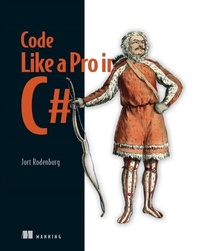
Code like a Pro in C
1st Edition
Published on 24. August 2021
416 pages
978-1-63835-641-7 (ISBN)
Description

Build on your existing programming skills and upskill to professional-level C# programming.
Summary
In Code Like A Pro in C# you will learn:
Unit testing and test-driven development
Refactor a legacy .NET codebase
Principles of clean code
Essential backend architecture skills
Query and manipulate databases with LINQ and Entity Framework Core
Critical business applications worldwide are written in the versatile C# language and the powerful .NET platform, running on desktops, cloud systems, and Windows or Linux servers. Code Like a Pro in C# makes it easy to turn your existing abilities in C# or another OO language (such as Java) into practical C# mastery. There's no "Hello World" or Computer Science 101 basics-you'll learn by refactoring an out-of-date legacy codebase, using new techniques, tools, and best practices to bring it up to modern C# standards.
Purchase of the print book includes a free eBook in PDF, Kindle, and ePub formats from Manning Publications.
About the technology
You know the basics, now get ready for the next step! Pro-quality C# code is efficient, clean, and fast. Whether you're building user-facing business applications or writing data-intensive backend services, the experience-based, practical techniques in this book will take your C# skills to a new level.
About the book
Code Like a Pro in C# teaches you to how write clean C# code that's suitable for enterprise applications. In this book, you'll refactor a legacy codebase by applying modern C# techniques. You'll explore tools like Entity Framework Core, design techniques like dependency injection, and key practices like testing and clean coding. It's a perfect path to upgrade your existing C# skills or shift from another OO language into C# and the .NET ecosystem.
What's inside
Unit testing and test-driven development
Refactor a legacy .NET codebase
Principles of clean code
Query and manipulate databases with LINQ and Entity Framework Core
About the reader
For developers experienced with object-oriented programming. No C# experience required.
About the author
Jort Rodenburg is a software engineer who has taught numerous courses on getting up to speed with C# and .NET.
Table of Contents
PART 1 USING C# AND .NET
1 Introducing C# and .NET
2 .NET and how it compiles
PART 2 THE EXISTING CODEBASE
3 How bad is this code?
4 Manage your unmanaged resources!
PART 3 THE DATABASE ACCESS LAYER
5 Setting up a project and database with Entity Framework Core
PART 4 THE REPOSITORY LAYER
6 Test-driven development and dependency injection
7 Comparing objects
8 Stubbing, generics, and coupling
9 Extension methods, streams, and abstract classes
PART 5 THE SERVICE LAYER
10 Reflection and mocks
11 Runtime type checking revisited and error handling
12 Using IAsyncEnumerable and yield return
PART 6 THE CONTROLLER LAYER
13 Middleware, HTTP routing, and HTTP responses
14 JSON serialization/deserialization and custom model binding
Summary
In Code Like A Pro in C# you will learn:
Unit testing and test-driven development
Refactor a legacy .NET codebase
Principles of clean code
Essential backend architecture skills
Query and manipulate databases with LINQ and Entity Framework Core
Critical business applications worldwide are written in the versatile C# language and the powerful .NET platform, running on desktops, cloud systems, and Windows or Linux servers. Code Like a Pro in C# makes it easy to turn your existing abilities in C# or another OO language (such as Java) into practical C# mastery. There's no "Hello World" or Computer Science 101 basics-you'll learn by refactoring an out-of-date legacy codebase, using new techniques, tools, and best practices to bring it up to modern C# standards.
Purchase of the print book includes a free eBook in PDF, Kindle, and ePub formats from Manning Publications.
About the technology
You know the basics, now get ready for the next step! Pro-quality C# code is efficient, clean, and fast. Whether you're building user-facing business applications or writing data-intensive backend services, the experience-based, practical techniques in this book will take your C# skills to a new level.
About the book
Code Like a Pro in C# teaches you to how write clean C# code that's suitable for enterprise applications. In this book, you'll refactor a legacy codebase by applying modern C# techniques. You'll explore tools like Entity Framework Core, design techniques like dependency injection, and key practices like testing and clean coding. It's a perfect path to upgrade your existing C# skills or shift from another OO language into C# and the .NET ecosystem.
What's inside
Unit testing and test-driven development
Refactor a legacy .NET codebase
Principles of clean code
Query and manipulate databases with LINQ and Entity Framework Core
About the reader
For developers experienced with object-oriented programming. No C# experience required.
About the author
Jort Rodenburg is a software engineer who has taught numerous courses on getting up to speed with C# and .NET.
Table of Contents
PART 1 USING C# AND .NET
1 Introducing C# and .NET
2 .NET and how it compiles
PART 2 THE EXISTING CODEBASE
3 How bad is this code?
4 Manage your unmanaged resources!
PART 3 THE DATABASE ACCESS LAYER
5 Setting up a project and database with Entity Framework Core
PART 4 THE REPOSITORY LAYER
6 Test-driven development and dependency injection
7 Comparing objects
8 Stubbing, generics, and coupling
9 Extension methods, streams, and abstract classes
PART 5 THE SERVICE LAYER
10 Reflection and mocks
11 Runtime type checking revisited and error handling
12 Using IAsyncEnumerable and yield return
PART 6 THE CONTROLLER LAYER
13 Middleware, HTTP routing, and HTTP responses
14 JSON serialization/deserialization and custom model binding
More details
Other editions
Additional editions
Jort Rodenburg
Code Like a Pro in C#
Book
09/2021
Manning Publications
€56.00
Article not available at the moment
Person
Jort Rodenburg is a software engineer specializing in C#. He has built software for numerous fields, from financial compliance to inkjet printing. Jort has mentored and taught courses on object-oriented programming to help developers get up to speed with C# and .NET.
Content
- Intro
- inside front cover
- Clean Code Checklist
- Code like a Pro in C#
- Copyright
- contents
- front matter
- preface
- acknowledgments
- about this book
- Who should read this book
- How this book is organized: A roadmap
- About the code
- liveBook discussion forum
- about the author
- about the cover illustration
- Part 1 Using C# and .NET
- 1 Introducing C# and .NET
- 1.1 Why work in C#?
- 1.1.1 Reason 1: C# is economical
- 1.1.2 Reason 2: C# is maintainable
- 1.1.3 Reason 3: C# is developer friendly and easy to use
- 1.2 Why not work in C#?
- 1.2.1 Operating system development
- 1.2.2 Real-time operating system embedded development in C#
- 1.2.3 Numerical computing and C#
- 1.3 Switching to C#
- 1.4 What you will learn in this book
- 1.5 What you will not learn in this book
- Summary
- 2 .NET and how it compiles
- 2.1 What is the .NET Framework?
- 2.2 What is .NET 5?
- Exercises
- 2.3 How CLI-compliant languages are compiled
- 2.3.1 Step 1: C# code (high-level)
- 2.3.2 Step 2: Common Intermediate Language (assembly level)
- 2.3.3 Step 3: Native code (processor level)
- Exercises
- Summary
- Part 2 The existing codebase
- 3 How bad is this code?
- 3.1 Introducing Flying Dutchman Airlines
- 3.2 Pieces of the puzzle: Taking a look at our requirements
- 3.2.1 Object-relational mapping
- 3.2.2 The GET /flight endpoint: Retrieving information on all flights
- 3.2.3 The GET /flight/{flightNumber} endpoint: Getting specific flight information
- 3.2.4 The POST /booking/{flightNumber} endpoint: Booking a flight
- 3.3 Coming to terms with the existing codebase
- 3.3.1 Assessing the existing database schema and its tables
- 3.3.2 The existing codebase: Web service configuration files
- 3.3.3 Considering models and views in the existing codebase
- Summary
- 4 Manage your unmanaged resources!
- 4.1 The FlightController: Assessing the GET /flight endpoint
- 4.1.1 The GET /flight endpoint and what it does
- 4.1.2 Method signature: The meaning of ResponseType and typeof
- 4.1.3 Collecting flight information with collections
- 4.1.4 Connection strings, or how to give a security engineer a heart attack
- 4.1.5 Using IDisposable to release unmanaged resources
- 4.1.6 Querying a database with SqlCommand
- 4.2 The FlightController: Assessing GET /flight/{flightNumber}
- 4.3 The FlightController: POST /flight
- 4.4 The FlightController: DELETE /flight/{flightNumber}
- Exercises
- Summary
- Part 3 The database access layer
- 5 Setting up a project and database with Entity Framework Core
- 5.1 Creating a .NET 5 solution and project
- 5.2 Setting up and configuring a web service
- 5.2.1 Configuring a .NET 5 web service
- 5.2.2 Creating and using HostBuilder
- 5.2.3 Implementing the Startup class
- 5.2.4 Using the repository/service pattern for our web service architecture
- 5.3 Implementing the database access layer
- 5.3.1 Entity Framework Core and reverse-engineering
- 5.3.2 DbSet and the Entity Framework Core workflow
- 5.3.3 Configuration methods and environment variables
- 5.3.4 Setting an environment variable on Windows
- 5.3.5 Setting an environment variable on macOS
- 5.3.6 Retrieving environment variables at run time in your code
- Exercises
- Summary
- Part 4 The repository layer
- 6 Test-driven development and dependency injection
- 6.1 Test-driven development
- Exercises
- 6.2 The CreateCustomer method
- 6.2.1 Why you should always validate input arguments
- 6.2.2 Using "arrange, act, assert" to write unit tests
- 6.2.3 Validating against invalid characters
- 6.2.4 In-lining test data with the [DataRow] attribute
- 6.2.5 Object initializers and autogenerated code
- 6.2.6 Constructors, reflection, and asynchronous programming
- 6.2.7 Locks, mutexes, and semaphores
- 6.2.8 Synchronous to asynchronous execution . . . continued
- 6.2.9 Testing Entity Framework Core
- 6.2.10 Controlling dependencies with dependency injection
- Exercises
- Summary
- 7 Comparing objects
- 7.1 The GetCustomerByName method
- 7.1.1 Question marks: Nullable types and their applications
- 7.1.2 Custom exceptions, LINQ, and extension methods
- 7.2 Congruence: From the Middle Ages to C#
- 7.2.1 Creating a "comparer" class using EqualityComparer&T&
- 7.2.2 Testing equality by overriding the Equals method
- 7.2.3 Overloading the equality operator
- Exercises
- Summary
- 8 Stubbing, generics, and coupling
- 8.1 Implementing the Booking repository
- 8.2 Input validation, separation of concerns, and coupling
- Exercises
- 8.3 Using object initializers
- 8.4 Unit testing with stubs
- 8.5 Programming with generics
- 8.6 Providing default arguments by using optional parameters
- 8.7 Conditionals, Func, switches, and switch expressions
- 8.7.1 The ternary conditional operator
- 8.7.2 Branching using an array of functions
- 8.7.3 Switch statements and expressions
- 8.7.4 Querying for pending changes in Entity Framework Core
- Exercises
- Summary
- 9 Extension methods, streams, and abstract classes
- 9.1 Implementing the Airport repository
- 9.2 Getting an Airport out of the database by its ID
- 9.3 Validating the AirportID input parameter
- 9.4 Output streams and being specifically abstract
- 9.5 Querying the database for an Airport object
- 9.6 Implementing the Flight repository
- 9.6.1 The IsPositive extension method and "magic numbers"
- 9.6.2 Getting a flight out of the database
- Exercises
- Summary
- Part 5 The service layer
- 10 Reflection and mocks
- 10.1 The repository/service pattern revisited
- 10.1.1 What is the use of a service class?
- Exercises
- 10.2 Implementing the CustomerService
- 10.2.1 Setting up for success: Creating skeleton classes
- 10.2.2 How to delete your own code
- Exercises
- 10.3 Implementing the BookingService
- 10.3.1 Unit testing across architectural layers
- 10.3.2 The difference between a stub and a mock
- 10.3.3 Mocking a class with the Moq library
- 10.3.4 Calling a repository from a service
- Exercises
- Summary
- 11 Runtime type checking revisited and error handling
- 11.1 Validating input parameters of a service layer method
- 11.1.1 Runtime type checks with the is and as operators
- 11.1.2 Type checking with the is operator
- 11.1.3 Type checking with the as operator
- 11.1.4 What did we do in section 11.1?
- 11.2 Cleaning up the BookingServiceTests class
- 11.3 Foreign key constraints in service classes
- 11.3.1 Calling the Flight repository from a service class
- Exercises
- Summary
- 12 Using IAsyncEnumerable&T& and yield return
- 12.1 Do we need an AirportService class?
- 12.2 Implementing the FlightService class
- 12.2.1 Getting information on a specific flight from the FlightRepository
- 12.2.2 Combining two data streams into a view
- 12.2.3 Using the yield return keywords with try-catch code blocks
- 12.2.4 Implementing GetFlightByFlightNumber
- Exercises
- Summary
- Part 6 The controller layer
- 13 Middleware, HTTP routing, and HTTP responses
- 13.1 The controller class within the repository/service pattern
- 13.2 Determining what controllers to implement
- 13.3 Implementing the FlightController
- 13.3.1 Returning HTTP responses with the IActionResult interface (GetFlights)
- 13.3.2 Injecting dependencies into a controller using middleware
- 13.3.3 Implementing the GET /Flight/{FlightNumber} endpoint
- 13.4 Routing HTTP requests to controllers and methods
- Exercises
- Summary
- 14 JSON serialization/ deserialization and custom model binding
- 14.1 Implementing the BookingController class
- 14.1.1 Introduction to data deserialization
- 14.1.2 Using the [FromBody] attribute to deserialize incoming HTTP data
- 14.1.3 Using a custom model binder and method attribute for model binding
- 14.1.4 Implementing the CreateBooking endpoint method logic
- 14.2 Acceptance testing and Swagger middleware
- 14.2.1 Manual acceptance testing with an OpenAPI specification
- 14.2.2 Generating an OpenAPI specification at runtime
- 14.3 The end of the road
- Summary
- appendix A Exercise answers
- Chapter 2: .NET and how it compiles
- Chapter 4: Manage your unmanaged resources!
- Chapter 5: Setting up a project and database with Entity Framework Core
- Chapter 6: Test-driven development and dependency injection
- Chapter 7: Comparing objects
- Chapter 8: Stubbing, generics, and coupling
- Chapter 9: Extension methods, streams, and abstract classes
- Chapter 10: Reflection and mocks
- Chapter 11: Runtime type checking revisited and error handling
- Chapter 12: Using IAsyncEnumerable&T& and yield return
- Chapter 13: Middleware, HTTP routing, and HTTP responses
- appendix B Clean code checklist
- appendix C Installation guides
- appendix D OpenAPI FlyTomorrow
- appendix E Reading list
- index
- inside back cover
- Clean Code Checklist
