

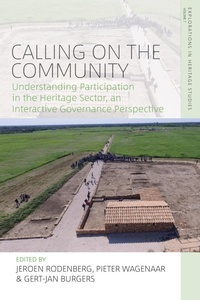
Calling on the Community
Understanding Participation in the Heritage Sector, an Interactive Governance Perspective
1st Edition
Published on 13. January 2023
290 pages
978-1-80073-839-3 (ISBN)
Description

There is a call in Heritage Studies to democratize heritage practices and place local communities at the forefront; heritage plays an important role in identity formation, and therefore in social inclusion and exclusion. Public participation is often presented as the primary means to prioritize communities. However, studies focusing on public participation are typically descriptive in nature and lack a strong analytical framework that enables us to understand participation. The essays in this volume apply Public Administration theory to collaborative governance and thus contribute to a better understanding of public participation in the heritage sector.
Reviews / Votes
"This volume of papers makes a significant contribution to new critical frameworks for understanding and shaping participative practice in heritage work, applying theories of public administration and governance networks towards innovative insights and solutions." * Gill Chitty, University of YorkMore details
Series
Edition
1. Auflage
Language
English
Place of publication
Oxford
United Kingdom
Target group
Professional and scholarly
Illustrations
Bibliography; Index; 24 Illustrations
ISBN-13
978-1-80073-839-3 (9781800738393)
DOI
10.3167/9781800738386
Copyright in bibliographic data and cover images is held by Nielsen Book Services Limited or by the publishers or by their respective licensors: all rights reserved.
Schweitzer Classification
Other editions
Additional editions
Jeroen Rodenberg | Pieter Wagenaar | Gert-Jan Burgers
Calling on the Community
Understanding Participation in the Heritage Sector, an Interactive Governance Perspective
Book
approx. 06/2026
Berghahn Books
€35.00
Shipment within 3-4 weeks
Jeroen Rodenberg | Pieter Wagenaar | Gert-Jan Burgers
Calling on the Community
Understanding Participation in the Heritage Sector, an Interactive Governance Perspective
Book
01/2023
Berghahn Books
€145.70
Shipment within 3-4 weeks
Persons
Jeroen Rodenberg is a lecturer and PhD candidate at the Department of Public Administration and Political Sciences, Vrije Universiteit Amsterdam. His research interests are heritage governance and policy and the history of public administration. He is involved in the pan-European research and training project on heritage planning Heriland.
Content
List of Illustrations
Introduction
Jeroen Rodenberg, Pieter Wagenaar and Gert-Jan Burgers
Part I: Framework: Theories of Heritage, Public Administration and Political Science
Chapter 1. Understanding the Governance of Heritage: A plea for Using Public Administration Theories in Heritage Studies
Jeroen Rodenberg and Pieter Wagenaar
Chapter 2. Interacting with Governance: A Public Administration Perspective on Interactive Governance for the Heritage Studies
Pieter Wagenaar and Jeroen Rodenberg
Chapter 3. From 'Democratic Turn' to 'Agnostic Approach': Understanding Participation from the Perspective of Mouffe's Agonistic Pluralism
Jarik Chambille
Part II: Top-Down Closed Interactive Heritage Governance: Stakeholder Participation
Chapter 4. Building a Community of Practice in a Heritage Landscape
Rob Collins, Graham Fairclough and Sam Turner
Chapter 5. Crafting Castella: Why Interactive Governance Led to Success in Reconstructing a Castellum in Utrecht, but not in Leiden
Eline Amsing, Pieter Wagenaar, Jeroen Rodenberg and Hans Renes
Chapter 6. Participatory Heritage Planning Policy in Coastal Europe: Lessons from the HERICOAST Project
Linde Egberts
Part III: Top-Down Open Interactive Heritage Governance: Citizen Participation
Chapter 7. Heritage and Co-Production? Evaluating the Legacy of Participating in Community Archaeology in the UK
Cath Neal
Chapter 8. Barriers to Public Participation in Memorialization Processes: Evidence from Holocaust Memorial of Names
Alana Castro de Azevedo
Chapter 9. Delisting Dresden: Bridging Local Interests and International Obligations
Bart Zwegers
Part IV: Bottom-Up Open Interactive Heritage Governance: Governing the Public Good and Common Pool Resources
Chapter 10. White Lions in South Africa: A Living Heritage
Jason Turner and Harry Wels
Part V: Bottom-Up Closed Interactive Heritage Governance: Governing Common Pool Resources
Chapter 11. Rethinking Ecomuseology: The Ecomuseo della Via Appia in the south of Italy
Gert-Jan Burgers, Christian Napolitano and Ilaria Ricci
Chapter 12. Participation as an Effective Way to Counter Authorized Heritage Discourse?
Nana Zheng and Gert-Jan Burgers
Conclusion
Pieter Wagenaar and Jeroen Rodenberg
Index
Introduction
Jeroen Rodenberg, Pieter Wagenaar and Gert-Jan Burgers
Part I: Framework: Theories of Heritage, Public Administration and Political Science
Chapter 1. Understanding the Governance of Heritage: A plea for Using Public Administration Theories in Heritage Studies
Jeroen Rodenberg and Pieter Wagenaar
Chapter 2. Interacting with Governance: A Public Administration Perspective on Interactive Governance for the Heritage Studies
Pieter Wagenaar and Jeroen Rodenberg
Chapter 3. From 'Democratic Turn' to 'Agnostic Approach': Understanding Participation from the Perspective of Mouffe's Agonistic Pluralism
Jarik Chambille
Part II: Top-Down Closed Interactive Heritage Governance: Stakeholder Participation
Chapter 4. Building a Community of Practice in a Heritage Landscape
Rob Collins, Graham Fairclough and Sam Turner
Chapter 5. Crafting Castella: Why Interactive Governance Led to Success in Reconstructing a Castellum in Utrecht, but not in Leiden
Eline Amsing, Pieter Wagenaar, Jeroen Rodenberg and Hans Renes
Chapter 6. Participatory Heritage Planning Policy in Coastal Europe: Lessons from the HERICOAST Project
Linde Egberts
Part III: Top-Down Open Interactive Heritage Governance: Citizen Participation
Chapter 7. Heritage and Co-Production? Evaluating the Legacy of Participating in Community Archaeology in the UK
Cath Neal
Chapter 8. Barriers to Public Participation in Memorialization Processes: Evidence from Holocaust Memorial of Names
Alana Castro de Azevedo
Chapter 9. Delisting Dresden: Bridging Local Interests and International Obligations
Bart Zwegers
Part IV: Bottom-Up Open Interactive Heritage Governance: Governing the Public Good and Common Pool Resources
Chapter 10. White Lions in South Africa: A Living Heritage
Jason Turner and Harry Wels
Part V: Bottom-Up Closed Interactive Heritage Governance: Governing Common Pool Resources
Chapter 11. Rethinking Ecomuseology: The Ecomuseo della Via Appia in the south of Italy
Gert-Jan Burgers, Christian Napolitano and Ilaria Ricci
Chapter 12. Participation as an Effective Way to Counter Authorized Heritage Discourse?
Nana Zheng and Gert-Jan Burgers
Conclusion
Pieter Wagenaar and Jeroen Rodenberg
Index
