

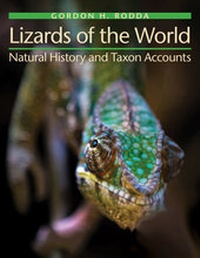
Lizards of the World
Natural History and Taxon Accounts
Published on 27. October 2020
832 pages
978-1-4214-3824-5 (ISBN)
Description

The first, definitive reference on the natural history and ecology of every one of the known 6500+ species of lizards, spanning the entire globe.
Our planet is literally crawling with lizards. More than 6500 species are known to science, and new species are being discovered annually. In this monumental work, eminent researcher Gordon Rodda has created the first compilation of the natural histories of all the world's lizards and amphisbaenians, as well as the Tuatara. Although other books have attempted to survey the scope of adaptations present in the world's lizards, only Rodda has been able to quantify and summarize all species or higher taxa.
Analyzing the relationships among traits such as morphologic characteristics, reproductive strategies, and food sources, Rodda uncovers novel insights into reptile ecology. Identifying 14 recurring character syndromes across all the world's lizards, he proposes a new lens for categorization. He also touches on
common names
geographic range
length
mass
age
maturation
differences between the sexes
nominal variables, including diel activity cycle and foraging mode
home range
predator avoidance tactics
thermal biology
social spacing
climate envelope
habitat and microhabitat
reproduction
parental care
diet
population density
conservation status
ecological business models
Rodda's alphabetical taxon accounts provide an instantly retrievable sketch of every species, genus, and family. Outlining more than 1500 statistically significant associations extracted from a data matrix composed of more than 300 conditions tabulated-to the extent known-for all 6528 species of lizards, Lizards of the World will be the go-to source for the next generation of reptile ecologists, as well as herpetology students and serious herpetoculturists.
Our planet is literally crawling with lizards. More than 6500 species are known to science, and new species are being discovered annually. In this monumental work, eminent researcher Gordon Rodda has created the first compilation of the natural histories of all the world's lizards and amphisbaenians, as well as the Tuatara. Although other books have attempted to survey the scope of adaptations present in the world's lizards, only Rodda has been able to quantify and summarize all species or higher taxa.
Analyzing the relationships among traits such as morphologic characteristics, reproductive strategies, and food sources, Rodda uncovers novel insights into reptile ecology. Identifying 14 recurring character syndromes across all the world's lizards, he proposes a new lens for categorization. He also touches on
common names
geographic range
length
mass
age
maturation
differences between the sexes
nominal variables, including diel activity cycle and foraging mode
home range
predator avoidance tactics
thermal biology
social spacing
climate envelope
habitat and microhabitat
reproduction
parental care
diet
population density
conservation status
ecological business models
Rodda's alphabetical taxon accounts provide an instantly retrievable sketch of every species, genus, and family. Outlining more than 1500 statistically significant associations extracted from a data matrix composed of more than 300 conditions tabulated-to the extent known-for all 6528 species of lizards, Lizards of the World will be the go-to source for the next generation of reptile ecologists, as well as herpetology students and serious herpetoculturists.
More details
Language
English
Place of publication
Baltimore
United States
Target group
Professional and scholarly
Illustrations
12 s/w Zeichnungen, 69 farbige Abbildungen, 69 s/w Abbildungen
69 Illustrations, black and white; 71 Illustrations, color; 12 Line drawings, black and white
File size
296,12 MB
ISBN-13
978-1-4214-3824-5 (9781421438245)
DOI
10.1353/book.77487
Copyright in bibliographic data and cover images is held by Nielsen Book Services Limited or by the publishers or by their respective licensors: all rights reserved.
Schweitzer Classification
Other editions
Additional editions
Book
10/2020
Johns Hopkins University Press
€154.50
Article not available at the moment
Person
Gordon H. Rodda is a zoologist emeritus at the United States Geological Survey's Fort Collins Science Center. He is a coeditor of Problem Snake Management: The Habu and Brown Treesnake.
Content
Chapter 1. Introduction and Methods
The Interplay between Ecological and Phylogenetic Causation
Definitions
Size Estimation
Analytical Methods
Chapter 2. What Are Lizards?
Composition
Morphology
Sexually Differing Traits
Geography
Activity
Reproduction
Diet
Populations
The Modal Lizard
Chapter 3. Linkages
Methods Unique to This Chapter
Mass
Morphology
Sexual Size Dimorphism
Color
Diet
Foraging
Time of Day (Diel Activity)
Predator Concealment Tactics
Microhabitat
Reproduction Allocation
Islands
Longevity
Population Density/Biomass
Introductions
Imperiled Lizards
Next Steps
Chapter 4. Ecological Business Models
Crack Hermit
Diurnal Canopy Walker
Giant Herbivore
Glider
Ground-foraging Tree Lizard
Immobility Expert
Litter Cryptozoid
Nocturnal Canopy Walker
Nocturnal Ground Lizard
Refugia-anchored Diurnal Ground Lizard
Sand Shark
Subterranean Forager
Trunk/Wall Lizard
Wide-ranging Chemosensor
Overview of Ecological Business Models
Chapter 5. Taxon Accounts
(alphabetical by family or genus name; use index to search by English name)
A (Ablepharus to Australolacerta)
B (Bachia to Bunopus)
C (Cadeidae and Cadea to Cyrtopodion)
D (Dactylocnemis to Dryadosaura)
E (Ebenavia to Exila)
F (Feylinia to Furcifer)
G (Gallotia to Gymnophthalmus)
H (Haackgreerius to Hypsilurus)
I (Iberolacerta to Isopachys)
J (Janetaescincus to Jarujinia)
K (Kaestlea to Kolekanos)
L (Lacerta to Lyriocephalus)
M (Mabuya to Morunasaurus)
N (Nactus to Nucras)
O (Oedodera to Ouroborus)
P (Pachycalamus to Pygopus)
Q (Quedenfeldtia)
R (Ramigekko to Rondonops)
S (Saara to Strophurus)
T (Tachygyia to Tytthoscincus)
U (Uma to Uvidicolus)
V (Vanzosaura to Voeltzkowia)
W (Woodworthia)
X (Xantusia to Xenosauridae and Xenosaurus)
Z (Zonosaurus to Zygaspis)
Acknowledgments
Appendices
A. Database Fields and Comments on Their Tabulation
B. Methods for Quantifying Lizard Sizes
C. Standards for Qualification of Absolute Population Densities
Literature Cited
Index
The Interplay between Ecological and Phylogenetic Causation
Definitions
Size Estimation
Analytical Methods
Chapter 2. What Are Lizards?
Composition
Morphology
Sexually Differing Traits
Geography
Activity
Reproduction
Diet
Populations
The Modal Lizard
Chapter 3. Linkages
Methods Unique to This Chapter
Mass
Morphology
Sexual Size Dimorphism
Color
Diet
Foraging
Time of Day (Diel Activity)
Predator Concealment Tactics
Microhabitat
Reproduction Allocation
Islands
Longevity
Population Density/Biomass
Introductions
Imperiled Lizards
Next Steps
Chapter 4. Ecological Business Models
Crack Hermit
Diurnal Canopy Walker
Giant Herbivore
Glider
Ground-foraging Tree Lizard
Immobility Expert
Litter Cryptozoid
Nocturnal Canopy Walker
Nocturnal Ground Lizard
Refugia-anchored Diurnal Ground Lizard
Sand Shark
Subterranean Forager
Trunk/Wall Lizard
Wide-ranging Chemosensor
Overview of Ecological Business Models
Chapter 5. Taxon Accounts
(alphabetical by family or genus name; use index to search by English name)
A (Ablepharus to Australolacerta)
B (Bachia to Bunopus)
C (Cadeidae and Cadea to Cyrtopodion)
D (Dactylocnemis to Dryadosaura)
E (Ebenavia to Exila)
F (Feylinia to Furcifer)
G (Gallotia to Gymnophthalmus)
H (Haackgreerius to Hypsilurus)
I (Iberolacerta to Isopachys)
J (Janetaescincus to Jarujinia)
K (Kaestlea to Kolekanos)
L (Lacerta to Lyriocephalus)
M (Mabuya to Morunasaurus)
N (Nactus to Nucras)
O (Oedodera to Ouroborus)
P (Pachycalamus to Pygopus)
Q (Quedenfeldtia)
R (Ramigekko to Rondonops)
S (Saara to Strophurus)
T (Tachygyia to Tytthoscincus)
U (Uma to Uvidicolus)
V (Vanzosaura to Voeltzkowia)
W (Woodworthia)
X (Xantusia to Xenosauridae and Xenosaurus)
Z (Zonosaurus to Zygaspis)
Acknowledgments
Appendices
A. Database Fields and Comments on Their Tabulation
B. Methods for Quantifying Lizard Sizes
C. Standards for Qualification of Absolute Population Densities
Literature Cited
Index
