

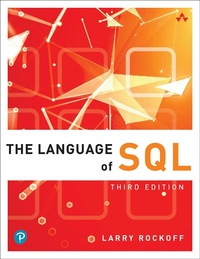
Language of SQL, The
3rd Edition
Published on 26. February 2022
272 pages
978-0-13-763263-3 (ISBN)
Description

Get Started Fast with SQL!
The only book you need to gain a quick working knowledge of SQL and relational databases.
Many SQL texts attempt to serve as an encyclopedic reference on SQL syntax-an approach that is often counterproductive because that information is readily available in online references published by the major database vendors.
For SQL beginners, it's more important for a book to focus on general concepts and to offer clear explanations and examples of what various SQL statements can accomplish. This is that book.
Several features make The Language of SQL unique among introductory SQL books.
First, you will not be required to download software or sit with a computer as you read the text. The intent of this book is to provide examples of SQL usage that can be understood simply by reading.
Second, topics are organized in an intuitive and logical sequence. SQL keywords are introduced one at a time, allowing you to grow your understanding as you encounter new terms and concepts.
Finally, this book covers the syntax of the latest releases of three widely used databases: Microsoft SQL Server 2019, MySQL 8.0, and Oracle 18c. Special "Database Differences" sidebars clearly show you any differences in syntax among these three databases, and instructions are included on how to obtain and install free versions of the databases.
Use SQL to retrieve data from relational databases
Apply functions and calculations to data
Group and summarize data in a variety of useful ways
Use complex logic to retrieve only the data you need
Design relational databases so that data retrieval is easy and intuitive
Update data and create new tables
Use spreadsheets to transform your data into meaningful displays
Retrieve data from multiple tables via joins, subqueries, views, and set logic
Create, modify, and execute stored procedures
Install Microsoft SQL Server, MySQL, or Oracle
The only book you need to gain a quick working knowledge of SQL and relational databases.
Many SQL texts attempt to serve as an encyclopedic reference on SQL syntax-an approach that is often counterproductive because that information is readily available in online references published by the major database vendors.
For SQL beginners, it's more important for a book to focus on general concepts and to offer clear explanations and examples of what various SQL statements can accomplish. This is that book.
Several features make The Language of SQL unique among introductory SQL books.
First, you will not be required to download software or sit with a computer as you read the text. The intent of this book is to provide examples of SQL usage that can be understood simply by reading.
Second, topics are organized in an intuitive and logical sequence. SQL keywords are introduced one at a time, allowing you to grow your understanding as you encounter new terms and concepts.
Finally, this book covers the syntax of the latest releases of three widely used databases: Microsoft SQL Server 2019, MySQL 8.0, and Oracle 18c. Special "Database Differences" sidebars clearly show you any differences in syntax among these three databases, and instructions are included on how to obtain and install free versions of the databases.
Use SQL to retrieve data from relational databases
Apply functions and calculations to data
Group and summarize data in a variety of useful ways
Use complex logic to retrieve only the data you need
Design relational databases so that data retrieval is easy and intuitive
Update data and create new tables
Use spreadsheets to transform your data into meaningful displays
Retrieve data from multiple tables via joins, subqueries, views, and set logic
Create, modify, and execute stored procedures
Install Microsoft SQL Server, MySQL, or Oracle
More details
Edition
3rd edition
Language
English
Place of publication
Boston
United States
Publishing group
Pearson Education (US)
Target group
Professional and scholarly
File size
6,70 MB
ISBN-13
978-0-13-763263-3 (9780137632633)
Copyright in bibliographic data and cover images is held by Nielsen Book Services Limited or by the publishers or by their respective licensors: all rights reserved.
Schweitzer Classification
Other editions
Additional editions
Larry Rockoff
Language of SQL, The
Book
12/2021
3rd Edition
Addison Wesley
€28.50
Article not available at the moment
Previous edition
Larry Rockoff
Language of SQL, The
E-Book
07/2016
2nd Edition
Addison Wesley
from
€34.55
Available for download
Person
Larry Rockoff has been involved with SQL and business intelligence development for many
years. His main area of interest is in using reporting tools to explore and analyze data in
complex databases. He holds an MBA from the University of Chicago and a BFA from the
University of Illinois.
In addition to writing about SQL, he has also published books on Microsoft Excel and Access.
His latest editions of those texts are Exploring Data with Excel 2019 and Exploring Data with
Access 2019.
He also maintains a website that features book reviews on technology topics, as well as broader
issues regarding technology and society: larryrockoff.com
Please feel free to visit that site to contact the author with any comments or questions.
years. His main area of interest is in using reporting tools to explore and analyze data in
complex databases. He holds an MBA from the University of Chicago and a BFA from the
University of Illinois.
In addition to writing about SQL, he has also published books on Microsoft Excel and Access.
His latest editions of those texts are Exploring Data with Excel 2019 and Exploring Data with
Access 2019.
He also maintains a website that features book reviews on technology topics, as well as broader
issues regarding technology and society: larryrockoff.com
Please feel free to visit that site to contact the author with any comments or questions.
Content
1 Relational Databases and SQL
2 Basic Data Retrieval
3 Calculated Fields and Aliases
4 Using Functions
5 Sorting Data
6 Selection Criteria
7 Boolean Logic
8 Conditional Logic
9 Summarizing Data
10 Subtotals and Crosstabs
11 Inner Joins
12 Outer Joins
13 Self Joins and Views
14 Subqueries
15 Set Logic
16 Stored Procedures and Parameters
17 Modifying Data
18 Maintaining Tables
19 Principles of Database Design
20 Strategies for Using Excel
Appendix A: Getting Started with Microsoft SQL Server
Appendix B: Getting Started with MySQL
Appendix C: Getting Started with Oracle
2 Basic Data Retrieval
3 Calculated Fields and Aliases
4 Using Functions
5 Sorting Data
6 Selection Criteria
7 Boolean Logic
8 Conditional Logic
9 Summarizing Data
10 Subtotals and Crosstabs
11 Inner Joins
12 Outer Joins
13 Self Joins and Views
14 Subqueries
15 Set Logic
16 Stored Procedures and Parameters
17 Modifying Data
18 Maintaining Tables
19 Principles of Database Design
20 Strategies for Using Excel
Appendix A: Getting Started with Microsoft SQL Server
Appendix B: Getting Started with MySQL
Appendix C: Getting Started with Oracle
