

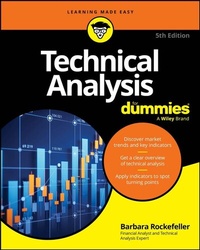
Technical Analysis For Dummies
Description

Understand and apply the latest evidence-based trading strategies and techniques in technical analysis
In the newly revised fifth edition of Technical Analysis For Dummies, renowned economist and foreign exchange forecaster Barbara Rockefeller walks you through the basic principles, formulas, and techniques you need to reliably predict the movement of prices based on technical data. This straightforward guide shows you how to put technical knowledge to work to generate profitable trades and make lucrative decisions within your portfolio.
This latest edition offers useful updates on new developments in the discipline, including the integration of artificial intelligence to analyze data, identify patterns, and make predictions. It also covers the incorporation of non-traditional data sources, like social media sentiment and web traffic.
Technical Analysis For Dummies also provides:
- Step-by-step guidance on spotting market trends and key indicators of future price increases or decreases
- Behavioral economics insights you can apply to your own trading strategy for immediate improvements in your risk-adjusted returns
- Discussions of the latest innovations in charting
With comprehensive and cutting-edge explorations of the theories, trends, and science that animate technical analysis, Technical Analysis For Dummies explains the hands-on tools and techniques you'll need to make informed, independent market decisions that maximize returns and minimize risk.
More details
Other editions
Additional editions
Content
Chapter 1
Introducing Technical Analysis
IN THIS CHAPTER
Knowing what certain words mean
Accepting the idea that the trend is your friend
Figuring out what can go wrong
Technical analysis is the study of price behavior to forecast the next price movement with some degree of probability and help you make better buy/sell trading decisions. Focusing on price behavior gives you a window into the mind of the market - what the majority of key players are thinking - rather than what experts are saying. Technical analysis seeks to identify and measure market sentiment, either bullish, bearish, or uncertain. It can be used alone or in conjunction with fundamental analysis.
To become a technical analyst, you need to figure out how to apply indicators and work up the courage to place the buy and sell orders with your broker. Indicators are plentiful, and I cover every major type of indicator in this book. In each case, you need to figure out whether the line/indicator embodies a bullish or bearish outlook, and those embedded buy/sell decisions fit your personal risk profile. Many lines/indicators contain a handy built-in buy-and-sell signal.
Knowing how to draw lines or order an indicator is relatively easy. Placing the trades is hard. This is because your technical-based buy/sell decisions don't come packaged with how much to trade, how long to hold, how much risk to take, or even how much risk is involved.
To help you start, this chapter provides an overview of this book and what you can expect. Consider it your jumping-off point into this book and the world of technical analysis.
FINDING THE ORIGINS OF TECHNICAL ANALYSIS
Technical analysis isn't some newfangled flash in the pan. Observing prices and shutting out other noise has been in development for more than a century. Charles Dow, one of the founders of The Wall Street Journal, observed around the turn of the 20th century that the price of a security neatly cuts through all the clutter of words and is the one piece of hard information you can trust, no matter what the other facts about a security and what people are saying about it.
Here are some basic observations underlying technical analysis that are attributed to Dow himself:
- Market prices move in trends much of the time.
- Trends can be identified with patterns that you see repeatedly (which I cover in Chapter 12) and with support and resistance trendlines (see Chapter 13).
- Primary trends (lasting months or years) are punctuated by secondary movements (lasting weeks or months) in the opposite direction of the primary trend. Secondary trends, today called retracements, corrections, or consolidations, are the very devil to deal with as a trader. (See Chapter 2 for more on retracements.)
- Trends remain in place until some major event comes along to stop them.
These ideas are part of what is called Dow theory, although Charles Dow himself never called it that, and many ideas are called Dow theory that would surprise Dow. A key point is that traders were using technical ideas long before the advent of electronic communication and software programs - technical analysis is hardly a gimmicky fad that will have a short shelf life.
Building on Dow theory were Robert D. Edwards and John Magee, whose Technical Analysis of Stock Trends (St. Lucie Press) was the first major book to use the term "technical analysis" in the title. It was published in 1948 and has been in print ever since. Edwards and Magee expanded on Dow's observations, covering many of the core concepts of technical analysis, such as support and resistance, breakouts, retracements, many patterns, and more. Edwards and Magee noted the universal pattern of a primary upmove followed by a shallower secondary pullback and then another upmove. You'll see this configuration repeatedly as you explore technical analysis. Edwards and Magee were the first to introduce the tools still in use today to evaluate the pattern and to trade it profitably.
What's different today is the advent of computers that take drawing lines and applying indicators away from paper and colored pencils to a screen and cursors. Something else that differs from the early and mid-20th century is the ongoing incursion of the scientific method into everyday life. At the turn of the last century, the scientific method was confined to scientists. Regular people would take a homemade folk remedy for a malady because their grandmother swore by it. Today, the average person wants to know whether that remedy was scientifically tested in double-blind trials and whether the results were peer-reviewed. The comparable development in technical analysis is to take an observation about market prices and to test what percentage of the time the observation results in a correct deduction.
Stepping Up to Science
Drawing lines on a chart may not seem "scientific" in any sense of the word, but technical analysis of prices follows the scientific method in that it entails systematic observation of the subject with standard measurement methods to form a hypothesis and then testing the hypothesis many, many times to validate the theory. But there's a problem. In a hard science, the thing being observed and measured is an object. In technical analysis, the thing being measured isn't hard - it's market sentiment generated by human beings. Humans display far more variability than physical objects. Even so, with those occasional variations far from norms, market sentiment tends to move in repetitive and predictable ways. Technical analysis gives you the tools to identify the sentiment in force at any one time.
Today's technical analysis has a wider understanding and appreciation of statistics and probability, and thus the value and pitfalls of forecasting. The theory of probability originated in the 16th and 17th centuries, but dealt mostly with the outcome of games and thus the best way to bet on games. Not until the 1920s and 1930s did statistics and probability enter the general public mainstream. Today, even ordinary people routinely ask health questions of their doctors in probability terms, such as what percentage of small children without the measles vaccination does it take for the rest of the school class to risk a measles outbreak?
Throughout this book, I use words like "highly likely" and "forecast." I say, for example, technical analysts use lines and indicators to identify price moves that provide a fairly reliable forecast of future price moves. The word "forecast" makes everybody squeamish because everyone knows stories of catastrophically bad ones. History has plenty, like a top economist saying in 1929 that the stock market was in fine fettle - just before the crash.
But don't be misled. Although the word is riddled with negative implications, everyone makes forecasts all the time. They just don't think of them as forecasts. In fact, you make forecasts many times every day. You take this travel route over some other route because you forecast it will save time or aggravation. On a larger scale, when you move to a new city, take a new job, get married, or buy a house, you're making a forecast about the outcome. Every life decision you make is a forecast - a bet - almost always made on incomplete or hidden information. Technical analysis entails forecasting, but don't let that scare you. You'll have plenty of data in dozens of formats to help you, and I describe as many as possible in this book.
Unpacking Lingo
To get you started, you learned most of the technical analysis vocabulary in grade school. Here is a list of some of the important lingo to know:
- Chart: The workspace of technical analysis is a chart. Much of the time, the chart will show time along the horizontal axis and price along the vertical axis, but not always. (Some charts are formed differently, as I discuss in Chapter 18).
- Bar: The price information on the chart is presented in several different formats, but usually you'll see each period's price as a standard vertical bar showing the price open, high, low, and close. (Refer to Chapter 9 for more about bars.) Bars, or a series of bars, can be used alone to detect patterns that reveal how participants in that market feel about the security and, therefore, what might happen next to the price. (Chapters 10, 11, and 12 discuss how technical analysts use bars to forecast prices.)
- Candlesticks: Another method of showing the same information as the bar is the candlestick bar (see Chapter 11).
- Lines: Drawing lines on the chart helps forecast future prices. For example, you may draw a line connecting a series of price lows and name it "support," meaning you expect the traders in this security will see the next low as a buying opportunity, raising the price again. (Chapters 13 and 14 provide more detail.)
- Indicators: You want to enhance the information in the price data by arithmetic manipulation, creating indicators. Indicators come in all shapes and sizes. For example, you see a price chart where the price jumps all over the place. You have no idea whether to buy it or at what price. Now take an average of the closing price over the past 20 days to smooth out...
