

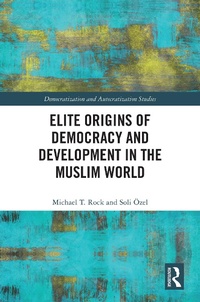
Elite Origins of Democracy and Development in the Muslim World
1st Edition
Published on 1. December 2023
262 pages
978-1-003-81334-7 (ISBN)
Description

Using an elite consensus/conflict analytical frame, this book examines why some majority Muslim countries perform so much better at democracy and/or development than others, questioning received wisdoms that Islam, authoritarianism, and underdevelopment go together. Identifying four distinct democracy and development outcomes in the Muslim world, four case studies are interrogated to show that there is more variability in democracy and development outcomes in Muslim majority countries than macro-historical studies and aggregate data have shown.
By demonstrating that democracy and development outcomes in Muslim countries are the consequence of elite conflict and elite consensus, rather than the precepts or institutions of Islam, the book places the competition for power among contending elites, rather than Islam, at the center of the story of democracy and development in the Muslim world.
This book will be of key interest to scholars and students of political development/development studies, democratization and autocratization studies, democracy promotion, and more broadly comparative politics.
By demonstrating that democracy and development outcomes in Muslim countries are the consequence of elite conflict and elite consensus, rather than the precepts or institutions of Islam, the book places the competition for power among contending elites, rather than Islam, at the center of the story of democracy and development in the Muslim world.
This book will be of key interest to scholars and students of political development/development studies, democratization and autocratization studies, democracy promotion, and more broadly comparative politics.
Reviews / Votes
"Despite decolonization, most Muslim countries remain autocracies, including most remaining oil-rich absolute monarchies. Their long-run growth has been slow, averaging 1.7% annually before the pandemic. Unsurprisingly, much academic writing claims to explain why Islam is associated with dictatorship and economic backwardness.Rock and Ozel offer a more variegated and nuanced analysis. After surveying the inconclusive literature, their analytical framework and case studies (of Egypt, Indonesia, Malaysia and Turkey) argue unified elites achieved democracy and development which ruling class divisions undermined."
Jomo Kwame Sundaram, Emeritus Professor and ex-UN Assistant Secretary-General
"This important, timeless, and refreshing volume sheds light on critical questions of democracy and development in the Muslim world. Rock and Ozel's painstaking research reveals the divergent political and developmental trajectories of Muslim majority countries in the Middle East and Asia, shining a light on the importance elite coalitions and conflict. A must read for scholars interested in questions of regime type and the political economy of development from a global perspective."
Kristin E. Fabbe, Jakurski Family Associate Professor of Business Administration, Harvard Business School, Harvard University
More details
Series
Edition
1. Auflage
Language
English
Place of publication
London
United Kingdom
Publishing group
Taylor & Francis Ebooks
Target group
College/higher education
Product notice
Reflowable
Illustrations
2 Tables, black and white; 2 Line drawings, black and white; 2 Illustrations, black and white
ISBN-13
978-1-003-81334-7 (9781003813347)
Copyright in bibliographic data and cover images is held by Nielsen Book Services Limited or by the publishers or by their respective licensors: all rights reserved.
Schweitzer Classification
Other editions
Additional editions
Michael T. Rock | Soli OEzel
Elite Origins of Democracy and Development in the Muslim World
Book
05/2025
1st Edition
Routledge
€67.50
Shipment within 10-20 days
Michael T. Rock | Soli OEzel
Elite Origins of Democracy and Development in the Muslim World
Book
12/2023
1st Edition
Routledge
€196.40
Shipment within 10-20 days
Persons
Michael T. Rock is Sam and Etta Wexler Professor Emeritus of Economic History at Department of Economics, Bryn Mawr College.
Soli OEzel is Professor of International Relations at the Department of International Relations Kadir Has University.
Soli OEzel is Professor of International Relations at the Department of International Relations Kadir Has University.
Content
1 Introduction
2 Egypt
3 Indonesia
4 Malaysia
5 Turkey
6 Conclusions
2 Egypt
3 Indonesia
4 Malaysia
5 Turkey
6 Conclusions
