

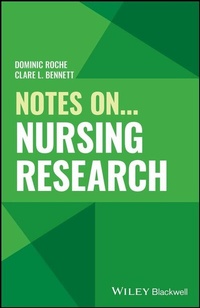
Notes On... Nursing Research
Description

Generate and apply high-quality research in a nursing context with this accessible guide
The production and application of rigorous, effective research can have a significant impact on nursing care. Notes On... Nursing Research offers an overview of nursing research, its relationship with clinical practice and patient outcomes, and its positive effects on the nursing professional. Beginning with an introduction to the fundamental principles of nursing research, it moves through the stages of designing and conducting research studies before concluding with specific applications of research to clinical practice and patient care.
Notes On... Nursing Research readers will also find:
- A step-by-step guide to formulating and answering a research question
- Detailed discussion of research methodologies including data collection and analysis, inferential statistics, multivariate statistics, evidence synthesis, and much more
- Specific examples showing how research has improved patient care and outcomes
Notes On... Nursing Research is ideal for undergraduate nurses, as well as a valuable resource for qualified and practicing nurses and other health professionals looking to develop their understanding of research.
More details
Other editions
Additional editions
Persons
Dominic Roche, PhD is Senior Lecturer in Adult Nursing at the School of Healthcare Sciences, College of Biomedical and Life Sciences, Cardiff University, UK.
Clare L. Bennett, D.Nurs is Reader in Knowledge Translation and Health Improvement and Co-Director of the Wales Centre for Evidence-Based Care at the School of Healthcare Sciences, College of Biomedical and Life Sciences, Cardiff University, UK.
Content
Preface vii
Acknowledgements ix
About the Authors x
About the Notes On... Series xii
1 An Introduction to Nursing Research 1
1.1 Introduction 1
1.2 What Is Research? 2
1.3 Why Is Research Important to Nursing? 2
1.4 Evidence-based Nursing 4
1.5 Research Methodologies: An Overview 7
1.6 Research Aims and Objectives 14
1.7 Prioritising Patient and Public Involvement 14
1.8 Summary 19
2 Identifying Areas of Inquiry 21
2.1 Introduction 21
2.2 The Hierarchy of Evidence 21
2.3 What Is a Literature Review? 23
2.4 Relevance of Literature Reviews in Nursing 25
2.5 Developing a Literature Review Question 26
2.6 Literature Searching 29
2.7 Screening against Inclusion and Exclusion Criteria 33
2.8 Critical Appraisal 34
2.9 Reporting the Findings 36
2.10 Limitations of the Literature Review 38
2.11 Summary 38
3 Qualitative Research 39
3.1 Introduction 39
3.2 What Is Qualitative Research? 39
3.3 Qualitative Research Design and Approaches 41
3.4 Sampling in Qualitative Research 45
3.5 Sample Populations 45
3.6 Recruitment in Qualitative Research 53
3.7 Data Generation in Qualitative Research 55
3.8 Data Analysis in Qualitative Research 58
3.9 Summary 60
4 Quantitative Research 63
4.1 Introduction 63
4.2 What Is Quantitative Research? 63
4.3 Quantitative Research Designs and Approaches 65
4.4 Key Concepts in Quantitative Research 73
4.5 Sampling in Quantitative Research 78
4.6 Data Collection Methods in Quantitative Research 82
4.7 Data Analysis and Interpretation in Quantitative Research 85
4.8 Summary 92
5 Mixed Methods Research 95
5.1 Introduction 95
5.2 Strengths and Limitations of Qualitative Research 96
5.3 Strengths and Limitations of Quantitative Research 96
5.4 Mixed Methods Research 98
5.5 Summary 101
6 Ethics and Integrity in Research 103
6.1 Introduction 103
6.2 What Are Research Ethics? 103
6.3 Ethical Principles in Research 104
6.4 Applying Ethical Principles to the Conduct of a Research Study 108
6.5 Research Governance 111
6.6 Avoiding Potential Ethical Pitfalls 112
6.7 Ethical Considerations Following Completion of the Research Study 115
6.8 Equality, Diversity, and Inclusion in Research 115
6.9 Summary 117
7 Evidence Synthesis 119
7.1 Introduction 119
7.2 What Is Evidence Synthesis? 120
7.3 Evidence Synthesis or a Literature Review? 121
7.4 Types of Evidence Synthesis 121
7.5 Conducting a Systematic Review 129
7.6 Summary 135
References 137
Index 143
1
An Introduction to Nursing Research
1.1 Introduction
In this chapter, we will introduce you to what nursing research is, why it is important, how it is approached, and how to develop research questions that you may want to ask about nursing practice. By doing so, we also aim to empower you to recognise nursing practice that is ritualised or entrenched, rather than evidence based, and to be able to identify whether the evidence underpinning a particular practice is outdated or weak. These skills will allow you to see how research influences and informs our nursing practice - why we do the things we do and the ways that we do them. This will also equip you in critiquing care delivery and in ascertaining whether we could produce better outcomes if we had stronger evidence to support our nursing practice.
Reflective Activity 1.1
To begin, an important question to consider is, 'What is research?' Make a list of everything you currently know about research and use this to create your own definition.
1.2 What Is Research?
A good place to start when exploring what we mean by 'research' is to consider how research differs from other sources of knowledge that may inform nursing practice, such as beliefs, tradition, intuition, habit, and common sense. In the United Kingdom (UK), research is defined by the Research Excellence Framework (REF) as 'the process of investigation leading to new insights, shared effectively' (REF 2019). Research can also be defined as the 'study of phenomena by the rigorous and systematic collection and analysis of data' (Parahoo 2014, p 30). There is also a difference between collecting information, for example through an audit, and undertaking research. So, compared to other sources of knowledge, research is a systematic way of knowing, in which the methods used must be available for scrutiny. This emphasis on a systematic and transparent approach gives researchers their particular claims to knowledge. Research systematically investigates ideas to increase knowledge and devise new interventions and new and better ways of working by establishing or confirming facts, reaffirming previous knowledge, solving problems, and supporting or developing new theories. In nursing, we can then use this new knowledge to inform our practice, by providing the evidence to support our evidence-based practice (EBP).
Reflective Activity 1.2
Discuss with your colleagues why they think research is important to nursing.
1.3 Why Is Research Important to Nursing?
So far, we have discussed what research is, but why should research command attention in our nursing practice? As registered nurses it is important that we understand the need to base our decisions about patient care on contemporary research evidence, factoring in the relevant legal, regulatory, and governance requirements and specific policies and ethical frameworks. This does not mean that nurses should always be engaged in research, but there is an expectation that we engage in practice which is based on the best available evidence. To do this effectively requires that we understand the different approaches and methods of research and that we have the skills and knowledge to be able to review and apply critical appraisal and critical thinking to different sources of knowledge around particular topics of relevance or interest. Ultimately, to identify what good practice is requires us to be able to test, measure, and evaluate it and so we need to know how to go about doing these things through the use of research.
Nursing research is integral to nursing practice in a diverse range of areas including education, ethics, clinical skills, and clinical practice, and nurses engage with research for several reasons. If you have ever used healthcare services, then you are a user of research. You are also likely to be a consumer of research through reading research papers, writing literature reviews, attending lectures or seminars, or when learning in practice. You are also using research when following clinical guidelines. Nurses can also be promoters of research, by providing evidence-based information to patients and service users, through supporting peers and colleagues to update their practice, and by developing and disseminating evidence-based guidelines and policies. Nurses might also be participants in research and the experiences and involvement of nurses, including nursing students, in research studies helps to inform the nursing evidence base. Nurses' involvement in research can also help to improve communication within nursing practice, build relationships and partnerships with other practitioners and disciplines, and help to further develop the critical evaluation of evidence-based nursing care. Involvement in research can also help nurses to develop competence and confidence in practice.
There are many different ways in which nurses might be involved in research, ranging from developing one's awareness of research methods and applying research evidence to clinical practice, through to contributing to research studies, and on to undertaking and leading research projects or a programme of research. All these approaches help to develop and promote a positive research culture in nursing. You may also be, or indeed aspire to be, an activist in research. This involves taking part in the design, conduct, and dissemination of research studies - and again, there are many roles a nurse can fulfil in these areas. Activists in research may be driven or inspired by personal, professional, organisational, or societal issues that lead them to develop and conduct research studies and programmes of research. For example, at a personal level, there may be phenomena faced by nurses in their own lives, or issues faced by service users, patients, or clients that lead to the development of research studies. Nurses can also encounter professional problems or challenges that generate research ideas, helping to advance the nursing profession and improve patient care. Organisational issues may also be evident, such as the ongoing evolution and development of the diverse roles of registered nurses, and changes to the way care is organised and delivered, including the continuing drive to advance nursing services in community-based care. There are also changes to the way nurses are educated and our continuing professional development needs. As nurses take on different challenges and demands of care, this requires strong supporting evidence, generated through research. There are also broader societal issues that warrant attention through nursing research, such as health inequalities, climate change, sustainability, and the impact of innovative technology such as artificial intelligence. Leaders in research set the agenda for research in areas of practice, facilitate and support others to undertake their research, or lead in other ways at both national and international levels. While this may seem a long way away for you at the moment, it is definitely something that we would advocate that you aspire to!
1.4 Evidence-based Nursing
As we have discussed, research can provide evidence for clinical practice, healthcare service organisation and delivery, and the patient and service user experience. Research can also help us to evaluate and innovate new interventions, policies, and practice. And of course, as with all contemporary healthcare, nursing practice should be based on the best available evidence, and this evidence should be robust and reliable. EBP (and thus evidence-based nursing) is a key requirement to support safe, effective patient care. There have been a range of formative definitions offered for this concept, including:
"The conscientious, explicit and judicious use of current best evidence in making decisions about the care of individual patients"
(Sackett et al. 1996, p 71).
This definition of evidence-based healthcare was later updated to incorporate what we know as the three pillars of evidence, which requires nurses and other healthcare professionals to combine the best available research evidence with clinical expertise and patient values and preferences to guide our decision-making, as outlined below and in Figure 1.1:
"Evidence-based medicine (EBM) is the integration of best research evidence with clinical expertise and patient values. [.] By patient values we mean the unique preferences, concerns and expectations each patient brings to a clinical encounter and which must be integrated into clinical decisions"
(Sackett et al. 2000, p 1).
"Decision making that considers the feasibility, appropriateness, meaningfulness, and effectiveness of healthcare practices [.] may be informed by the best available evidence, the context in which care is delivered, the individual patient and the professional judgement and expertise of the health professional informs this process."
(Jordan et al. 2019)
We have established that evidence-based healthcare and thus evidence-based nursing focuses on the need to use interventions and conduct practice that is supported by the best-quality and most up-to-date evidence or knowledge available. However, an important word here is 'judicious' - we need to use the best available quality...
