

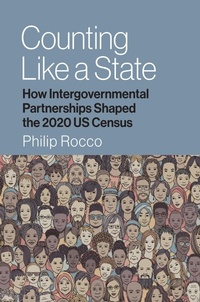
Counting Like a State
Description

An inside look at the 2020 Census that shows the importance of state and local cooperation in the complex federal project of census taking.
The census plays a foundational, if all too easily ignored, role in the operation of the American state, shaping everything from congressional representation to the allocation of trillions of federal dollars. While census taking aspires to the high-modernist goal of ?seeing like a state??centralizing, standardizing, and homogenizing knowledge about a polity?it is subject to far more conflict and negotiation than final tabulations, maps, or technical documentation make apparent. This is especially true in a large, decentralized polity like the United States where the Constitution entrusts the ultimate authority for the census in the legislative branch.
In Counting Like a State, Philip Rocco shows how the production of the US census now hinges crucially not only on what happens in Washington but also on a series of intergovernmental partnerships. State and local officials, though not formally responsible for census taking, figure importantly in the implementation of the decennial count. These officials are essential partners in the construction and maintenance of address lists, as well as in outreach and promotion campaigns in hard-to-count communities. The 2020 Census compounded these challenges with new crises. Intergovernmental partnerships played a key role in preventing President Trump from adding a citizenship question, as state and local officials mounted a coordinated legal counteroffensive. Many local officials also simply refused to cooperate with the Trump administration's efforts to exclude undocumented immigrants from the apportionment count. The census also took place in the context of a global pandemic that stretched administrative resources to the breaking point. While these partnerships allowed the Census Bureau to adapt to ever-changing conditions on the ground, state and local governments also sounded the alarm when the Trump administration sought to rush the census. These efforts helped preserve the quality of the data collected in the 2020 count.
Rocco's illuminating study of the 2020 Census pulls back the curtain on the administrative state to reveal how something as complex and centralizing as a census takes place within a decentralized, federalist system. Drawing on analyses of interviews with hundreds of public officials and quantitative analyses of state and local census activities, Counting Like a State allows scholars and practitioners to better understand what facilitates as well as what impedes effective intergovernmental partnerships for census taking.
More details
Other editions
Additional editions
Person
Content
List of Tables
List of Figures
List of Abbreviations
Acknowledgments
Introduction
1. Census Politics and the Federal System
2 Battle Royale: How State and Local Officials Stopped the Citizenship Question
3. A Sense of Where You Are: Local Knowledge and the Master Address File
4. Getting Out the Count: Partnerships, Politics, and Census Promotion
5. Between a Pandemic and a Power Grab: Federalism and the Politics of Census Integrity
6. Counting the Forgotten: How Governments Respond to Flawed Data
Conclusion
Appendix
Notes
Index
