

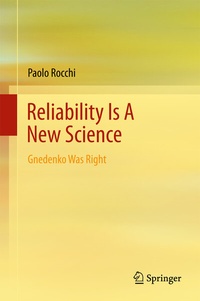
Reliability is a New Science
Description

This work illustrates research conducted over a ten-year timespan and addresses a fundamental issue in reliability theory. This still appears to be an empirically disorganized field and the book suggests employing a deductive base in order to evolve reliability as a science. The study is in line with the fundamental work by Gnedenko.
Boris Vladimirovich Gnedenko (1912 - 1995) was a Soviet mathematician who made significant contributions in various scientific areas. His name is especially associated with studies of dependability, for which he is often recognized as the 'father' of reliability theory. In the last few decades, this area has expanded in new directions such as safety, security, risk analysis and other fields, yet the book 'Mathematical Methods in Reliability Theory' written by Gnedenko with Alexander Soloviev and Yuri Bélyaev still towers as a pillar of the reliability sector's configuration and identity.
The present book proceeds in the direction opened by the cultural project of the Russian authors; in particular it identifies different trends in the hazard rate functions by means of deductive logic and demonstrations. Further, it arrives at multiple results by means of the entropy function, an original mathematical tool in the reliability domain. As such, it will greatly benefit all specialists in the field who are interested in unconventional solutions.
Reviews / Votes
"The book offers a surprising and elevated view on reliability theory. . We also find numerous significant examples and relevant numerical illustrations. A consistent set of bibliographic references concludes each chapter of the book. We think that the novel perspectives proposed by this work represent valuable contributions in the dynamic field of reliability theory." (Eugen Paltanea, zbMATH 1381.60004, 2018)More details
Other editions
Additional editions
Person
Content
1 Background and Motivation. - 2 Old and Novel Tools for the Calculus of the Hazard Rate.- 3 How Systems Break Down. - 4 Constant Decline.- 5 Random Factors.- 6 Accelerated Decline.- 7 When the Premises are Untrue.- 8 Ideal Hazard Rate 9. Properties of Repairable Systems.- 10. Conclusive Remarks and Comments.- Appendix A History of Reliability in Literature.- Appendix B Two Sided Estimates of Rate Convergence in Limit Theorem for Minimums of Random Variables.- Appendix C Mortality Plateau.
