

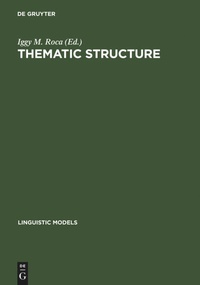
Thematic Structure
Its Role in Grammar
1st Edition
Published on 19. January 2012
XIII, 325 pages
978-3-11-087261-3 (ISBN)
Description

No detailed description available for "Thematic Structure".
More details
Other editions
Additional editions
Book
04/1992
1st Edition
De Gruyter Mouton
€179.95
Shipment within 7-9 days
Book
01/1992
1st Edition
De Gruyter Mouton
€259.00
Article exhausted; check different version
Content
- Intro
- List of Contributors
- Foreword
- Introduction
- Thematic conditions on syntactic structures: evidence from locative applicatives
- 1. Background: benefactive and instrumental applicatives
- 2. The problem of locative applicatives
- 2.1. Chichewa
- 2.2. Kinyarwanda and Sesotho
- 3. The role of the applied affix
- 4. Contrast 1: Chichewa vs. Sesotho
- 5. Contrast 2: Kinyarwanda vs. Chichewa/Sesotho
- 6. Chichewa benefactive applicatives revisited
- 7. Implications
- Notes
- References
- Morphology, semantics and argument structure
- 1. Introduction
- 2. Lexical-conceptual structure
- 3. Morphological operations on LCS
- 4. Verbal prefixation and LCS
- 5. Middle verbs
- 6. Conclusions
- Notes
- References
- Deverbal compounds and the external argument
- 1. English deverbal compounds
- 2. Italian deverbal compounds
- 3. Italian and English
- 4. English deverbal compounds revisited
- 5. Summary
- Notes
- References
- Sentence accents and argument structure
- 1. Bresnan's account: the Nuclear Stress Rule
- 2. The generalization
- 2.1 Difficulty of perceiving nonfinal accents
- 2.2. Two PP's in one argument
- 3. Exploiting the generalization
- 3.1 Multiword predicates
- 3.2. Embedded clauses
- 4. Conclusion
- Appendix
- Notes
- References
- The syntactic character of thematic structure
- 0. Introduction
- 1. The double object construction
- 2. Conflation as incorporation
- 3. Other patterns of conflation
- 4. Lexical representations
- 5. D-structure representations
- 6. Problems of method and the determination of Lexical Relational Structures
- 7. Conflations and the English middle construction
- 8. Conflation from the inner subject position
- 9. The relational structures of location and locatum verbs
- 10. Functional categories in the lexicon
- 11. Some final remarks
- Notes
- References
- Aspect and Theta Theory
- 1. The problem
- 2. Resultatives
- 2.1. Small clauses
- 2.2. Resultatives
- 2.3. Conclusion
- 3. Licensing
- 3.1. The theory of modification
- 3.2. Aspect and Aktionsart
- 3.3. Licensing Resultatives
- 3.4. Accomplishments
- 4. Morphologically complex accomplishments
- 5. Morphologically simplex verbs
- 6. Conclusion
- Notes
- References
- Raising in syntax, semantics and cognition
- 1. Introduction and overview
- 2. Raising patterns in syntax
- 3. Raising patterns in semantics
- 4. The function of raising
- 5. Raising patterns in cognition
- 6. Conclusion
- Notes
- References
- Secondary predication as a diagnostic of underlying structure in Pama-Nyungan languages
- 1. Part-whole constructions in Warlpiri
- 2. Stative predicates in Warlpiri
- 3. Secondary predicates in Arrernte-type languages
- 4. Lexical structure of verbs
- 5. "Perception" predicates
- 6. Conclusion
- Notes
- References
- The lexical semantics of verbs of motion: the perspective from unaccusativity
- 1. Verbs of motion: a problem for the unaccusative hypothesis?
- 2. Three classes of verbs of motion
- 3. Correlations of meaning components with unaccusativity
- 3.1. Arrive verbs
- 3.2. Manner of motion verbs
- 3.3. Run verbs with directional phrases
- 3.4. Summary
- 4. Implications for lexical semantic representation
- 5. Conclusion
- Notes
- References
- The projection principle(s): a reexamination
- 1. A review
- 2. The projection principle
- 3. The projection principle and the extended projection principle
- References
- Circumstantial complements and direct objects in the Romance languages: configuration, Case, and thematic structure
- 1. A traditional view of the problem
- 2. Some tests for "Objecthood"
- 2.1. Commutation tests
- 2.2. Passive constructions
- 2.3. Causative constructions
- 2.4. Auxiliary selection
- 2.5. Extraction
- 2.6. Cliticization
- 3. A configurational account
- 4. Case and Theta-Role assignment
- 5. Some further data
- 6. Conclusion
- Notes
- References
- Author index
- Subject index
