

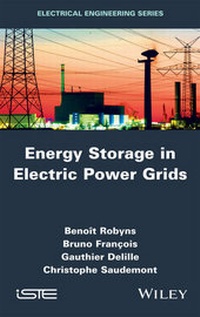
Energy Storage in Electric Power Grids
Description

More details
Other editions
Additional editions
Persons
Benoît ROBYNS is Research Director at the École des Hautes Etudes d'Ingénieur (HEI) in Lille, France. He is the head of the "Power Systems" team at the Laboratory of Electrotechnics and Power Electronics of Lille (L2EP).
Bruno FRANÇOIS is Professor at the École Centrale of Lille, France. He is a member of the "Power Systems" team at the Laboratory of Electrotechnics and Power Electronics of Lille (L2EP).
Gauthier DELILLE is Research Engineer at Electricité de France R&D in Clamart, France.
Christophe SAUDEMONT is Professor at the École des Hautes Etudes d'Ingénieur (HEI) of Lille, France. He is a member of the "Power Systems" team at the Laboratory of Electrotechnics and Power Electronics of Lille (L2EP).
Content
1
Issues in Electrical Energy Storage
1.1. Difficulties of storing electrical energy
The electrical energy vector has been highly developed over the past 150 years, as it is extremely practical to use, is not pollutant during use and can generate very little pollution if produced from renewable energies. Its transport over long distances at very high voltage is possible due to transformers, which make it possible to adjust the amplitude of voltage and current waves at will. This possibility offered by transformers goes a long way toward explaining why electrical grids have been developed using alternating voltages and currents.
The weak point of the electricity vector is that electrical currents cannot be stored directly. It is possible to store electrostatic energy (in capacitors) or magnetic energy (in superconducting coils), but the storage capacities of these solutions are quite limited. In order to obtain substantial storage capacities, electrical energy must be transformed into another form of energy. Storage in the form of potential energy by means of turbine pumping stations enables large quantities of energy to be stored, but these stations must be located in regions able to provide significant differences in height between two hydraulic storage tanks. Electrochemical storage using lead batteries has long been used for onboard applications and emergency power supplies, while the storage of kinetic energy by means of flywheels has been used for several decades for fixed applications such as emergency power supplies and some onboard applications, including satellites.
Electrochemical batteries make it possible to store electrical energy in continuous form. Inertial energy storage is used in machines that are required to operate at variable speed, that is, variable frequency. With electrical grids supplying electricity in the form of alternating voltage and currents at fixed frequencies, the implementation of these storage technologies remained complicated until the advent of electronic power, which was introduced in the 1960s, and is currently used to transform the form and characteristics of currents and voltages at will.
The difficulty of storing electrical energy explains why the management of electrical grids has been designed according to the principle of direct consumption of the electrical energy produced, even when the distance between production and consumption is several hundred kilometers. This approach has evolved slightly in France, with the development of nuclear facilities ideally able to produce constant power, favoring the development of hydraulic storage.
The direct consumption of energy has the advantage of a higher overall energetic yield. In fact, the energetic conversion required for storage causes very different losses depending on the storage technologies used. These losses can range from 10% to 50%, or even more. However, this notion of yield can be put into perspective if the stored energy comes from a source for which the non-stored energy would be lost anyway, as is the case with energy that is wind or photovoltaic in origin.
Finally, note, that electrical energy can be stored and subsequently used in another energetic form. This is the case with hot-water tanks in domestic grids, whose final use is thermal energy and the production of hydrogen via electrolysis. Some loads have a storage capacity enabling the control of the power supply from the electrical grid, as with cold storage in supermarket refrigerators, or storage in the batteries of electrical vehicles.
1.2. Why store electrical energy?
The management of electrical grids is based principally on the direct consumption of the electrical energy produced. As consumption is variable, this approach requires the constant adaptation of production to this consumption. Figures 1.1 and 1.2 show typical domestic and commercial consumer profiles, illustrating the variable character of consumption depending on the time of day, season and type of load.
Figure 1.1. Typical profiles of domestic consumers, not including electrical heating (RTE)
Figure 1.2. Typical profiles of tertiary and artisanal consumers (RTE)
Since the development of renewable energy sources, electrical grids have been forced to face the accommodation of highly intermittent production, as is the case for wind, photovoltaic and marine energies, as well as small hydraulic run-of-the-river energies [ROB 12c]. Figure 1.3 illustrates a wind turbine's production of 300 kW more than 5 min. Apart from high variability, fluctuations of 100 kW in 3 s have been recorded. Figure 1.4 illustrates the production of a photovoltaic facility in the span of a day; the presence of clouds induces a high variability of this production.
Figure 1.3. Example of power generated by a fixed speed wind turbine of 300 kW
Figure 1.4. Profile of a sunny day with clouds (source: Auchan)
Hydraulic resources also show significant fluctuations. For example, ocean waves are an abundant resource, but with large and rapid variations, as shown in Figure 1.5. The flow of a river is also subject to significant fluctuations over months and years, as shown in Figure 1.6, even hours in case of flooding following heavy rainfall. Small run-of-the-river hydraulic facilities, which are not equipped with upstream dams or spillways, will therefore produce uncontrolled variable power when subjected to these fluctuations [ROB 12c].
Figure 1.5. Variation in wave height [MOU 08]
Figure 1.6. Variations in output of the Oise river over 10 years [ROB 12c]
These examples show that the balance between production and consumption does not occur naturally, and has been complicated by the increasing development of high-variability renewable energies. Storage of the electrical energy produced by these renewable sources makes it possible to smooth their production, and thus to facilitate their adaptation to consumption.
Conversely, sources such as nuclear power plants ideally produce at constant power. In this case, storage of overproduction during the night makes it possible to compensate for underproduction during the peak hours of the day.
The infrastructures of transport systems such as railways, metros and trams also call grid for fluctuating power on electrical grids due to the starts and stops of traction units, and to fluctuations in traffic at different times of the day [ROB 15].
Finally, the onboard systems of various modes of transport (rail, naval, aeronautical, aerospace, road vehicle, robot, etc.) incorporate electrical storage systems to power backup systems and local electrical grids, recover energy while braking and ensure vehicle propulsion. The development of electric vehicles in particular will significantly increase the need for high-performance onboard electrical storage in order to provide the vehicles with as much autonomy as possible in complete safety [ROB 15].
1.3. Value enhancement of storage in electrical grids
Energy storage systems are costly, and the additional cost they incur in a system of production or consumption can be prohibitive to their installation. It is necessary then to make sure that the economic enhancement of storage over its lifespan will at least compensate for the investment and maintenance costs. The cost of storage varies greatly depending on the technologies and the maturity level of these technologies, which are the subject of a great deal of research and development work. The value enhancement of storage in electrical grids will be dependent on the various services it can provide, which will depend on its positioning in the grid.
Two approaches to the development of storage in electrical grids can be distinguished:
- - associated with large intermittent production units (e.g. hydraulic storage associated with wind power connected to the transportation grid);
- - diffuse, that is, distributed within the distribution grid, for example.
To make storage profitable, one approach consists of mutualizing the services that a storage system can contribute among various actors (managers, producers and consumers) [DEL 09]. These services consist of:
- - local precise and dynamic voltage control;
- - support of grid in degraded operation;
- - return of voltage in network parts;
- - reactive compensation for grid managers (and customers);
- - reduction of transport losses;
- - power quality;
- - energy postponement and support to the production units;
- - primary frequency control and frequency stability of insular grids;
- - solving of congestion;
- - support for participation in ancillary services;
- - erasure recovery;
- - guarantee of a production profile;
- - peak smoothing;
- - consumption postponement;
- - supply quality/continuity.
The developments presented in this book will illustrate the implementation of several of these services.
The mutualization of services can be associated with a corresponding mutualization of actors; multiple production resources of different types (renewable, difficult to predict and foreseeable, fossil, etc.), multiple consumers and multiple storage systems using different technologies, all...
