

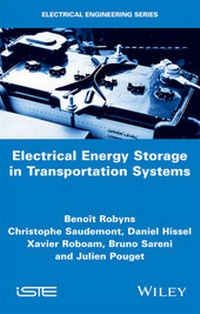
Electrical Energy Storage in Transportation Systems
Published on 16. August 2016
348 pages
978-1-119-34772-9 (ISBN)
Description

This book deals with the management and valuation of energy storage in electric power grids, highlighting the interest of storage systems in grid applications and developing management methodologies based on artificial intelligence tools. The authors highlight the importance of storing electrical energy, in the context of sustainable development, in "smart cities" and "smart transportation", and discuss multiple services that storing electrical energy can bring.
Methodological tools are provided to build an energy management system storage following a generic approach. These tools are based on causal formalisms, artificial intelligence and explicit optimization techniques and are presented throughout the book in connection with concrete case studies.
More details
Other editions
Additional editions
Software
09/2016
Wiley
€173.48
No shipping information available
Benoit Robyns | Christophe Saudemont | Daniel Hissel
Electrical Energy Storage in Transportation Systems
Book
08/2016
1st Edition
Wiley-ISTE
€164.50
Shipment within 15-20 days
Persons
Benoit ROBYNS, Hautes Etudes d'Ingénieur, Lille, France
Christophe SAUDEMONT, Hautes Etudes d'Ingénieur, Lille, France
Asma MERDASSI, Hautes Etudes d'Ingénieur, Lille, France
Daniel HISSEL, Université de Franche-Comté
Xavier ROBOAM, Institut National Polytechnique de Toulouse
Bruno SARENI, Institut National Polytechnique de Toulouse
Bruno FRANCOIS, Ecole Centrale de Lille
Content
- Cover
- Title Page
- Copyright
- Contents
- Foreword
- Introduction
- 1. Issues in Electrical Energy Storage for Transport Systems
- 1.1. Storage requirements for transport systems
- 1.2. Difficulties of storing electrical energy
- 1.3. The electrical power supply of transport systems
- 1.4. Storage management
- 1.4.1. Specifications
- 1.4.2. Supervisor structure
- 1.4.3. Functional graphs
- 1.4.4. Membership functions
- 1.4.5. Functional graphs
- 1.4.6. Rules
- 1.4.7. Indicators
- 1.4.8. Optimization of supervisor parameters
- 1.4.9. Type-2 fuzzy logic
- 1.4.10. Methodologies for the development of energy management in a storage system
- 2. Local DC Grid with Energy Exchange for Applications in Aviation
- 2.1. Introduction
- 2.2. Onboard grid
- 2.3. Local DC grid
- 2.4. Supervisor design methodology
- 2.5. Specifications
- 2.5.1. Objectives
- 2.5.2. Constraints
- 2.5.3. Means of action
- 2.6. Supervisor structure
- 2.6.1. Input values
- 2.6.2. Output values
- 2.7. Selection of design tools
- 2.8. Identification of different operating states: the functional graph
- 2.8.1. General functional graph
- 2.8.2. Functional subgraphs
- 2.9. Tools
- 2.10. Membership functions
- 2.11. Operational graph
- 2.12. Fuzzy rules
- 2.13. Experimental validation
- 2.13.1. Supervisor implementation
- 2.13.2. Experimental configuration
- 2.13.3. Results and analyses
- 2.14. Fuzzy supervisor optimization
- 2.14.1. Supervisor optimization methodology based on fuzzy rules
- 2.14.2. Application at levels N1 and N2
- 2.15. Conclusion
- 3. Electric and Hybrid Vehicles
- 3.1. Introduction
- 3.2. Storage technologies in hybrids and EVs
- 3.3. Development of EVs and interaction with electric power grids
- 3.3.1. Issues in the development of EVs
- 3.3.2. Charge of EVs
- 3.3.3. Issues in the electric power grid integration
- 3.4. EV charging supervision
- 3.4.1. Introduction
- 3.4.2. EV charging models
- 3.4.3. Electric power distribution grid
- 3.4.4. Supervision
- 3.4.5. Results
- 3.5. The reversible charge of EVs
- 3.5.1. Introduction
- 3.5.2. Vehicle to grid and contribution of the reversible charge to the electric power grids
- 3.5.3. Vehicle-to-home and contribution of the reversible charge to buildings
- 3.6. Configurations and operating principle of HV
- 3.6.1. Hybridization levels
- 3.6.2. Configurations of power trains
- 3.7. Energy management in a hybrid vehicle
- 3.7.1. Introduction
- 3.7.2. Fuzzy logic for energy management
- 3.7.3. Type-2 fuzzy logic
- 3.7.4. Application to the energy management of an EV
- 3.8. Conclusion
- 4. Railway System: Diesel-Electric Hybrid Power Train
- 4.1. Introduction
- 4.2. Design of an autonomous hybrid locomotive
- 4.2.1. Introduction to the issues in design and energy management within the fram
- 4.2.2. Frequency management strategy
- 4.2.3. Importance and processing of railway assignments
- 4.2.4. Sequential design: from dimensioning to analysis
- 4.2.5 Implementation of the PLATHEE demonstrator
- 4.3. Conclusion
- 4.4. Exercise: definition of the energy requirements in the railway sector and application of storage to electric traction
- 4.4.1. Kinematic study of a train
- 4.4.2. Study on energy profile of a train
- 4.4.3. Basic design and comparison of energy storage system technologies for railway applications
- 4.5. Appendices
- 4.5.1. Technical characteristics of storage sources and components carried on board the PLATHEE
- 5. Railway System: Hybrid Railway Power Substation
- 5.1. Introduction
- 5.2. Hybrid railway power substations
- 5.2.1. Issues in the railway electrification system
- 5.2.2. The HRPS solution
- 5.2.3. State-of-the-art of the HRPS
- 5.3. Energy management in an HRPS
- 5.3.1. Methodology
- 5.3.2. Technical specifications
- 5.3.3. Supervisor structure
- 5.3.4. Determination of the functional graphs of the short-term supervisor
- 5.3.5. Membership functions
- 5.3.6. Determination of functional graphs
- 5.3.7. Fuzzy rules
- 5.3.8. Performance indicators
- 5.3.9. Modeling and results
- 5.3.10. Energy management optimization
- 5.4. Experimentation of an HRPS and sensitivity analysis
- 5.5. Railway smart grid perspective
- 5.6. Conclusion
- 5.7. Acknowledgments
- Bibliography
- Index
- Other titles from iSTE in Electrical Engineering
- EULA
