

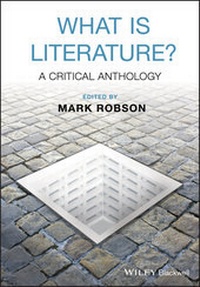
What is Literature?
Description

What is Literature? A Critical Anthology explores the most fundamental question in literary studies. 'What is literature?' is the name of a problem that emerges with the idea of literature in European modernity. This volume offers a cross-section of modern literary theory and reflects on the history of thinking about literature as a specific form. What is Literature? reveals how ideas of the literary draw on the foundations of Western thought in ancient Greece and Rome, charting the emergence of modern literature in the eighteenth century, and including selections from the present state of the art.
The anthology includes the work of leading writers and critics of the last two thousand years including Plato, Henry James, Virginia Woolf, Edward Said, Gayatri Chakravorty Spivak, Jacques Rancière, and many others. The book is an insightful examination of the nature of literature, its meanings and values, functions and forms, provocations and mysteries.
What is Literature? brings together in one volume influential and intriguing essays that show our enduring fascination with the idea of literature. This important guide:
* Contains a broad selection of the most significant texts on the topic of literature
* Includes leading writers from ancient times to the most recent thinkers on literature and criticism
* Encourages readers to reflect on the varied meanings of "literature"
What is Literature? A Critical Anthology is a unique collection of texts that will appeal to every student and scholar of literature and literary criticism in the European tradition.
More details
Other editions
Additional editions
Person
MARK ROBSON??is the Chair of English and Theatre Studies at the University of Dundee, Scotland, where he also teaches philosophy and visual culture. He founded and is the Director of the Centre for Critical and Creative Cultures at Dundee, and is author and editor of several books including Theatre & Death, The Sense of Early Modern Writing and (with James Loxley) Shakespeare, Jonson, and the Claims of the Performative.
Content
Introduction 1
1 Hamburg Dramaturgy (1769) 8
G. E. Lessing
2 Of the Standard of Taste (1777) 32
David Hume
3 Critique of Judgment (1790) 45
Immanuel Kant
4 On the Aesthetic Education of Man (1795) 65
Friedrich Schiller
5 On the Study of Greek Poetry (1797) and Philosophical Fragments (1798-1800) 74
Friedrich Schlegel
6 Lectures on Dramatic Art (1811) 88
A. W. Schlegel
7 Preface to Lyrical Ballads, with Pastoral and Other Poems (1802) 104
William Wordsworth
8 Biographia Literaria (1817) 124
Samuel Taylor Coleridge
9 Aesthetics: Lectures on Fine Art (1835) 134
G. W. F. Hegel
10 The Function of Criticism at the Present Time (1864) 148
Matthew Arnold
11 The Birth of Tragedy (1872) 166
Friedrich Nietzsche
12 The Art of Fiction (1884) 188
Henry James
13 Crisis of Verse (1897) 202
Stéphane Mallarmé
14 Art as Technique (1917) 210
Viktor Shklovsky
15 The Uncanny (1919) 226
Sigmund Freud
16 Tradition and the Individual Talent (1919) and The Function of Criticism (1923) 252
T. S. Eliot
17 A Room of One's Own (1929) 265
Virginia Woolf
18 The Storyteller (1936): Reflections on the Works of Nikolai Leskov 282
Walter Benjamin
19 Pierre Menard, Author of the Quixote 299
Jorge Luis Borges
20 What is Literature? (1948) 306
Jean-Paul Sartre
21 Literature and the Right to Death (1948) 320
Maurice Blanchot
22 Language (1950) 349
Martin Heidegger
23 Trying to Understand Endgame (1958) 363
Theodor W. Adorno
24 The Meridian (1960) 389
Paul Celan
25 What is an Author? (1969) 398
Michel Foucault
26 Sorties: Out and Out: Attacks/Ways Out/Forays (1975) 411
Hélène Cixous
27 What is a Minor Literature? (1975) 426
Gilles Deleuze and Félix Guattari
28 Literature and Life (1993) 437
Gilles Deleuze
29 The Literary Absolute (1978) 441
Philippe Lacoue-Labarthe and Jean-Luc Nancy
30 Orientalism (1978) 459
Edward W. Said
31 Autobiography as De-facement (1979) 479
Paul de Man
32 Che cos'è la poesia? (1988) and Before the Law (1982) 489
Jacques Derrida
33 Signs Taken for Wonders (1986): Questions of Ambivalence and Authority under a Tree Outside Delhi, May 1817 519
Homi K. Bhabha
34 What is the History of Literature? (1997) 538
Stephen Greenblatt
35 A Critique of Postcolonial Reason (1999) 558
Gayatri Chakravorty Spivak
36 Literature for the Planet (2001) 576
Wai Chee Dimock
37 The Politics of Literature (2003) 596
Jacques Rancière
38 Close Reading in an Age of Global Writing (2013) 609
Rebecca L. Walkowitz
Index 621
Introduction
Let us suppose that literature begins
at the moment when literature becomes
a question.
Maurice Blanchot, this volume p. 321
In this era of global capital triumphant,
to keep responsibility alive in the reading and teaching
of the textual is at first sight impractical.
It is, however, the right of the textual
to be responsible, responsive, answerable.
Gayatri Chakravorty Spivak
Every anthology gathers a series of questions. It is not a display of answers. A true question voices a doubt, expressing a desire to know rather than giving expression to that which is known. To ask the right question entails identifying what it is that you don't know, and sometimes it is only once something apparently known becomes a question - is called into question, we might say - that in a shimmer of hesitation, of uncertainty, or of doubt, the gap makes itself known. This is what the quotation from Blanchot above invites us to think: what if literature only begins when we are no longer sure (what it is), when we suspend certainty, when we allow something to appear that can bear the name of literature without conforming to what we formerly understood by that name? And yet, as the quotation from Spivak that accompanies it reminds us, this does not allow us to abdicate responsibility. Reading and teaching are each activities or (institutional) spaces in which what is called literature - which remains a privileged domain of the textual - makes demands on all those prepared to read and to learn. Bringing these two thinkers and their words here together, we might say: responding to the unknown, unsure of where we are or what exactly it is that is making these demands, may seem, to borrow Spivak's term, impractical, but it is the only way to keep responsibility alive in the form of the question, that is, by taking the question seriously as a question.
This anthology bears a question as its title: What is literature? It will still sit there as a question on the cover even after you have read some or all of the contents. 'What is literature?' is not a new question. It has a history, and in fact it is historically bounded. Who, then, now, might hold the answer, assuming there is one? If we think of literature as a name, what does it name? Turning to the Oxford English Dictionary (OED), for example, the clearest definition of the modern understanding of literature is found in entry 3a, which refers to a 'restricted sense' of 'writing which has claim to consideration on the ground of beauty of form or emotional effect'. It then adds, almost as an aside, 'This sense is of very recent emergence both in Eng[lish] and Fr[ench]', which is why I referred to it as the modern understanding. This is a sense of the word literature that emerges in modernity, and is inseparable from it. The OED's definition contains two crucial elements for understanding how the word is commonly used, but doesn't entirely resolve the question of literature's identity. Quite the opposite.
'Beauty of form' makes us think about the shape or structure of the literary work, and at the same time makes us wonder how to define beauty (What are the criteria? Who decides? Is this a subjective or objective judgement? And so on). Then the definition takes a funny turn as it gives us the second element: 'or emotional effect'. Emotional effect is broad enough to cover everything from being profoundly moved to faintly irritated, from becoming intensely bored to intermittent anger, excitement, disgust, enchantment, fascination, puzzlement, arousal and despair. We can love a poem or hate a novel. All that seems fine, although we might want to add other possible effects that aren't purely emotional (bodily reactions, or even, now and then, the odd thought or idea). That's not the funny bit. The oddity, for me at least, is the 'or'. Is the form (beautiful or otherwise) not contributing to the effect on the reader? Does it have to be one or the other, either beauty or emotional effect, or is the definition simply saying that you only need one to qualify as literature? In both cases, this is only staking a claim to consideration. Who or what does the considering? How is this claim expressed? Maybe it has to be thought of as a kind of multivocal performance, in which a piece of writing - while being beautiful or making us cry or laugh or inspiring us to hurl it across the room - is also at every moment pointing at itself and inaudibly shouting 'Look, I'm literature'.
Beauty and emotion are not universal. The dictionary's use of them recognizes that this is a restricted sense of literature, but it has become the common one for us. For most modern critics, literature 'as such' is something that emerges in the long eighteenth century, replacing older categories based on poetics and rhetoric. This is the 'very recent' emergence of a sense of the word literature noted by the OED (for whom the eighteenth century remains very recent). The notion of literature in this specific sense is part of the foundations for the Romantic - and at the outset largely German - tradition of treating literature and other arts under the heading of the aesthetic. This tradition is the focus for this volume since its influence on later thinking about art remains decisive, both spawning a strong set of ideas that continue to feature in discussion of art and also producing a powerful allergic reaction in which the whole notion of the aesthetic is repeatedly rejected. The idea, for example, that art can open up the possibility of accessing knowledge or truth that could not be gained by any other means is still regularly proposed and equally persistently contested. The idea, then, that there is something special about art objects which marks them out from 'ordinary' objects remains controversial. An equivalent argument in literary studies might be the notion that there is something special about literary language that separates it decisively from ordinary language, or that there is something peculiar about the relation of the author to her or his - or more accurately our - language(s). Even if we believe this, we need to be able to explain why. This is territory repeatedly contested in the texts gathered in this anthology.
***
Any question that takes the form 'what is .?.?.?' asks us to think about the essence of something. In this sense, it is a philosophical question, and certainly there have been many philosophical attempts to define literature (often antagonistically, making clear that philosophy is not, even should not be, literature). In a well-known passage from Plato's Phaedrus, Socrates suggests that: 'You must know the truth concerning everything you are speaking or writing about; you must learn how to define each thing in itself; and, having defined it, you must know how to divide it into kinds until you reach something indivisible'. As the citation from the OED indicates, this knowing is not straightforward. What happens if we try to take this prescription and apply it to the discussion of literature?
While their texts do not appear in this anthology, there are two shadows that more than any other have fallen across this question of literature and its definition in the last couple of thousand years. For good or ill, they cannot be ignored. Knowing a little about their central ideas will help in understanding both the terms and the ground of the debates that appear in this book. The tradition of European philosophy that finds its roots in Plato (c. 427-c. 347 BCE) and Aristotle (384-322 BCE) centres on representation in its handling of art and literature - circling around the Greek term mimesis, which can be translated as either representation or imitation - and is dominated by two issues: can representation bring us any closer to truth, and, what social or political function might representation have? Plato famously has Socrates expel the poets from his Republic, primarily because he thinks that art is fundamentally imitative, and therefore takes us a step away from truth. If we want to know about tables, we learn more by looking at tables than at drawings of tables, for instance. The table is at least made by someone who knows how to make tables. An artist may not even know that much about the object presented, and cannot speak from a position of secure knowledge that guarantees truth.
Aristotle's thinking on poetry, like Plato's, is focused on the issue of mimesis, but Aristotle's much more positive valuation of imitation and representation may be read as a conscious if indirect challenge to Plato. It is art's imitative nature that ties it fruitfully to the world, allowing it to become a means for understanding human behaviour and indeed to offer a model of conduct, and it is this positive worldly relation that is stressed over a more abstract notion of truth. What both Plato and Aristotle do in effect is to shift the ground away from literature itself towards something that frames it and, in doing so, gives it significance: truth, moral philosophy in the form of examples of behaviour, or a form of activity that enhances social cohesion (such as communal attendance at theatrical festivals in Aristotle's Poetics). Art and literature are important...
