

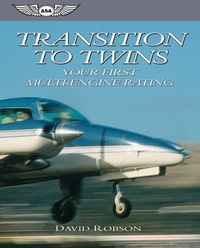
Transition To Twins
Your First Multi-Engine Rating
Published on 18. September 2000
220 pages
978-1-64425-111-9 (ISBN)
Description

There is a wealth of flight training information that relies on word of mouth for distribution. Some pilots are lucky enough to rub shoulders with someone who had the wisdom of experience and the desire to pass it on. David Robson's book effectively broadens the distribution by sharing his wealth of multi-engine flying know-how in a new manual for pilots and flight instructors.Transition to Twins provides information and advice to pilots undergoing their first Multi-Engine Rating, and is one of the most concise and well-illustrated books on flying twin-engine airplanes. This manual covers all facets of multi-engine flight:Chapters 1-9 discuss all areas of twin operation including system descriptions, aerodynamics, normal and abnormal operations, VFR, night, and IFR considerations, flight planning, and weight and balance. A chapter on commercial operations introduces not only the airmanship required, but also how to deal with passengers, crew, cargo, schedules, and duty times.Then Chapter 10 lays out each step to earning a multi-engine rating, including a syllabus with both ground and flight training lessons. The book concludes with questions to prepare pilots for a multi-engine checkride, to check-out in a new multi-engine airplane, or for an insurance competency exam for any twin airplane.Transition to Twins will prove an invaluable manual to student and instructor alike.
More details
Other editions
Additional editions
Book
10/2000
Aviation Supplies & Academics Inc
€38.56
Shipment within 3-4 weeks
Content
- Intro
- Copyright
- Table of Contents
- Preface
- Author
- Introduction
- Chapter 1: Introducing the Twin and its Systems
- Introduction
- Complex Systems
- Navaids
- Twins
- Cockpit
- Hypothetical Twin
- Chapter 2: Definitions
- Speeds
- Other Definitions
- Chapter 3: Normal Operation of a Light Twin
- Preflight Preparation
- Starting Engines
- Performance Table For Your Aircraft
- Chapter 4: Understanding Asymmetrics
- Forces and Moments
- Complex Forces and Moments
- Yaw, Sideslip and Balance
- The Forces and Moments at Work
- Flight Sequence-Uncorrected Engine Failure
- Control After Engine Failure
- Refinements/Finesse
- Option One
- Option Two
- Option Three
- Factors Which Affect Controllability
- Minimum Control Airspeed
- VMC
- Factors Affecting VMC
- Performance After Engine Failure
- Conclusions
- Summary
- Chapter 5: Abnormal Operations
- Engine Start
- Taxiing
- Takeoff
- Engine Failure/Loss of Thrust on Takeoff
- Engine Failure in the Climb
- Engine Failure in the Cruise
- Actions
- Effect of Engine Failure on Other Systems
- Engine Failure in the Descent
- Engine Failure During the Approach
- Engine Failure During Normal Go-around
- Asymmetric Pattern
- Asymmetric Go-around
- Asymmetric Landing
- Fire In Flight
- Propeller No Unfeather
- Engine Restart in Flight
- Taxiing on One Engine
- Propeller Runaway
- Stall/Spin
- Icing
- Chapter 6: Performance and Flight Planning
- Planned Flight
- Flight Planning Sequence
- Weight and Balance
- Performance
- PNR and ETP
- IFR Considerations
- Conclusion
- Chapter 7: Night Operations
- Introduction
- Preflight Preparation
- Taxiing at Night
- Night Takeoff
- Night Patterns
- Final Approach
- Touch-and-go Landing
- Chapter 8: IFR Operations
- Introduction
- Preflight Preparation
- Preflight Planning
- Normal Operations-IFR
- Abnormal Operations-IFR
- Chapter 9: Commercial Operations
- Introduction
- Passengers (Private or Commercial)
- Crew
- Cargo
- Pressures
- Getting It Together
- Airmanship
- Chapter 10: Multi-Engine Rating
- Introduction
- Overall Objective of the Multi-Engine Rating
- Course Structure
- Instructional Technique
- Ground Training
- Flight Training
- Lecture: L1-Aircraft Systems
- Lecture: L2-Engines, Propeller and Fuel Systems
- Lecture: L3-Principles of Multi-Engine Flight
- Lecture: L4-Minimum Control and Safety Speeds
- Lecture: L5-Effects of Engine Failure on Systems and Performance
- Lecture: L6-Weight and Balance (Loading)
- Lecture: L7-Performance
- Lecture: L8-Flight Planning
- Exercise F1: Introduction to Aircraft Type-Long Briefing
- Exercise F1: Introduction to Aircraft Type-Preflight Briefing
- Exercise F2: General Handling and Patterns-Long Briefing
- Exercise F2: General Handling and Patterns-Preflight Briefing
- Exercise F3: Introduction to Asymmetric Flight-Long Briefing
- Exercise F3: Introduction to Asymmetric Flight-Preflight Briefing
- Exercise F4: Minimum Control and Safety Speeds-Long Briefing
- Exercise F4: Minimum Control and Safety Speeds-Preflight Briefing
- Exercise F5: Asymmetric Patterns-Long Briefing
- Exercise F5: Asymmetric Patterns-Preflight Briefing
- Exercise F6: Asymmetric Performance and Pattern-Long Briefing
- Exercise F6: Asymmetric Performance and Pattern-Preflight Briefing
- Exercise F7: Instrument Flying-Long Briefing
- Exercise F7: Instrument Flying-Preflight Briefing
- Exercise F8: Night Asymmetric Patterns-Long Briefing
- Exercise F8: Night Asymmetric Patterns-Preflight Briefing
- Chapter 11: Questions you must and questions you should be able to answer about your aircraft
- Introduction
- General Aircraft Data
- Airspeed Limitations
- Emergency Procedures
- Normal Procedures
- Weight and Balance and Performance
- Fuel System, Fuel and Fluids
- Asymmetric Performance
- Airframe
- Auxiliary Systems
- Flight Instruments
- Piloting
- Afterword
