

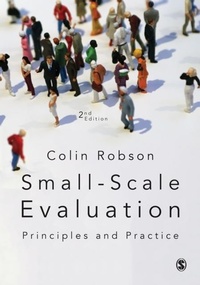
Small-Scale Evaluation
Principles and Practice
2nd Edition
Published on 28. September 2017
232 pages
978-1-5264-1790-9 (ISBN)
Description

Evaluation research can assess the value and effectiveness of interventions and innovations involving people. While this has often been on a grand scale, this book focuses on small-scale projects carried out by an individual or small group, typically lasting for weeks or at most a few months, at a local rather than national level. Using limited jargon and featuring integrated, real-world examples, this second edition offers a clear, accessible background to evaluation and prepares you to undertake your own small-scale evaluation research project.
Key features include discussion of:
Different approaches to evaluation and how to choose between them
The advantages and disadvantages of randomized controlled trials (RCTs)
Realist evaluation and its increasing importance
The centrality of ethical and political issues
The influence and opportunity of the Internet
Tightly focused on the realities of carrying out small-scale evaluation, Small-Scale Evaluation is a highly practical guide covering the needs of both social scientists and others without this background.
Colin Robson is an Emeritus Professor in the School of Human & Health Sciences at the University of Huddersfield.
Key features include discussion of:
Different approaches to evaluation and how to choose between them
The advantages and disadvantages of randomized controlled trials (RCTs)
Realist evaluation and its increasing importance
The centrality of ethical and political issues
The influence and opportunity of the Internet
Tightly focused on the realities of carrying out small-scale evaluation, Small-Scale Evaluation is a highly practical guide covering the needs of both social scientists and others without this background.
Colin Robson is an Emeritus Professor in the School of Human & Health Sciences at the University of Huddersfield.
Reviews / Votes
A masterfully written text making complex issues approachable and very workable! Robson's personable style as if engaged in a conversation with the reader entices and enlightens. It is rare to find a text that to such an extent combines user-friendliness and an engaging style without compromising scientific stringency, ethics or practical usefulness and common sense. This is indeed a treasure trove for students and professionals of any kind and everywhere whose study or work involves people in groups and organisations in need of development, change or just a healthy reality check on how their organisation is doing. -- Roland S Persson This is a marvelous book. It communicates clearly and directly to the reader, making the subject accessible and usable rather than abstruse or forbidding. Robson excels in thinking with the reader and getting the reader to think along with him, so that reading his work seems like collaborating with a helpful mentor. Supported by many helpful diagrams and charts, he uses real-world situations, contexts, examples, and research literature to give the reader an understanding of how she might go about conducting actual research using this book as a guide. He discusses the challenges a researcher can face in conducting evaluations, such as getting those being studied to collaborate in the research project, and the strengths and weaknesses, benefits and pitfalls of so doing. And it is of great value that his focus is specifically on small-scale evaluation, because that is the type of evaluation in which a student or budding researcher is most likely to be involved. Robson is a great demystifier and guide--other research texts would benefit greatly from adopting Robson's style of thinking, writing, and guiding. -- Jeremy J. ShapiroMore details
Edition
Second Edition
Language
English
Place of publication
London
United Kingdom
Target group
College/higher education
Professional and scholarly
Product notice
Reflowable
ISBN-13
978-1-5264-1790-9 (9781526417909)
Copyright in bibliographic data and cover images is held by Nielsen Book Services Limited or by the publishers or by their respective licensors: all rights reserved.
Schweitzer Classification
Other editions
Additional editions
Book
10/2017
2nd Edition
SAGE Publications Inc
€97.50
Shipment within 10-20 days
Book
10/2017
2nd Edition
SAGE Publications Inc
€178.20
Shipment within 10-20 days
Person
Colin Robson is an Emeritus Professor in the School of Human & Health Sciences at the University of Huddersfield. He directed a series of local, regional and national research and evaluation projects, mainly in aspects of special educational needs, at Huddersfield in association with the Hester Adrian Research Centre, University of Manchester. He subsequently was a supervisor for over twenty research students, mainly at Doctoral level, covering a wide range of disciplines - education, social work, management, music, and aspects of health, including nursing, midwifery and osteopathy, while developing and leading a postgraduate programe in Social Research and Evaluation. More recently he was, for over a decade, chief Consultant at the Centre for Educational Research and Innovation at OECD in Paris, for projects evaluating and comparing national systems for the education of students with disabilities, learning and behavioural difficulties and social disadvantages, and a follow-up project for Eurostat, the statistical arm of the European Union.
Content
Chapter 1: Introduction
Who is the book for?
What do you need to be able to carry out an evaluation?
Evaluation research
Small-scale evaluation research
The literature search
The Internet
Using the book
A note on 'Tasks'
Chapter 2: Evaluation: The What and the Why
What is evaluation?
Why evaluate?
Evaluation and social research
What do they think they want?
What are they going to find credible?
Chapter 3: The Advantages of Collaboration
Stakeholders
Other models of involvement
Using consultants
Persuading others to be involved
When is some form of participatory evaluation indicated?
Chapter 4: Evaluation Designs
Different approaches to evaluation
Needs assessment
Outcome evaluation
Process evaluation
Combining process and outcome approaches
Formative and summative evaluation
Efficiency evaluation
Reviews
Program monitoring
Theory-based evaluation
An interim summing up
Chapter 5: Designing Your Evaluation
Reviewing the 'literature'
Research questions
Methods of data collection
Data quality
Sampling
Prespecified and emergent designs
Doing a shoe-string evaluation
Chapter 6: Ethical and Political Considerations
Ethical issues
The problem of unintended consequences
Evaluations involving children and other vulnerable populations
Ethical issues in online research
Ethical boards and committees
The politics of evaluation
Chapter 7: Practicalities
Time budgeting
Gaining access
Getting organized
Getting help and support
Chapter 8: Dealing with the Data
Coding data
Analysis and interpretation of quantitative data
Analysis and interpretation of qualitative data
Chapter 9: Communicating the Findings
Evaluation reports
Facilitating the implementation of evaluation findings
Chapter 10: Taking it further
Further reading
Postscript
Appendix A: Chapter Tasks
Appendix B: Simple Evaluations
Who is the book for?
What do you need to be able to carry out an evaluation?
Evaluation research
Small-scale evaluation research
The literature search
The Internet
Using the book
A note on 'Tasks'
Chapter 2: Evaluation: The What and the Why
What is evaluation?
Why evaluate?
Evaluation and social research
What do they think they want?
What are they going to find credible?
Chapter 3: The Advantages of Collaboration
Stakeholders
Other models of involvement
Using consultants
Persuading others to be involved
When is some form of participatory evaluation indicated?
Chapter 4: Evaluation Designs
Different approaches to evaluation
Needs assessment
Outcome evaluation
Process evaluation
Combining process and outcome approaches
Formative and summative evaluation
Efficiency evaluation
Reviews
Program monitoring
Theory-based evaluation
An interim summing up
Chapter 5: Designing Your Evaluation
Reviewing the 'literature'
Research questions
Methods of data collection
Data quality
Sampling
Prespecified and emergent designs
Doing a shoe-string evaluation
Chapter 6: Ethical and Political Considerations
Ethical issues
The problem of unintended consequences
Evaluations involving children and other vulnerable populations
Ethical issues in online research
Ethical boards and committees
The politics of evaluation
Chapter 7: Practicalities
Time budgeting
Gaining access
Getting organized
Getting help and support
Chapter 8: Dealing with the Data
Coding data
Analysis and interpretation of quantitative data
Analysis and interpretation of qualitative data
Chapter 9: Communicating the Findings
Evaluation reports
Facilitating the implementation of evaluation findings
Chapter 10: Taking it further
Further reading
Postscript
Appendix A: Chapter Tasks
Appendix B: Simple Evaluations
