

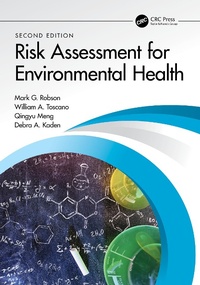
Risk Assessment for Environmental Health
2nd Edition
Published on 30. December 2022
400 pages
978-1-000-81609-9 (ISBN)
Description

Understanding risk to humans is one of the most important problems in environmental public health. Risk assessment is constantly changing with the advent of new exposure assessment tools, more sophisticated models, and a better understanding of disease processes. Risk assessment is also gaining greater acceptance in the developing world where major environmental problems exist. Developed in partnership with the Association of Schools of Public Health, this comprehensive text offers a thorough survey of risk assessment, management, and communications as these practices apply to public health.
Key Features:
Provides a practical overview of environmental risk assessment and its application by discussing the process and providing case studies and examples
Focuses on tools and approaches used for humans in an environment involving potential chemical hazards
Fully updated, the first part introduces the underlying principles and techniques of the field, and the second examines case studies in terms of different risk assessment scenarios
Risk assessment is a core requirement for the MPH degree in environmental health
Useful "stories" suitable for case studies
Key Features:
Provides a practical overview of environmental risk assessment and its application by discussing the process and providing case studies and examples
Focuses on tools and approaches used for humans in an environment involving potential chemical hazards
Fully updated, the first part introduces the underlying principles and techniques of the field, and the second examines case studies in terms of different risk assessment scenarios
Risk assessment is a core requirement for the MPH degree in environmental health
Useful "stories" suitable for case studies
More details
Edition
2nd edition
Language
English
Place of publication
London
United Kingdom
Publishing group
Taylor & Francis Ltd
Target group
Professional and scholarly
Illustrations
45 Tables, black and white; 44 Line drawings, color; 51 Line drawings, black and white; 19 Halftones, color; 2 Halftones, black and white; 63 Illustrations, color; 53 Illustrations, black and white
ISBN-13
978-1-000-81609-9 (9781000816099)
Copyright in bibliographic data and cover images is held by Nielsen Book Services Limited or by the publishers or by their respective licensors: all rights reserved.
Schweitzer Classification
Other editions
Additional editions
Mark G. Robson | William A. Toscano | Qingyu Meng
Risk Assessment for Environmental Health
Book
12/2022
2nd Edition
CRC Press
€260.20
Shipment within 15-20 days
Mark G. Robson | William A. Toscano | Qingyu Meng
Risk Assessment for Environmental Health
Book
12/2022
2nd Edition
CRC Press
€123.80
Shipment within 15-20 days

Book
01/2005
CRC Press
Unfortunately, price unknown
Available (delivery time upon request)
Persons
Professor Mark G. Robson earned his PhD in plant science from Rutgers University in 1988 and his MPH in environmental health from the University of Medicine and Dentistry of New Jersey (UMDNJ) in 1995. He is currently Distinguished Professor of Plant Biology at Rutgers School of Environmental and Biological Sciences and also is Visiting Professor and Senior Academic Advisor at Chulalongkorn University in Bangkok Thailand.
Professor William A. Toscano earned his PhD in biochemistry at the University of Illinois, Urbana-Champaign, in 1978. He was a Postdoctoral Fellow in Pharmacology at the University of Washington Medical School, Seattle, from 1978 to 1980, after which he joined the toxicology faculty at the Harvard School of Public Health. In 1989, he moved to the University of Minnesota School of Public Health as Associate Professor and in 1993 to the Tulane School of Public Health and Tropical Medicine, where he was Professor and Chair of Environmental Health Sciences. In 1999, he returned to the University of Minnesota School of Public Health, where he is Professor Emeritus of Environmental Health, University of Minnesota School of Public Health.
Dr. Qingyu Meng is an Adjunct Research Professor at Desert Research Institute and a Staff Toxicologist at Department of Toxic Substances Control, California Environmental Protection Agency. His research focuses on air pollution exposure assessment and chemical exposures in consumer products. He contributed to multiple Integrated Science Assessments, which serve as the scientific basis for setting National Ambient Air Quality Standards for criteria pollutants. He has authored and co-authored more than 70 peer-reviewed publications in exposure science. He is a member of the Society of Toxicology and the Society for Risk Analysis, and was President of the Tri-state Chapter of the International Society for Exposure Science. He is an associate editor of Human and Ecological Risk Assessment - An International Journal.
Dr. Debra A. Kaden has more than 30 years of experience in toxicology and environmental health sciences, with an emphasis in the area of air toxics. She is a senior practitioner in the Ramboll's Health Science practice. Dr. Kaden is a member of the Society for Risk Analysis (SRA) - where she sits on several committees and is a past president of the New England chapter. She is also a member of the Society of Toxicology (SOT) and the International Society for Exposure Science (ISES).
Dr. Kaden has authored more than 25 peer-reviewed publications in toxicology and environmental health sciences. She has spearheaded critical reviews of the state of science to identify research priorities for understanding exposure and health effects of mobile source air toxics, diesel exhaust, and electric and magnetic fields. She has also organized and convened workshops and conferences on scientific topics relevant to air pollution. She earned her MS and PhD degrees in toxicology from the Massachusetts Institute of Technology.
Professor William A. Toscano earned his PhD in biochemistry at the University of Illinois, Urbana-Champaign, in 1978. He was a Postdoctoral Fellow in Pharmacology at the University of Washington Medical School, Seattle, from 1978 to 1980, after which he joined the toxicology faculty at the Harvard School of Public Health. In 1989, he moved to the University of Minnesota School of Public Health as Associate Professor and in 1993 to the Tulane School of Public Health and Tropical Medicine, where he was Professor and Chair of Environmental Health Sciences. In 1999, he returned to the University of Minnesota School of Public Health, where he is Professor Emeritus of Environmental Health, University of Minnesota School of Public Health.
Dr. Qingyu Meng is an Adjunct Research Professor at Desert Research Institute and a Staff Toxicologist at Department of Toxic Substances Control, California Environmental Protection Agency. His research focuses on air pollution exposure assessment and chemical exposures in consumer products. He contributed to multiple Integrated Science Assessments, which serve as the scientific basis for setting National Ambient Air Quality Standards for criteria pollutants. He has authored and co-authored more than 70 peer-reviewed publications in exposure science. He is a member of the Society of Toxicology and the Society for Risk Analysis, and was President of the Tri-state Chapter of the International Society for Exposure Science. He is an associate editor of Human and Ecological Risk Assessment - An International Journal.
Dr. Debra A. Kaden has more than 30 years of experience in toxicology and environmental health sciences, with an emphasis in the area of air toxics. She is a senior practitioner in the Ramboll's Health Science practice. Dr. Kaden is a member of the Society for Risk Analysis (SRA) - where she sits on several committees and is a past president of the New England chapter. She is also a member of the Society of Toxicology (SOT) and the International Society for Exposure Science (ISES).
Dr. Kaden has authored more than 25 peer-reviewed publications in toxicology and environmental health sciences. She has spearheaded critical reviews of the state of science to identify research priorities for understanding exposure and health effects of mobile source air toxics, diesel exhaust, and electric and magnetic fields. She has also organized and convened workshops and conferences on scientific topics relevant to air pollution. She earned her MS and PhD degrees in toxicology from the Massachusetts Institute of Technology.
Content
List of Boxes
Foreword
Preface
Editors
Contributors
1. Introduction to Risk Assessment
Mark G. Robson, William A. Toscano, Qingyu Meng, and Debra A. Kaden
2. The Risk Assessment-Risk Management Paradigm
Gilbert S. Omenn and David L. Eaton
3. Risk Assessment and Regulatory Decision-Making in Environmental Health
Felicia Wu and Joseph V. Rodricks
4. Exposure Assessment: The Ways We Measure Exposure and Its Application to Risk
Assessment
Donghai Liang
5. Biological Monitoring of Exposure to Environmental Chemicals throughout the Life
Stages: Requirements and Issues to Consider for Birth Cohort Studies
Parinya Panuwet, P. Barry Ryan, Dana Boyd Barr, and Warangkana Naksen
6. Role of Epidemiology in Environmental Health Research
Wil Lieberman-Cribbin and Emanuela Taioli
7. Toxicological Basis for Risk Assessment
Mark G. Robson and William A. Toscano
8. The Application of Physiologically Based Pharmacokinetic (PBPK) Modeling to
Risk Assessment
Raymond S. H. Yang, Yasong Lu, and Zhoumeng Lin
9. Adverse Outcomes Pathways (AOPs)
Elizabeth V. Wattenberg
10. Epigenetics in Risk Assessment
Carmen Marsit and Jinze Li
11. Probabilistic Models for Characterizing Aggregate and Cumulative Risk
Qingyu Meng
12. Occupational Risk Assessment
Adam M. Finkel, Douglas O. Johns, and Christine Whittaker
13. Children's Environmental Health Risk Assessment
Rebecca C. Dzubow and Ruth A. Etzel
14. Addressing the Limits of Risk Assessment by Focusing on Safer Alternatives
Risk Assessment for Environmental Health
Joel Tickner, Molly Jacobs, and Margaret H. Whittaker
15. How European Countries Approach Regulatory Risk Assessment
Helmut Greim
16. Envirome Disorganization and Ecological Riskscapes: The Algal Bloom Epitome
Matteo Convertino and Haojiong Wang
17. Risk Communication
Elaine M. Faustman, Jill C. Falman, and Susan L. Santos
Index
Foreword
Preface
Editors
Contributors
1. Introduction to Risk Assessment
Mark G. Robson, William A. Toscano, Qingyu Meng, and Debra A. Kaden
2. The Risk Assessment-Risk Management Paradigm
Gilbert S. Omenn and David L. Eaton
3. Risk Assessment and Regulatory Decision-Making in Environmental Health
Felicia Wu and Joseph V. Rodricks
4. Exposure Assessment: The Ways We Measure Exposure and Its Application to Risk
Assessment
Donghai Liang
5. Biological Monitoring of Exposure to Environmental Chemicals throughout the Life
Stages: Requirements and Issues to Consider for Birth Cohort Studies
Parinya Panuwet, P. Barry Ryan, Dana Boyd Barr, and Warangkana Naksen
6. Role of Epidemiology in Environmental Health Research
Wil Lieberman-Cribbin and Emanuela Taioli
7. Toxicological Basis for Risk Assessment
Mark G. Robson and William A. Toscano
8. The Application of Physiologically Based Pharmacokinetic (PBPK) Modeling to
Risk Assessment
Raymond S. H. Yang, Yasong Lu, and Zhoumeng Lin
9. Adverse Outcomes Pathways (AOPs)
Elizabeth V. Wattenberg
10. Epigenetics in Risk Assessment
Carmen Marsit and Jinze Li
11. Probabilistic Models for Characterizing Aggregate and Cumulative Risk
Qingyu Meng
12. Occupational Risk Assessment
Adam M. Finkel, Douglas O. Johns, and Christine Whittaker
13. Children's Environmental Health Risk Assessment
Rebecca C. Dzubow and Ruth A. Etzel
14. Addressing the Limits of Risk Assessment by Focusing on Safer Alternatives
Risk Assessment for Environmental Health
Joel Tickner, Molly Jacobs, and Margaret H. Whittaker
15. How European Countries Approach Regulatory Risk Assessment
Helmut Greim
16. Envirome Disorganization and Ecological Riskscapes: The Algal Bloom Epitome
Matteo Convertino and Haojiong Wang
17. Risk Communication
Elaine M. Faustman, Jill C. Falman, and Susan L. Santos
Index
