

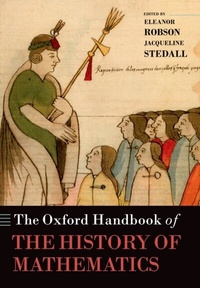
The Oxford Handbook of the History of Mathematics
1st Edition
Published on 18. December 2008
978-0-19-154995-3 (ISBN)
Description

This Handbook explores the history of mathematics under a series of themes which raise new questions about what mathematics has been and what it has meant to practice it. It addresses questions of who creates mathematics, who uses it, and how. A broader understanding of mathematical practitioners naturally leads to a new appreciation of what counts as a historical source. Material and oral evidence isdrawn upon as well as an unusual array of textual sources. Further, the ways in which people have chosen to express themselves are as historically meaningful as the contents of the mathematics they have produced. Mathematics is not a fixed and unchanging entity. New questions, contexts, and applications all influence what counts as productive ways of thinking. Because the history of mathematics should interact constructively with other ways of studying the past, the contributors to this book come from a diverse range of intellectual backgrounds in anthropology, archaeology, art history, philosophy, and literature, as well as history of mathematics more traditionally understood.
The thirty-six self-contained, multifaceted chapters, each written by a specialist, are arranged under three main headings: 'Geographies and Cultures', 'Peoples and Practices', and 'Interactions and Interpretations'. Together they deal with the mathematics of 5000 years, but without privileging the past three centuries, and an impressive range of periods and places with many points of cross-reference between chapters. The key mathematical cultures of North America, Europe, the Middle East, India, and China are all represented here as well as areas which are not often treated in mainstream history of mathematics, such as Russia, the Balkans, Vietnam, and South America. A vital reference for graduates and researchers in mathematics, historians of science, and general historians.
More details
Other editions
Additional editions
Eleanor Robson | Jacqueline Stedall
The Oxford Handbook of the History of Mathematics
Book
02/2011
Oxford University Press
€83.50
Shipment within 15-20 days
Eleanor Robson | Jacqueline Stedall
The Oxford Handbook of the History of Mathematics
Book
12/2008
Oxford University Press
€234.60
Shipment within 15-20 days
Persons
Eleanor Robson is a Senior Lecturer in the Department of History and Philosophy of Science at the University of Cambridge and a Fellow of All Souls College, Oxford. She is the author of Mesopotamian mathematics, 2100-1600 BC (1999), Mathematics in ancient Iraq: a social history (2008), and many articles on the socio-intellectual history of the cuneiform world. She is co-director of an AHRC-funded project on the geography of knowledge in Assyria and Babylonia.
Jacqueline Stedall is Junior Research Fellow in Mathematics at The Queen's College, Oxford. Her research focuses on European mathematics from the 16th century to the 18th with a special interest in the development of algebra. Recent publications include Mathematics Emerging: a sourcebook, 1540-1900 (2008) and The 'Magisteria magna' of Thomas Harriot (2008, with Janet Beery). She is also editor of the BSHSM Bulletin, journal of the British Society of the History of Mathematics.
Content
- Introduction
- Geographies and Cultures: Global
- 1.1: G E R Lloyd: What was mathematics in the ancient world? Greek and Chinese perspectives
- 1.2: Gary Urton: Mathematics and authority: a case study in New and Old World accounting
- 1.3: Catherine Jami: Heavenly learning, statecraft, and scholarship: the Jesuits and their mathematics in China
- 1.4: Karen Parshall: The internationalization of mathematics in a world of nations, 1800-1960
- Geographies and Cultures: Regional
- 2.1: Markus Asper: The two cultures of mathematics in ancient Greece
- 2.2: Jacqueline Stedall: Tracing mathematical networks in seventeenth-century England
- 2.3: Alexei Volkov: Mathematics and mathematics education in traditional Vietnam
- 2.4: Snezana Lawrence: A Balkan trilogy: mathematics in the Balkans before the First World War
- Geographies and Cultures: Local
- 3.1: Eleanor Robson: Mathematics education in an Old Babylonian scribal school
- 3.2: David Gilman Romano: The archaeology of mathematics in an ancient Greek city
- 3.3: Massimo Mazzotti: Engineering the Neapolitan state
- 3.4: David Aubin: Observatory mathematics in the nineteenth century
- People and Practices: Lives
- 4.1: Sonja Brentjes: Patronage of the mathematical sciences in Islamic societies
- 4.2: Kate Bennett: John Aubrey and the 'Lives of our English mathematical writers'
- 4.3: Irina and Dmitri Gouzévitch: Introducing mathematics, building an empire: Russia under Peter I
- 4.4: Mary Croarken: Human computers in eighteenth and nineteenth-century Britain
- People and Practices: Practices
- 5.1: Corinna Rossi: Mixing, building, and feeding: mathematics and technology in ancient Egypt
- 5.2: Brian Spooner and William Hanaway: Siyaq: numerical notation in the Persianate world
- 5.3: John Denniss: Learning arithmetic: textbooks and their users in England 1500-1900
- 5.4: Carrie Brezine: Algorithms and automation: mathematics and weaving
- People and Practices: Presentation
- 6.1: Stephen Chrisomalis: The cognitive and cultural foundations of numbers
- 6.2: Kim Plofker: Sanskrit mathematical verse
- 6.3: Volker Remmert: Antiquity, nobility, and utility: picturing the Early Modern mathematical sciences
- 6.4: Leo Corry: Writing the ultimate mathematical textbook: Nicolas Bourbaki's Eléments de mathématique
- Interactions and Interpretations: Intellectual
- 7.1: Christopher Cullen: People and numbers in early imperial China
- 7.2: Mark Thakkar: Mathematics in fourteenth-century theology
- 7.3: Benjamin Wardhaugh: Mathematics, music, and experiment in late seventeenth-century England
- 7.4: Jeremy Gray: Modernism in mathematics
- Interactions and Interpretations: Mathematical
- 8.1: Sabine Rommeveaux: The transmission of the Elements to the Latin West: three case studies
- 8.2: Niccolo Guicciardini: 'Gigantic implements of war': images of Newton as a mathematician
- 8.3: June Barrow-Green: From cascades to calculus: Rolle's Theorem
- 8.4: Tinne Hoff Kjeldsen: Abstraction and application: new contexts, new interpretations in twentieth-century mathematics
- Interactions and Interpretations: Historical
- 9.1: Annette Imhausen: Traditions and myths in the historiography of Egyptian mathematics
- 9.2: Ken Saito: Reading ancient Greek mathematics
- 9.3: Carol Bier: Number, shape, and the nature of space: thinking through Islamic art
- 9.4: Reinhard Siegmund-Schultze: The historiography and history of mathematics in the Third Reich
- About the contributors
- Index
