

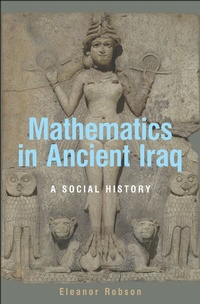
Mathematics in Ancient Iraq
A Social History
1st Edition
Published on 24. August 2020
472 pages
978-0-691-20140-5 (ISBN)
Description

This monumental book traces the origins and development of mathematics in the ancient Middle East, from its earliest beginnings in the fourth millennium BCE to the end of indigenous intellectual culture in the second century BCE when cuneiform writing was gradually abandoned. Eleanor Robson offers a history like no other, examining ancient mathematics within its broader social, political, economic, and religious contexts, and showing that mathematics was not just an abstract discipline for elites but a key component in ordering society and understanding the world.
The region of modern-day Iraq is uniquely rich in evidence for ancient mathematics because its prehistoric inhabitants wrote on clay tablets, many hundreds of thousands of which have been archaeologically excavated, deciphered, and translated. Drawing from these and a wealth of other textual and archaeological evidence, Robson gives an extraordinarily detailed picture of how mathematical ideas and practices were conceived, used, and taught during this period. She challenges the prevailing view that they were merely the simplistic precursors of classical Greek mathematics, and explains how the prevailing view came to be. Robson reveals the true sophistication and beauty of ancient Middle Eastern mathematics as it evolved over three thousand years, from the earliest beginnings of recorded accounting to complex mathematical astronomy. Every chapter provides detailed information on sources, and the book includes an appendix on all mathematical cuneiform tablets published before 2007.
The region of modern-day Iraq is uniquely rich in evidence for ancient mathematics because its prehistoric inhabitants wrote on clay tablets, many hundreds of thousands of which have been archaeologically excavated, deciphered, and translated. Drawing from these and a wealth of other textual and archaeological evidence, Robson gives an extraordinarily detailed picture of how mathematical ideas and practices were conceived, used, and taught during this period. She challenges the prevailing view that they were merely the simplistic precursors of classical Greek mathematics, and explains how the prevailing view came to be. Robson reveals the true sophistication and beauty of ancient Middle Eastern mathematics as it evolved over three thousand years, from the earliest beginnings of recorded accounting to complex mathematical astronomy. Every chapter provides detailed information on sources, and the book includes an appendix on all mathematical cuneiform tablets published before 2007.
More details
Language
English
Place of publication
Princeton, NJ
United States
Publishing group
De Gruyter
Target group
Professional and scholarly
Edition type
Digital original
Product notice
Reflowable
Illustrations
24 halftones. 51 line illus. 60 tables.
ISBN-13
978-0-691-20140-5 (9780691201405)
Schweitzer Classification
Other editions
Additional editions
Book
09/2008
Princeton University Press
€88.50
Article not available at the moment
Person
Eleanor Robsonis reader in ancient Middle Eastern science at the University of Cambridge and a fellow of Darwin College, Cambridge. Her books include Mesopotamian Mathematics, 2100-1600 BC and, edited with Jacqueline Stedall, The Oxford Handbook of the History of Mathematics.
Content
- Cover Page
- Half-title Page
- Title Page
- Copyright Page
- Dedication Page
- Contents
- List of Figures
- List of Tables
- Preface
- Acknowledgments
- Chapter One: Scope, Methods, Sources
- 1.1 The Subject: Ancient Iraq and Its Mathematics
- 1.2 The Artefacts: Assyriological and Mathematical Analysis
- 1.3 The Contexts: Textuality, Materiality, and Social History
- Chapter Two: Before the Mid-Third Millennium
- 2.1 Background and Evidence
- 2.2 Quantitative Management and Emerging Statehood
- 2.3 Enumeration and Abstraction
- 2.4 Symmetry, Geometry, and Visual Culture
- 2.5 Conclusions
- Chapter Three: The Later Third Millennium
- 3.1 Background and Evidence
- 3.2 Maps, Plans, and Itineraries: Visual and Textual Representations of Spatial Relationships
- 3.3 Accounting for Time and Labour: Approximation, Standardisation, Prediction
- 3.4 The Development of the Sexagesimal Place Value System (SPVS)
- 3.5 Conclusions
- Chapter Four The Early Second Millennium
- 4.1 Background and Evidence
- 4.2 Metrology, Multiplication, Memorisation: Elementary Mathematics Education
- 4.3 Words and Pictures, Reciprocals and Squares
- 4.4 Measurement, Justice, and the Ideology of Kingship
- 4.5 Conclusions
- Chapter Five: Assyria
- 5.1 Background and Evidence
- 5.2 Palatial and Mercantile Numeracy in Early Assyria
- 5.3 Counting Heads, Marking Time: Quantifi cations in Royal Inscriptions and Records
- 5.4 Arû: Number Manipulation in Neo-Assyrian Scholarship
- 5.5 Conclusions
- Chapter Six: The Later Second Millennium
- 6.1 Background and Evidence
- 6.2 Tabular Accounting in Southern Babylonia
- 6.3 Land Surveyors and Their Records in Northern Babylonia
- 6.4 Quantifi cation as Literary Device in the Epic of Gilgames
- 6.5 Conclusions
- Chapter Seven: The Early First Millennium
- 7.1 Background and Evidence
- 7.2 Libraries and Schools: The Formalisation of the First-Millennium Scribal Curriculum
- 7.3 Home Economics: Numeracy in a Mid-First-Millennium Urban Household
- 7.4 Measuring Houses, Maintaining Professionalism
- 7.5 Conclusions
- Chapter Eight: The Later First Millennium
- 8.1 Background and Evidence
- 8.2 Babylon: Mathematics in the Service of Astronomy?
- 8.3 Achaemenid Uruk: The Sangû-Ninurta and Ekur-zakir Families
- 8.4 Seleucid Uruk: The ?unzû and Sîn-leqi-unninni Families
- 8.5 Conclusions
- Chapter Nine: Epilogue
- 9.1 The Big Picture: Three Millennia of Mathematics in Ancient Iraq
- 9.2 Ancient Mathematics in the Modern World
- 9.3 Inside Ancient Mathematics: Translation, Representation, Interpretation
- 9.4 The Worlds of Ancient Mathematics: History, Society, Community
- 9.5 Conclusions
- Appendix A: Metrological Systems
- Appendix B: Published Mathematical Tablets
- Notes
- Bibliography
- Index of Tablets
- Subject Index
