

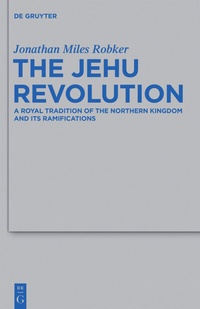
The Jehu Revolution
Description

This monograph re-evaluates the literary development of 2 Kings 9-10 within the context of the Deuteronomistic History. This undertaking opens with a thorough text and literary critical examination of the pericope, arriving at the conclusion that the narrative of 2 Kings 9-10 represents neither an insertion into the Deuteronomistic corpus, nor an independent literary tradition. Rather, when considering the Greek textual traditions of the biblical narrative (most especially B and Ant.), one can appreciate the narrative of Jehu's revolution within the literary context of an extensive politically motivated narrative about the Israelite monarchy covering the period from the reigns of Jeroboam I to Jeroboam II. The identification of this pro-Jehuide source within the book of Kings enables a reliable dating into the 8th century BCE for much of the material in Kings focusing on the Northern Kingdom. Comparing this biblical narrative to other (mostly Mesopotamian and Syrian) texts relevant to Israelite history of the period advances the discourse about the veracity of the biblical narrative when contrasted with extrabiblical traditions and permits the plausible reconstruction of Israelite history spanning the 8th and 9th centuries BCE.
More details
Other editions
Additional editions
Person
Content
2 - Chapter 1: Introduction: Objectives and Methodology [Seite 11]
2.1 - The Problem [Seite 11]
2.2 - Objectives [Seite 12]
2.3 - Methodology [Seite 16]
2.4 - Excursus: The Greek Text of Kings [Seite 18]
3 - Chapter 2: The Literary Jehu: A Construct and its Ramifications [Seite 27]
3.1 - The Oldest Biblical Jehu Tradition: 2 Kings 9-10 [Seite 27]
3.2 - Literary Criticism [Seite 45]
3.3 - Analysis of Style [Seite 68]
3.4 - Date of Composition [Seite 72]
3.5 - Form and Sitz im Leben [Seite 75]
4 - Chapter 3: The Jehuide Dynasty [Seite 80]
4.1 - Excursus: A Judean Redaction or a Judean Source? [Seite 91]
4.2 - 2 Kings 13:1-9 [Seite 93]
4.2.1 - Translation and Textual Considerations [Seite 93]
4.2.2 - Narrative Considerations [Seite 94]
4.3 - 2 Kings 13:10-14:22 [Seite 96]
4.3.1 - Translation and Textual Considerations [Seite 96]
4.3.2 - Narrative Considerations [Seite 100]
4.4 - 1 Kings 20:1-34 [Seite 109]
4.4.1 - Translation and Textual Considerations [Seite 109]
4.4.2 - Narrative Considerations [Seite 115]
4.5 - 2 Kings 14:23-29 [Seite 120]
4.5.1 - Translation and Textual Considerations [Seite 120]
4.5.2 - Narrative Considerations [Seite 121]
5 - Chapter 4: The Israel Source in the Book of Kings: From Jeroboam II through Joram [Seite 127]
5.1 - David and Solomon: 1 Kings 1:1-11:25 [Seite 127]
5.2 - Jeroboam I: 1 Kings 11:26-14:20 [Seite 128]
5.2.1 - Translation and Textual Considerations [Seite 129]
5.2.2 - Narrative Considerations [Seite 133]
5.3 - Nadab through Joram: 1 Kings 15:25-16:34 + 22 [Seite 140]
5.3.1 - Translation and Textual Considerations [Seite 140]
5.3.2 - Narrative Considerations [Seite 148]
5.4 - The Plausibility of a Political Source in the Time of Jeroboam I [Seite 167]
5.5 - Concluding Remarks [Seite 174]
6 - Chapter 5: Historicity and the Bible: Evaluating the Biblical Materials for Reconstructing Israel's History [Seite 176]
6.1 - Introduction [Seite 176]
6.2 - The Israel Source [Seite 176]
6.3 - Other Material in Kings [Seite 181]
6.4 - Hosea [Seite 184]
6.5 - Amos [Seite 191]
6.6 - Chronicles [Seite 198]
6.7 - Josephus [Seite 203]
6.8 - Concluding Remarks and Evaluations [Seite 205]
7 - Chapter 6: Akkadian Sources [Seite 207]
7.1 - Shalmaneser III [Seite 207]
7.1.1 - The Campaign of 853 [Seite 211]
7.1.2 - The Campaign of 849 [Seite 220]
7.1.3 - The Campaign of 848 [Seite 221]
7.1.4 - The Campaign of 845 [Seite 223]
7.1.5 - The Campaign of 841 [Seite 225]
7.1.6 - The Campaign of 838 [Seite 233]
7.1.7 - Summary of Shalmaneser III [Seite 235]
7.2 - Adad-na¯ra¯ri¯ III and Shalmaneser IV [Seite 235]
7.3 - The Assyrian Texts [Seite 239]
8 - Chapter 7: Levantine Epigraphy: Tel Dan, Mesha, Zakkur, Samarian Materials [Seite 242]
8.1 - Textual Sources in Syria and Palestine [Seite 242]
8.2 - The Mesha Inscription [Seite 242]
8.2.1 - General Matters and Dating [Seite 242]
8.2.2 - Translation [Seite 243]
8.2.3 - Historical Considerations and Reconstruction [Seite 246]
8.3 - The Tel Dan Inscription [Seite 250]
8.3.1 - General Matters and Dating [Seite 250]
8.3.2 - Reconstruction and Translation [Seite 256]
8.3.3 - Historical Considerations and Reconstruction [Seite 275]
8.4 - The Zakkur Inscription [Seite 285]
8.4.1 - General Matters and Dating [Seite 285]
8.4.2 - Translation [Seite 285]
8.4.3 - Historical Considerations and Reconstruction [Seite 287]
8.5 - Samarian Stele Fragments [Seite 288]
8.6 - The Samaria Ostraca [Seite 289]
8.6.1 - General Information and Dating [Seite 289]
8.6.2 - Contents [Seite 290]
8.6.3 - Historical Considerations [Seite 292]
8.7 - Conclusions [Seite 293]
9 - Chapter 8: Conclusions [Seite 295]
9.1 - Historical Reconstruction [Seite 295]
9.2 - Impulses for Further Study [Seite 311]
10 - Appendix: The Israel Source [Seite 313]
11 - Bibliography [Seite 325]
12 - Index of Biblical Citations [Seite 343]
