

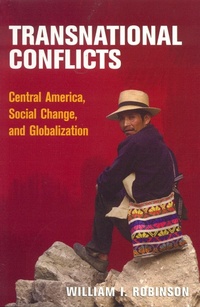
Transnational Conflicts
Central America, Social Change, and Globalization
Published on 5. May 2020
400 pages
978-1-78960-895-3 (ISBN)
Description

In this timely and provocative study, William I. Robinson challenges received wisdom on Central America. He starts with an exposition on the new global capitalism. Then, drawing on a wide range of historical documentation, interviews, and social science research, he proceeds to show how capitalist globalization has thoroughly transformed the region, disrupting the conventional pattern of revolutionary upheaval, civil wars, and pacification, and ushering in instead a new transnational model of economy and society.
Beyond his focus on Central America, Robinson provides a critical framework for understanding development and social change in other regions of the world in the age of globalization. Demonstrating how the very forces of capitalism have brought into being new social agents and political actors unlikely to acquiesce in the face of the emerging order, Transnational Conflicts shows why the Isthmus, along with other regions, is likely to return to the headlines in the near future.
Beyond his focus on Central America, Robinson provides a critical framework for understanding development and social change in other regions of the world in the age of globalization. Demonstrating how the very forces of capitalism have brought into being new social agents and political actors unlikely to acquiesce in the face of the emerging order, Transnational Conflicts shows why the Isthmus, along with other regions, is likely to return to the headlines in the near future.
More details
Edition
Ebook UK & RoW
Language
English
Place of publication
London
United Kingdom
Target group
College/higher education
Professional and scholarly
Product notice
Reflowable
ISBN-13
978-1-78960-895-3 (9781789608953)
Copyright in bibliographic data and cover images is held by Nielsen Book Services Limited or by the publishers or by their respective licensors: all rights reserved.
Schweitzer Classification
Other editions
Additional editions
Book
10/2003
Verso Books
€33.00
Shipment within 3-4 weeks
Person
William Robinson is Assistant Professor of Sociology at the University of California, Santa Barbara. He is the author of several books, including David and Goliath: The US War Against Nicaragua and A Theory of Global Capitalism.
Content
- Cover Page
- Title Page
- Copyright Page
- Contents
- Foreword and Acknowledgements
- Acronyms and Abbreviations
- Introduction: Development and Social Change
- Towards A Globalization Perspective
- Origin of this Study and Methodological and Epistemological Concerns
- Organization of the Book
- 1. The Dialectics of Globalization and Development
- The Problematic of Globalization and Development
- Globalization as Epochal Shift and Systemic Change
- From a World Economy to a Global Economy
- Beyond Nation-State Paradigms: Towards a New Transnational Studies
- Towards a New Conceptualization of Development
- Contours of Global Capitalist Society
- Global Class Formation: From National to Transnational Classes
- Transnationalization of the State
- Transnational Hegemony and a Global Social Structure of Accumulation
- Conceptualizing Global-Regional-Local Change
- Transnational Processes and Transitions to Global Capitalism
- A Globalization Model of Third World Transitions
- A Model of Transnational Processes
- 2. The Politics of Globalization and the Transitions in Central America
- Central America as a Site of Transnational Processes
- Central America's Integration into the Global Economy and Society
- Social Structures and Social Forces in Central America: An Overview of the Transitions
- Divergence and Convergence in Paths to Globalization: Country Case Studies
- Nicaragua: From Revolution to Counterrevolution
- El Salvador: Transition Under Direct US Tutelage
- Guatemala: The Paradoxes of the "Counterinsurgency State"
- Honduras: A Divergent Route to Globalization
- Costa Rica: From "Exceptionalism" to Globalization
- 3. The New Transnational Model in Central America: I: Incorporation into the Global Economy
- Central America in the World Economy Prior to Globalization
- The Crisis of Central America's Post-WWII Social Structure of Accumulation
- Central America's Emerging Profile in the Global Economy
- The Fourth Period of Central American Rearticulation and Expansion
- From ISI to the Maquiladoras
- Non-Traditional Agricultural Exports
- Tourism and Hospitality
- The Export of Labor and Remittances
- Conclusions
- 4. The New Transnational Model in Central America: II: Incorporation into Global Society
- Restructuring the State and Civil Society
- The Rise of Transnational Fractions and "Technopols" in Central America
- From the "Developmental State" to the "Neo-Liberal State" and the New Hegemony of Capital
- Transnationalization of Civil Society in Central America
- The NGO Phenomenon in Central America
- Structural Adjustment in Central America: Commodification, Financial Liberalization, and Proletarianization
- Financial Liberalization and the New Financial Elite
- Neo-Liberal Social Policies: The Privatization of Social Reproduction
- Rural Transformation, Depeasantization, and Urbanization
- Transnational Social Structure
- Restructuring the Central American Labor Force: Informalization and the New Capital-Labor Relation
- Transnational Migration
- Women and Transnational Processes: Global and Central American Dimensions
- 5. The Contradictions of Global Capitalism and the Future of Central America
- A New Cycle of Capitalist Development in Central America?
- Can Capitalist Expansion be Sustained?
- The Viability of the Transnational Model
- Global Capitalism and Social Exclusion in Central America
- Maldevelopment for Whom in Central America?
- The Future of Popular Struggle in Central America and in Global Society
- Global Polarization and the Crisis of Social Reproduction
- The Illusion of "Peace and Democracy" in Central America
- A Long March Through Civil Society? The Prospects for Counter-Hegemony
- Final Considerations
- Whither the Sociology of Development? From a Territorial to a Social Conception of Development
- An Afterword on Researching Globalization and Social Change
- Notes
- Index
