

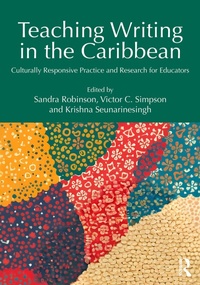
Teaching Writing in the Caribbean
Culturally Responsive Practice and Research for Educators
1st Edition
Published on 23. January 2026
354 pages
978-1-040-45347-6 (ISBN)
Description

This book provides pre-service Caribbean teachers and educators with contextually tested, robust strategies and ways of thinking about writing instruction which will improve their students' writing proficiency. It engages with the post-colonial context of Caribbean language teaching to offer a pedagogical methodology that is distinctive in its approach to the teaching of writing within the Caribbean and its diaspora.
It offers a wealth of examples, strategies, activities and tasks that are culturally sensitive to support the practice of writing educators in secondary and post-secondary institutions, teacher educators involved in teacher preparation, students studying at the university level in the Caribbean, as well as practitioners and researchers in the practice of Caribbean approaches to the teaching of writing to students within the diaspora. Written by experts and practitioners whose content and pedagogical experience with writing instruction spans primary, secondary and tertiary level classrooms, the 14 chapters are underpinned by evidence-informed practice. The text includes authentic classroom examples as well as templates and tools for educators.
This is a key resource for Caribbean educators teaching writing across all levels, pre-service teachers and teacher educators in the Caribbean, as well as researchers and scholars in language and literacy education.
It offers a wealth of examples, strategies, activities and tasks that are culturally sensitive to support the practice of writing educators in secondary and post-secondary institutions, teacher educators involved in teacher preparation, students studying at the university level in the Caribbean, as well as practitioners and researchers in the practice of Caribbean approaches to the teaching of writing to students within the diaspora. Written by experts and practitioners whose content and pedagogical experience with writing instruction spans primary, secondary and tertiary level classrooms, the 14 chapters are underpinned by evidence-informed practice. The text includes authentic classroom examples as well as templates and tools for educators.
This is a key resource for Caribbean educators teaching writing across all levels, pre-service teachers and teacher educators in the Caribbean, as well as researchers and scholars in language and literacy education.
Reviews / Votes
'Teaching writing in the Caribbean: Culturally responsive practice and research for educators is a fresh, direct and enthusiastic guide for teachers of writing in the Caribbean. It has been prepared by more than a dozen, well-qualified Caribbean nationals with experience and expertise in teaching as well as in writing. It encourages personal planning, training, research, flexibility and focus on the learner in the preparation of teachers of writing. It should be a compulsory textbook in courses aimed at converting students into sensitive and sensible teachers of writing.'Peter A. Roberts, Professor Emeritus The University of the West Indies, Cave Hill Campus, Barbados and former Chief Examiner for CSEC English 'A'.
'[T] he teacher is also foregrounded and treated in a professional, collegial and developmental way. As we move through the book, the teacher-reader is constantly being asked to reflect on the information, the applications and the research - to integrate the ideas into her own practice and monitor her own development through continuing research and professional learning communities. In fact, the number of articles and myriad voices in this collection models a kind of community in itself.
The core of the book is learner-centred with its concern for honouring the language background of the students by its use of culturally relevant examples that draw on authentic classroom interaction, and artefacts, while also referencing Caribbean curricula and literature. The title itself makes clear that focus on the 'particular'
As important as cultural responsiveness, is the essential principle of planning, which is foundational to language teaching, especially second language teaching. This is underscored in the chapters that focus on 'design': the work can be naturalistic and authentic but must also be intentional in its rigorous implementation. Several of the chapters foreground planning in its widest sense - taking account of external factors whether it is the contextual elements of classroom ecology; or the necessary systematic planning embedded in a specific writing task. Or, broader still, the meticulous work of lesson and unit planning.'
Beverley Bryan, Retired Professor of Language Education from The University of the West Indies, Mona Campus, Jamaica
More details
Edition
1. Auflage
Language
English
Place of publication
London
United Kingdom
Publishing group
Taylor & Francis Ltd
Target group
College/higher education
Professional and scholarly
Illustrations
39 Tables, black and white; 24 Line drawings, black and white; 26 Halftones, black and white; 50 Illustrations, black and white
File size
14,49 MB
ISBN-13
978-1-040-45347-6 (9781040453476)
Copyright in bibliographic data and cover images is held by Nielsen Book Services Limited or by the publishers or by their respective licensors: all rights reserved.
Schweitzer Classification
Other editions
Additional editions
Sandra Robinson | Victor C. Simpson | Krishna Seunarinesingh
Teaching Writing in the Caribbean
Culturally Responsive Practice and Research for Educators
Book
approx. 01/2026
1st Edition
Routledge
€206.40
Not yet published
Sandra Robinson | Victor C. Simpson | Krishna Seunarinesingh
Teaching Writing in the Caribbean
Culturally Responsive Practice and Research for Educators
Book
approx. 01/2026
1st Edition
Routledge
€66.00
Not yet published
Persons
Sandra Robinson is a lecturer in English and Language Arts Education in the School of Education at the University of the West Indies, Cave Hill Campus.
Victor C. Simpson is a retired Senior Lecturer in Hispanic Caribbean Literature at The University of the West Indies Cave Hill Campus, Barbados.
Krishna Seunarinesingh is a lecturer in the Teaching of English at the School of Education, The University of the West Indies, St. Augustine Campus, Trinidad and Tobago.
Victor C. Simpson is a retired Senior Lecturer in Hispanic Caribbean Literature at The University of the West Indies Cave Hill Campus, Barbados.
Krishna Seunarinesingh is a lecturer in the Teaching of English at the School of Education, The University of the West Indies, St. Augustine Campus, Trinidad and Tobago.
Content
Foreword - Beverley Bryan
Preface
Introduction -Teaching Writing as Necessity and Skill -
Sandra Robinson, Victor Simpson and Krishna Seunarinesingh
Framing a Perspective of Writing with Teachers in Mind
Chapter 1
Writing Teachers: Transforming the Knowledge of Writing into the Teaching of Writing - Sandra Robinson, Victor Simpson and Krishna Seunarinesingh
Chapter 2
Becoming A Strategic Writing Teacher - Krishna Seunarinesingh
Chapter 3
Establishing a Context for Writing - Adeola Matthew
Chapter 4
Theoretical and Pedagogical Foundations of Teaching Writing - Sandra Robinson
Constructing Writing through Research, Planning and Use of Technology
Chapter 5:
Perspectives on Writing Research - Marise Butler
Chapter 6
Technology and Writing in the English Classroom -Judith Hatt and Krishna Seunarinesingh
Chapter 7
Designing Writing for Teaching: Principles and Practices - Angelina Polius
Chapter 8
Planning for Writing - Using the Unit and Lesson to Shape Writing Instruction -Desryn Collins
Building the Structure and Content of Writing
Chapter 9
Instruction in Critical Writing Elements - Victor Simpson
Chapter 10
Enabling Student Writing through Note Taking - Kelvin Quintyne
Chapter 11
Improving Writing Skills - The Mechanics - Janice Jules and Korah Belgrave
Chapter 12
Responding to Student Writing - Lynette Tyson-Noel
Supporting Students' Writing Experience Through Practice: Strategies and Activities
Chapter 13
Writing Strategies that Work - Karen Thomas and Yvonne Alexis-Jones
Chapter 14
Writing in Response to Literature - Karen Thomas and Sharon Philip with Andrea Keizer-Bowman
Chapter 15
Teaching Writing Across the Curriculum - Janice Jules, Bernisa Roberts, Lydia Quinn and Gillian Fleary-Lazarus with Veronica Simon
Chapter 16
An Afterword: Teaching Writing for Now and Beyond
Index
Appendices
Helpful resources
Some strategies that work
Useful websites
Templates
Resources
Preface
Introduction -Teaching Writing as Necessity and Skill -
Sandra Robinson, Victor Simpson and Krishna Seunarinesingh
Framing a Perspective of Writing with Teachers in Mind
Chapter 1
Writing Teachers: Transforming the Knowledge of Writing into the Teaching of Writing - Sandra Robinson, Victor Simpson and Krishna Seunarinesingh
Chapter 2
Becoming A Strategic Writing Teacher - Krishna Seunarinesingh
Chapter 3
Establishing a Context for Writing - Adeola Matthew
Chapter 4
Theoretical and Pedagogical Foundations of Teaching Writing - Sandra Robinson
Constructing Writing through Research, Planning and Use of Technology
Chapter 5:
Perspectives on Writing Research - Marise Butler
Chapter 6
Technology and Writing in the English Classroom -Judith Hatt and Krishna Seunarinesingh
Chapter 7
Designing Writing for Teaching: Principles and Practices - Angelina Polius
Chapter 8
Planning for Writing - Using the Unit and Lesson to Shape Writing Instruction -Desryn Collins
Building the Structure and Content of Writing
Chapter 9
Instruction in Critical Writing Elements - Victor Simpson
Chapter 10
Enabling Student Writing through Note Taking - Kelvin Quintyne
Chapter 11
Improving Writing Skills - The Mechanics - Janice Jules and Korah Belgrave
Chapter 12
Responding to Student Writing - Lynette Tyson-Noel
Supporting Students' Writing Experience Through Practice: Strategies and Activities
Chapter 13
Writing Strategies that Work - Karen Thomas and Yvonne Alexis-Jones
Chapter 14
Writing in Response to Literature - Karen Thomas and Sharon Philip with Andrea Keizer-Bowman
Chapter 15
Teaching Writing Across the Curriculum - Janice Jules, Bernisa Roberts, Lydia Quinn and Gillian Fleary-Lazarus with Veronica Simon
Chapter 16
An Afterword: Teaching Writing for Now and Beyond
Index
Appendices
Helpful resources
Some strategies that work
Useful websites
Templates
Resources
